No, You May Not Live in Our Midst
By the time in 1948 that my family bought our very first house, the restrictive covenant on the deed had been declared unenforceable by the United States Supreme Court. Soon after we moved in, two neighbors came by to ask whether they could count on us voluntarily to abide by the terms of the covenant.
I don’t have the language of the covenant before me, but it wasn’t very different from that adopted in parts of Seattle as late as 1947: “No person or persons of Asiatic, African or Negro blood, lineage or extraction shall be permitted to occupy a portion of said property, or any building thereon, except domestic servant or servants may be actually and in good faith employed by white occupants of said premises.”
To our visitors’ discomfiting surprise — this was Baltimore, where racial segregation was both the law and the norm — my father refused their “invitation.” I no longer remember whether my father’s explanation of the decision was spoken to our neighbors or just to us, his wife and sons.
But the gist of what he said remains: We, members of a people that has been so despised and oppressed — we should say that here in America, we will join the oppressors? We will say to these other groups — many of whom have been in this land much longer than we — “No, you may not live in our midst?” No sir, never!
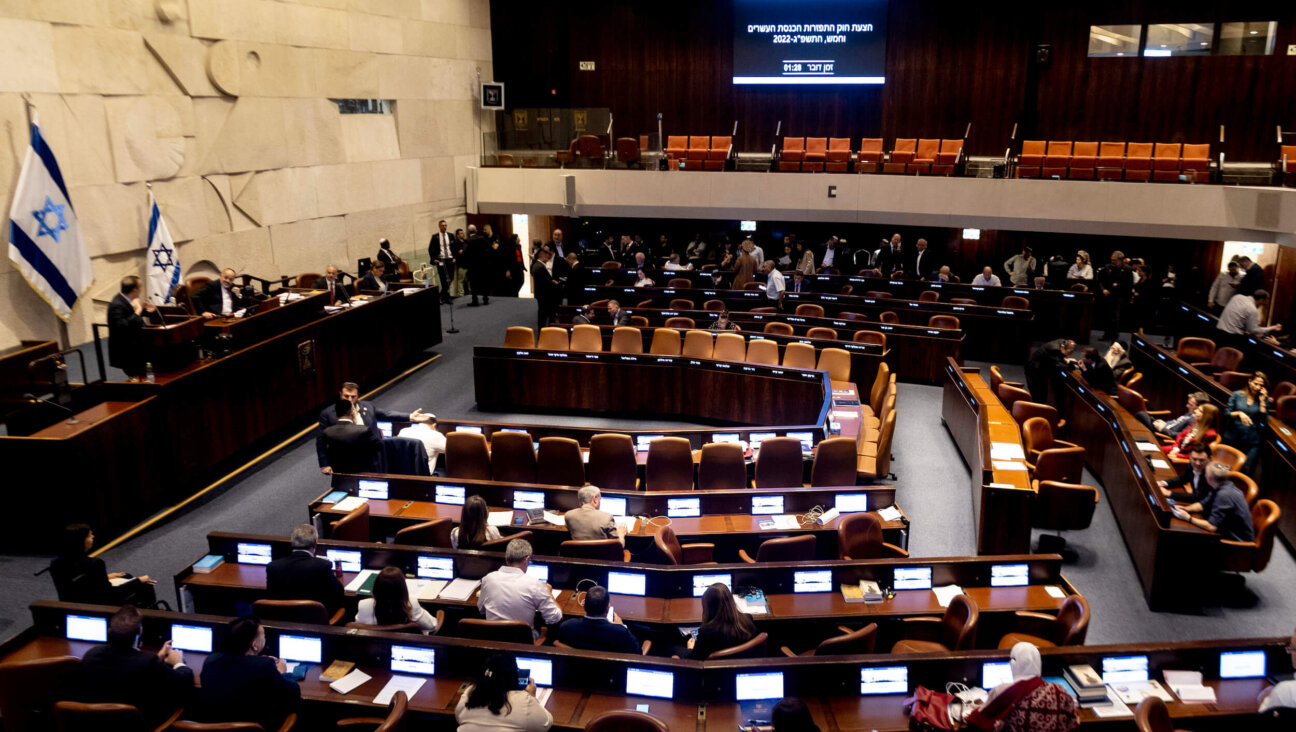
What calls this to mind these days is the shameful case of the passage last month by Israel’s Knesset of a law that would prohibit Jewish National Fund land from being leased to non-Jews — in context, from being leased to Arab citizens of Israel.
In a nutshell: The JNF, founded in 1901, owns about 13% of the land of Israel in the name of the Jewish people. About a third was acquired in pre-state days, principally from large (and often absentee) Arab land owners; the balance was purchased from the state itself after independence.
Now, neither state land (80% of the land of Israel) nor JNF land can be sold — not to Jews, not to Arabs, not to anyone. That is made explicit in the Basic Law adopted by the Knesset in 1960. Ownership of those lands can never be transferred. Both kinds of land are available only for lease, most leasing being for long term, 49 or 98 years. (The 7% of land not held by the state or JNF is privately owned.)
In 1961, the JNF contracted with the Israel Lands Authority, a government agency, for the ILA to manage its property. The contract provided that JNF land would be managed in accordance with the policies of the JNF, rather than the policies of the ILA, which was bound by the state’s anti-discrimination laws.
The common understanding was that JNF land, having been purchased by the Jewish people, was available for lease only to Jews. But in 2004, Israel’s Supreme Court ruled in favor of Adel Kaadan, an Israeli Arab who had sought to buy a home in Katzir, a moshav on the Mediterranean coast that had denied him on the grounds that Katzir was for Jews only.
The court ruling, limited to the Katzir case alone, was based on the Basic Law on human dignity and liberty, which opens: “The purpose of this Basic Law is to protect human dignity and liberty, in order to establish in a Basic Law the values of the State of Israel as a Jewish and democratic state.” “Equality,” among the rights enumerated in the law, was deemed both a Jewish and a democratic value.
Now petitioners have come before the court to ask that the Katzir finding be generalized to govern all ILA transactions, including specifically those dealing with JNF land. The bill now before the Knesset, approved on first reading by a vote of 64-16, would specifically exempt JNF land from the requirement for non-discrimination, allocating JNF lands only to Jews. That means that if the ILA continues as manager of JNF land, it will be required to enforce a restrictive covenant.
How can such a prospect be justified? How can it be reconciled with the pledge of the State of Israel articulated in its Declaration of Independence, to “ensure complete equality of social and political rights to all its inhabitants irrespective of religion, race or sex.”
One way: Forget the talk about Jewish and democratic. So, Russell Robinson, CEO of the JNF in the United States: “For 2,000 years, I don’t remember that we were praying and dreaming that we can’t wait to establish a democratic state in the Middle East, but we did say that we can’t wait to reestablish a Jewish homeland.” Or Morton Klein, president of the Zionist Organization of America: “Israel is not America. It was created first as a Jewish state, where America was created first as [a] democracy.”
Or acknowledge the democratic imperative, as does the JNF Web site: “JNF’s extensive activities are carried out in the name of the Jewish people for the benefit of the public as a whole and for all sectors of its population, whatever their religion or ethnicity.”
But remember to add that because of the Holocaust, we deserve a minor exemption: There is, the Web site tell us, “no contradiction between the state’s obligation to set a land-use policy based on equality as far as state land is concerned, and the right of the Jewish people to safeguard its assets.”
But be sure, when the next critic claims that Israel practices apartheid, to hurry to accuse him of antisemitism.
No, sir, never!
I’m personally matching all gifts to the Forward, up to $36,000. Can I match your gift now?

Hello, fellow Forward reader! I’m Joel Brown, a Forward reader and supporter for more than 15 years, and currently the chair of the board of directors.
I’m an avid Forward reader because it ticks so many of my essential boxes: excellent journalism, Jewish focus and diverse viewpoints. In today’s political climate, what I most appreciate is the Forward’s independence — made possible by the generosity of its membership.
The Forward is committed to bringing you unbiased, nuanced Jewish news. From my position as board chair, I see an exciting future as we expand our position as the definitive independent voice of contemporary American Judaism.
— Joel Brown, Forward board chair
Support our mission to tell the Jewish story fully and fairly.