Jewish Communities Reach the Finnish Line

By Dan Friedman

Published October 13, 2009, issue of October 23, 2009.
  • Print
  • Author Archive
  • Arts & Culture

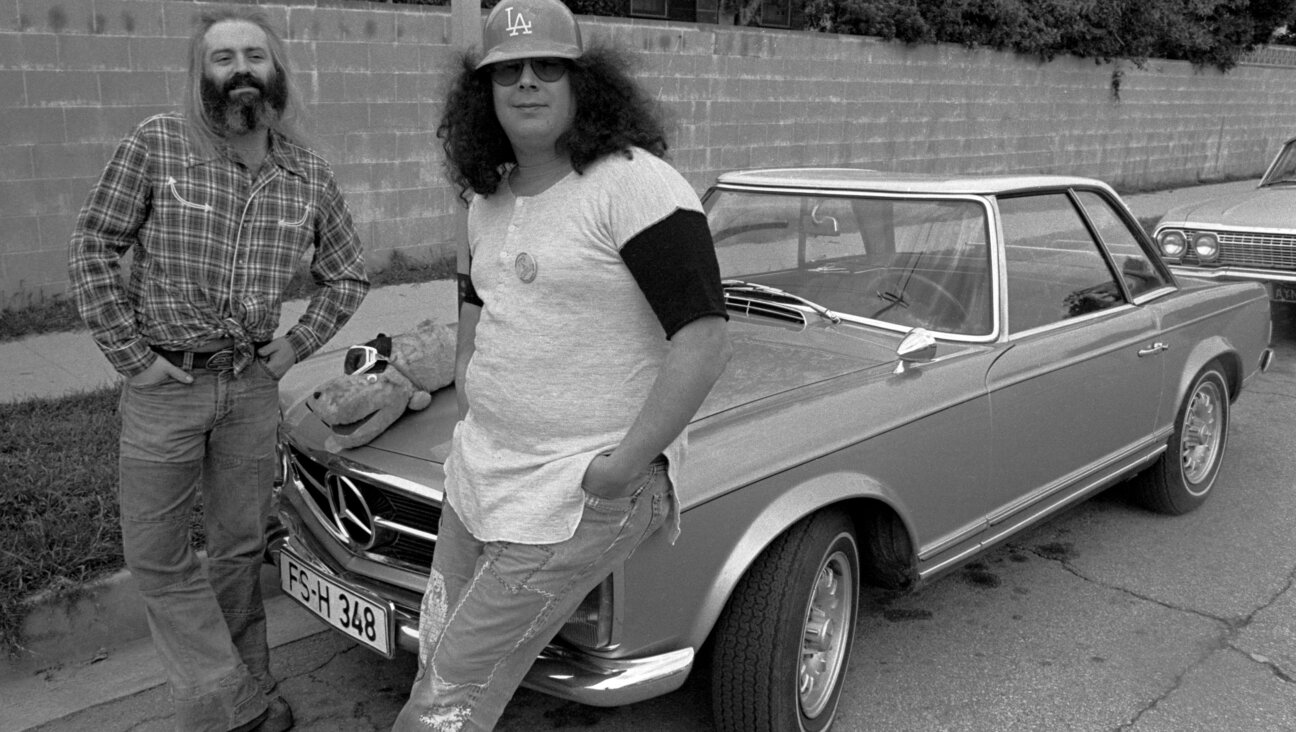
Dina Kantor grew up in Minneapolis to a Jewish father and a Finnish mother who had converted. Her Jewish and Finnish worlds were quite separate but, in 2006, she went to Finland to explore the Finnish Jewish communities of Helsinki and Turku. Originally treating it as part of her MFA program at the School of the Visual Arts in New York, Kantor became engrossed in the subject. No longer a snapshot of this tiny community (only 1,500 people from the Finnish population of 5 million), her ongoing project provides the audience with a portrait over time.

At first sight, showing the daily life of Finland’s Jewish community is secondary to the clean Scandinavian aesthetics of Kantor’s images. Nevertheless, on the closer inspection invited by the elegance and openness of the photographs, these intimate portraits suggest deeper stories which she shared with me recently.

Below, listen to our interview and view Kantor’s arresting photographs:
Kantor’s exhibition, Finnish and Jewish, is at the Blue Sky Gallery in Portland, Ore. until November 1.


  • Print
  • Author Archive
  • Arts & Culture

Comments
Mark Wed. Oct 14, 2009

very nice

Erik Fri. Oct 16, 2009

beautiful

JEFFRY V. MALLOW Fri. Oct 16, 2009

Apropos of the sentence, "At first sight, showing the daily life of Finland’s Jewish community is secondary to the clean Scandinavian aesthetics of Kantor’s images": Finns are Nordic, but not Scandinavian. This is both the technical definition and their own self-definition. They speak a non-Indo-European language of the Uralo-Altaic group. Scandinavians of course speak Indo-European languages: Danish, Swedish, Norwegian, and Icelandic, as well as dialects (languages without armies) such as Faroese. Thus, conferences and congresses which include Finns are called "Nordic," not "Scandinavian."

Bob Merkin Fri. Oct 16, 2009

It is my understanding that Finland shares, with Albania, a unique distinction.

Of European nations which were occupied by the Nazis or voluntarily allied themselves with Nazi Germany, only Finland and Albania rejected the Nazis' requirement that puppet governments cooperate in the rounding up, deportation, and extinction of Jews in Axis-cntrolled countries.

Of Albania, Wikipedia reports:

*** Albania was one of the European countries occupied by the Axis powers that ended World War II with a larger Jewish population than before the War. Only one Jewish family was deported and killed during the Nazi occupation of Albania. ***

Of the wartime experience of Finland/Suomi, Wikipedia again:

*** In November 1942, eight foreign Jewish refugees were handed over to Nazi Germany, a fact for which Finnish prime minister Paavo Lipponen issued an official apology in 2000.

Approximately 2600-2800 prisoners of war were exchanged for 2100 Finnish prisoners of war with Germany. About 2000 of them joined the Wehrmacht, but among the rest there were about 500 political officers or politically dangerous persons, who most likely perished in concentration camps. Based on the a list of names, there were about 70 Jews among the extradited, though they were not extradited based on religion.

Yad Vashem records that 22 Jews of Finland died in the Shoah, allthough all of them died fighting in the Finnish army [i.e., for an army allied with the Axis powers]. ***

Of the Finnish alliance itself, the Suomi had little choice. Stalin's Soviet Union had already invaded and tried to conquer Finland in the 1930s, and been repulsed, but with significant loss of territory. As with Czarist Russian invasions in the 19th century, Finland had kept its independence by the skin of its teeth.

For a midget scurrying between the legs of violent giants, the domestic political pressure was enormous for Finland to ally itself with an anti-Soviet protector.

It is odd to find within the Nazi realm governments which insisted on protecting their Jewish communities, but the world has never acknowledged any obligation to be a simple place. I wish this unique achievement of Finland and Albania were better known and recognized within the Jewish community. Other Nazi allies and occupation puppet governments could have made the same choice, but to their shame, did not.

dorothy Sun. Oct 18, 2009

I wish the photos had been better synchronized with the interview so that I could look at the same picture she was talking about.

AK Mon. Oct 19, 2009

Finland was aligned with Nazi Germany by military-strategic necessity, not by ideology. This happened only after Finland had failed in its appeals on Western powers (which were allied with Stalin) and respective German and Soviet military advances had rendered the plans of Nordic and Baltic cooperation obsolete. Poland was divided, Estonia, Latvia and Lithuania occupied by the USSR, and Norway and Denmark by Germany. Sweden remained "neutral". Finland couldn't stay neutral since Stalin was already aligned with Hitler in the Molotov-Ribbentrop pact, and accordingly, invaded Finland. It was therefore both logical and necessary to rely on inevitable German-Soviet hostility and align with Germany in it.

The alignment with Germany left the Finnish government and the democratic political system intact. There was never a pro-German puppet government in Finland. Nor were there ever a genuine domestic fascist government like in Italy and Romania. Finnish fascists - such as the Lapua movement - were weak, and although there were some aggressive nationalist currents in the interwar period, they were anti-communist and sometimes anti-Russian in character, not really anti-Semitic. The anti-Semitic currents that existed in Finland were less significant than those in Western let alone Eastern Europe. While anti-Semitism was blatant and mainstream in most of Europe throughout the nineteenth century, Finland was one of the places where it never reached the level of pogroms. In fact, during the time that Finland was part of the Russian Empire, many Jews fled to Finland for its larger freedom and tolerance, and this was the origin of most of Finland's Jewish community.

Finland is also a unique place for another reason. In Finland, the small Jewish and Muslim communities - both originating mainly in Russia - formed very friendly relations. There have even been significant mixed marriages between the Jewish and Tatar Muslim communities.

AK Mon. Oct 19, 2009

Regarding the language: Turku is really Turku, not "Türkü". In fact, the letter ü doesn't belong to Finnish alphabets and occurs only in German, Turkish and Estonian names. The sound is marked in Finnish with y.

Technically, Mr. Mallow is right. Finnish is not a Scandinavian language. However, Finns generally accept the common Western lumping of them together with the geographic Scandinavia, that is, Sweden and Norway, because as a cultural denominator "Scandinavian" is more commonly known than "Nordic". We should also not forget that for hundreds of years Finland was part of the Swedish kingdom, and hosts a small albeit significant Swedish-speaking minority, concentrated mainly on the coasts.

Prior to the World War II, Finland shared a lot with the three Baltic countries Estonia, Latvia and Lithuania, which are similarly "lumped" although Estonia and Finland are linguistically Fenno-Ugric and religiously Protestant, while Latvia and Lithuania are lingustically Baltic and religiously Lithuania is Catholic while Latvia is divided (Protestants, Catholics and Orthodox). More than fifty years of Soviet occupation in the Baltic countries broke the previous perception of "four Baltic countries" (Finland included) and strengthened the "Scandinavian" context of Finland, who wanted to avoid being seen as a country belonging to the Soviet sphere of influence.

Michael Kaplan Mon. Oct 19, 2009

As a Portland,Oregon resident and past visitor to both Finland and Estonia-I just want to say to Ms. Kantor: Nice job! Regarding the language family issue,I live part time in Hungary, for Finland and Estonia,the closest language relative in Europe. The general historical comments are accurate e.g. Finland as both a Nordic and Scandinavian country,let alone the conduct during World War II(in contrast to say another Nazi ally,Hungary); however,Bulgaria also"protected" local citizens of Jewish background,but not the Jews in Bulgarian occupied territory. In any case,my thanks to Ms.Kantor for doing such a fine job;something requiring a special sensitivity that some foreign commentators might lack.

Miriiam Chartier Tue. Oct 20, 2009

Loved it! Thank you.

norman zelvin Wed. Oct 21, 2009

I am a descendent of a Finnish/Jewish family with well known cousins now living in Helsinki and Espoo.I read Dina Kantor's story in the Forward .My great grandfathers' residence there began in 1869 when as a cantonist he was discharged there and brought up a family of 9 children .I am 80 and now live in Eastchester, NY 10709.

Her story is very interesting and the Jewish Community has been involved standing on a highwire existance there.

Could you possibly possibly let me have her address , eMail ou USPS. Thanks. Norman Zelvin

Donna Yanowitz Thu. Oct 22, 2009

I had a very large family in Finland - still have a few relatives there. My grandmother was born there in the mid 1800's, married at age 14 and came to the US. She left her parents and several brothers and sisters who remained there. Their offspring are now living in Helsinki and Turku. The name was Klimchefsky (sp?).

I have an extensive family tree of all of the relatives which may be of interest to you. One of my young relatives did the research of all the Finnish Jews and our family as a school project a few years ago.

Betsy Frank Fri. Oct 23, 2009

I have visited Finland 4 times and have had the opportunity to spend a Passover Seder in Helsinki with the Jewish Community there. I knew of the tragedy of the Kantor family. As you were showing the pictures, I was remembering my time in Finland.


The Forward welcomes reader comments in order to promote thoughtful discussion on issues of importance to the Jewish community. In the interest of maintaining a civil forum, the Forward requires that all commenters be appropriately respectful toward our writers, other commenters and the subjects of the articles. Vigorous debate and reasoned critique are welcome; name-calling and personal invective are not. While we generally do not seek to edit or actively moderate comments, the Forward reserves the right to remove comments for any reason.


Most Read Articles