Rise of the Machines
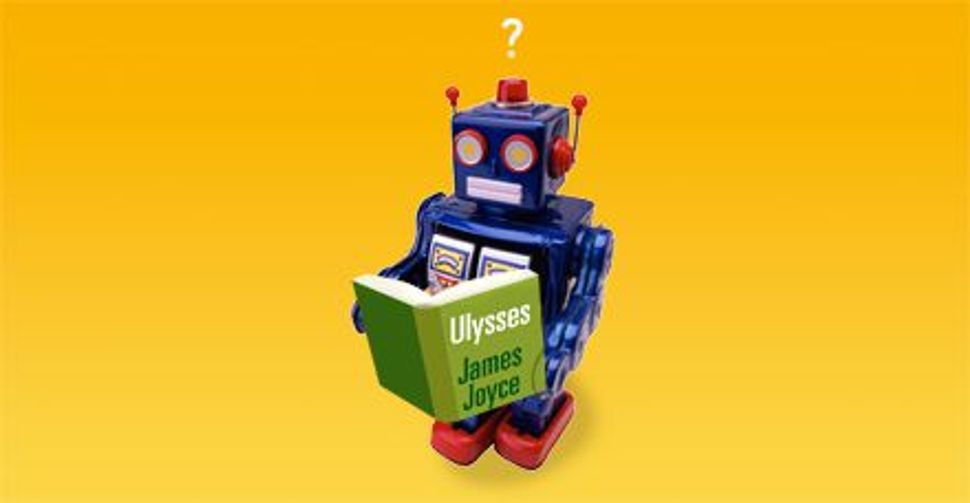
Image by kurt hoffman
Gideon Weisz of Boulder, Colo., calls my attention to a recent BBC translation gaffe that has British Jews chuckling. In their comedy “Episodes,” the British television channel’s producers staged a scene in a Jewish cemetery in which there is a tombstone bearing the English inscription:
Beloved Husband and Father
Yehudi Penzel
Dearly Missed
Beloved Head of Family
Above the English, the same inscription appears on the stone in Hebrew. It is, however, written backward, from left to right like English rather than from right to left like Hebrew, so that its first line, for example, which should be ba’al v’av ahuv, reads vuha va’v la’ab. And to compound the felony, the words “dearly missed” have been translated as heḥ – emitz b’yoker, which might be retranslated into English as either “He missed at a high price” or “He turned expensively sour.”

Image by kurt hoffman
It’s pretty obvious what must have happened. Someone at the BBC obtained a computer translation of Mr. Penzel’s English epitaph into Hebrew and told someone else what Hebrew letters to spell it with, not bothering to mention that these needed to be written in the opposite direction from English. Worse yet, the computer translated the English verb “miss” as Hebrew heḥ emitz, which can mean to sour or to miss or flub something, such as a goal or opportunity, but never to long for a person.
Well, these things happen, even in the year 2012. Back in the 1980s, when computer translation was still a novelty, there was a story — whether true or not, I have no idea — of an English-Japanese program into which was fed the English proverb “Out of sight, out of mind.” Back came the Japanese for “Invisible, insane.”
To be sure, a more sophisticated translation program could avoid such errors. It would be able to pick up on the fact that the “missed” of Yehudi Penzel’s epitaph is in the passive construction of “is missed,” that “dearly” denotes emotional preciousness and not price, and that the best Hebrew equivalent would be mitgage’ lekha im me’od, “[We] miss you very much.” That’s not too much to ask of a contemporary computer.
The question I sometimes think about, though, is this: Given the current rate of progress in computer programming in general, and in translation programs in particular, is it theoretically conceivable that someday, computers will outperform human translators, just as they can outperform human chess players? Will human translators one day become as obsolete as human telephone operators?
In many fields, they undoubtedly will. Already today, computers can translate the average newspaper article adequately, if not perfectly, and it’s just a matter of time before they’re as good at it as any of us and incredibly faster. There’s no reason that it won’t eventually be possible to put the whole Sunday Times into idiomatic French or German in a matter of minutes or even seconds. Most areas of translation will be automated; some already have been.
But high-quality literary translation is something else. It’s not enough for a literary translator to know unerringly what certain words mean and to render that meaning accurately in another language. He or she must also know what those words feel like; what their precise tone and music are; what sensations, thoughts, memories and associations they invoke or are likely to invoke in a reader, and what the best way is to convey all this in another language. The literary translator needs more than the kind of linguistic information that can be crammed into a computer. He or she needs, one is tempted to say, to have lived a human life.
The other day, I was reading the first page of what may be my favorite novel in the world, James Joyce’s “A Portrait of the Artist as a Young Man.” It begins:
Once upon a time and a very good time it was there was a moocow coming down along the road and this moocow that was down along the road met a nicens little boy named baby tuckoo.
His father told him that story: his father looked at him through a glass: he had a hairy face.
No doubt an intelligent computer can be taught that “Once upon a time” is a formula from fairy tales; that “moocow” and “nicens” are the language of an adult trying to talk baby-talk; that “a glass” is a small child’s way of expressing the idea of eyeglasses, and that other languages have their equivalents for these things. But can a computer have had a childhood itself? Can it know the feeling of being told a bedtime story? Can it, even theoretically, understand that “and a very good time it was” may be either the words of the father telling the story or of the son remembering it long afterward, and that it is crucial to preserve this ambiguity in a translation? It’s unlikely. And if it can’t recognize such things in Joyce’s English, it’s certainly not going to be able to convey them fully in French, German or Russian.
And this is “A Portrait of the Artist” at its simplest! From here on, as the novel’s protagonist grows older, its language gets progressively more complex. Good literary translators needn’t fear for their jobs anytime soon.
Questions for Philologos can be sent to [email protected]
I’m personally matching all gifts to the Forward, up to $36,000. Can I match your gift now?

Hello, fellow Forward reader! I’m Joel Brown, a Forward reader and supporter for more than 15 years, and currently the chair of the board of directors.
I’m an avid Forward reader because it ticks so many of my essential boxes: excellent journalism, Jewish focus and diverse viewpoints. In today’s political climate, what I most appreciate is the Forward’s independence — made possible by the generosity of its membership.
The Forward is committed to bringing you unbiased, nuanced Jewish news. From my position as board chair, I see an exciting future as we expand our position as the definitive independent voice of contemporary American Judaism.
— Joel Brown, Forward board chair
Support our mission to tell the Jewish story fully and fairly.