As Chuck Hagel Confirmation Hearing Looms, New Push for Pentagon Pick
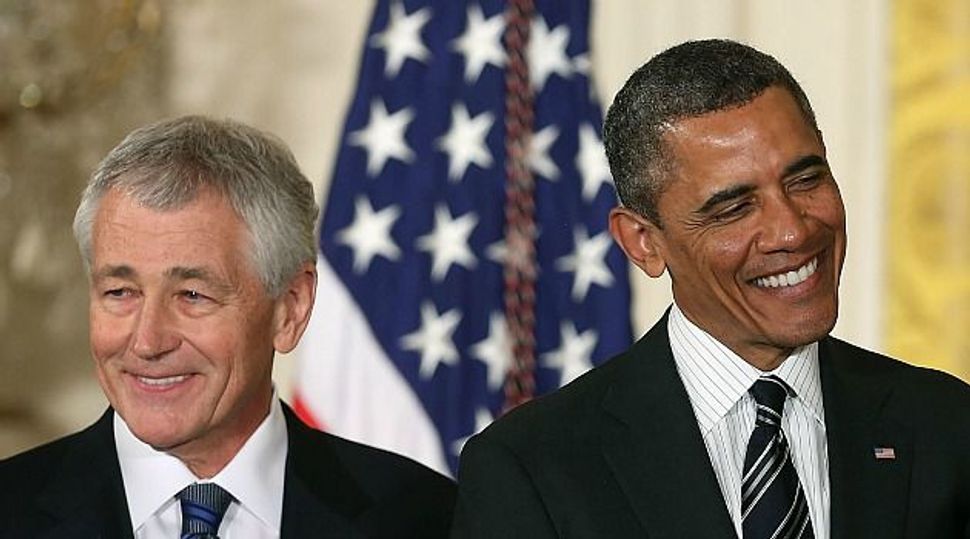
No Chances: Despite signs that Chuck Hagel has enough support to win Senate confirmation, the White House is mounting an all-out push to outflank opponents. Image by getty images
As Chuck Hagel, President Barack Obama’s nominee to lead the Pentagon, prepared to meet with senior New York Senator Chuck Schumer in mid-January, the White House stepped in and ensured that the get-together would take place quickly – and in the West Wing.
Some of the loudest objections to Obama’s choice of Hagel for secretary of defense stemmed from lawmakers’ concerns about his past comments on Israel and Iran.
And with Schumer, the leading Jewish Democrat in Congress, among those expressing doubts, the administration wanted to make absolutely clear that it expected his support. Hosting the meeting in the White House wing housing the president’s official offices was a symbol of its importance to the administration.
The West Wing session – followed by Schumer’s effusive endorsement of Hagel – was part of an all-out offensive Obama’s White House has launched to secure Hagel’s nomination, administration officials and congressional aides said. The campaign has included a Pentagon task force, hours of meetings and, at times, some judicious direct intervention.
Hagel, 66, a decorated Vietnam War veteran and former two-term Republican senator, emerged as a leading candidate to replace Leon Panetta almost as quickly as the defense secretary announced his retirement.
Hagel’s Senate confirmation hearing is scheduled for Thursday morning, and his approval is less than a sure bet.
To battle a well-financed firestorm of objections from neoconservative and gay rights groups, the White House lined up a large team to work with Hagel and make the former Nebraska senator’s case to his former colleagues.
The group included Obama allies like Senate Democratic leader Harry Reid, who pushed Schumer and other balky Democrats to back Hagel, White House officials and Hagel aides from his two terms in the Senate.
Administration officials have reached out to Jewish groups and reassured gay rights activists. Hagel met with leaders of some of the largest Jewish-American groups at the White House on Friday, where he was joined by Vice President Joe Biden.
And they have enlisted an array of luminaries to serve as Hagel ambassadors. Thirteen former secretaries of defense and state and national security advisers from both parties sent a letter to senators last week strongly backing his nomination.
Hagel will be introduced at his hearing by two former Senate Armed Services committee chairmen, Democrat Sam Nunn and Republican John Warner, who both – like Hagel – were known for breaking from party doctrine on a range of issues.
‘MURDER BOARDS’
Hagel has set up a Pentagon office and has a transition team helping him to prepare. He has met with Panetta, deputy defense secretary Ashton Carter and other military leaders, including Martin Dempsey, the chairman of the Joint Chiefs of Staff.
The nominee has had two “murder board” sessions, panels to grill him to prepare for questions from skeptical – and hostile – senators.
A source close to the confirmation process said Hagel may squeeze in a third “murder board” session before Thursday.
Carter, who will stay on as deputy secretary of defense during Obama’s second term, told reporters at the Pentagon on Friday that Obama had called him to tell him about the Hagel nomination and asked him to remain, which would provide a measure of stability.
Critics have questioned Hagel’s past statements over the power of the “Jewish lobby” in Washington, and what they say is his resistance to sanctions on Iran and eagerness to further cut defense spending. No Republican has yet publicly endorsed him.
Hagel is expected to have a tougher time with the Armed Services Committee, which must clear his nomination, than in the full 100-member Senate, where Republicans hold 45 seats.
There are 12 Republicans on the 26-member panel, but many are among the Senate’s most conservative members. At least three, including the panel’s top Republican, James Inhofe of Oklahoma, said they would oppose Hagel even before hearing his testimony.
But others, including fellow Vietnam War veteran John McCain, Kelly Ayotte of New Hampshire, Utah’s Mike Lee and Deb Fischer of Nebraska, said they would reserve judgment until after Hagel’s testimony.
McCain’s vote is considered key. He campaigned for Hagel in 1996, and Hagel was national co-chairman of the Arizona Republican’s unsuccessful 2000 presidential bid. On Tuesday, McCain said he would wait to make up his mind until he hears Hagel’s testimony.
TRAITOR TO THE RIGHT, WORRY TO THE LEFT
Some Republicans view Hagel as a traitor for questioning the Bush administration’s handling of the Iraq War, which he initially supported.
Some Democrats and moderate Republicans, meanwhile, question Hagel’s social conservatism, saying it raises concerns about how strongly he would support equal rights for women or homosexuals in the military.
“Hagel annoyed people on both the right and left with some of his comments,” said Lawrence Korb, a senior fellow at the Center for American Progress and assistant secretary of defense under President Ronald Reagan.
“My guess is in the committee, he’s going to get out, but not by a lot,” Korb said.
Controlling 55 seats in the Senate, Democrats have enough votes to confirm Hagel by a simple majority. They would need five Republican votes to overcome Senate procedural hurdles, although an effort to block Hagel would infuriate Democrats as the two parties try to negotiate delicate issues like spending cuts and a bipartisan immigration plan.
Hagel has held dozens of meetings with senators to address their concerns and appeal for their support, staying on Capitol Hill from early morning well into the evening repeatedly in the weeks leading up to his confirmation hearing.
He was due to have 10 more meetings on Tuesday, cramming for his make-or-break appearance before the panel. Aides have said they expect he will have met with at least 50 of the 100 senators before Thursday morning.
Despite a grueling schedule, Hagel has shown glimpses of humor.
He accidentally wandered into the Senate press gallery last week while looking for a men’s room and gamely fielded a few questions – saying little – when he emerged.
And the Omaha World Herald newspaper reported that Hagel ran into Elizabeth Warren, Massachusetts’ new senator, in the Capitol basement while hurrying between meetings one day last week.
“We were just talking about you,” Warren said.
To which Hagel replied, “Everybody’s been talking about me.”
I’m personally matching all gifts to the Forward, up to $36,000. Can I match your gift now?

Hello, fellow Forward reader! I’m Joel Brown, a Forward reader and supporter for more than 15 years, and currently the chair of the board of directors.
I’m an avid Forward reader because it ticks so many of my essential boxes: excellent journalism, Jewish focus and diverse viewpoints. In today’s political climate, what I most appreciate is the Forward’s independence — made possible by the generosity of its membership.
The Forward is committed to bringing you unbiased, nuanced Jewish news. From my position as board chair, I see an exciting future as we expand our position as the definitive independent voice of contemporary American Judaism.
— Joel Brown, Forward board chair
Support our mission to tell the Jewish story fully and fairly.