Israel Sleepwalking Into Crisis Over Jewish Settlements on Occupied Palestinian Land
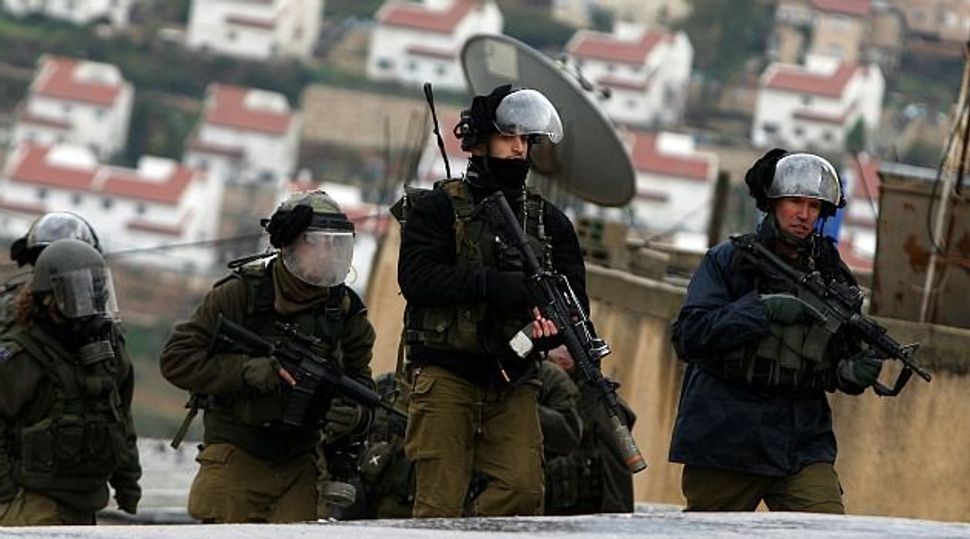
Image by getty images
Israel risks sleepwalking into a crisis with its allies over relentless settlement-building in the occupied West Bank and East Jerusalem unless it realises that the international anger is genuine and adjusts its course.
The next few months may prove crucial if Israel is to avoid diplomatic disaster, with a new government forming around Prime Minister Benjamin Netanyahu and U.S. President Barack Obama set to make his first official visit to the Holy Land in the spring.
Obama will not just be coming for a photo opportunity. He is expected to try to revive a push for peace in hopes of finding an Israeli coalition receptive to deepening Western concerns about the prospects of creating a viable Palestinian state.
“The two-state solution is not dead, but it is in mortal danger,” said Daniel Seidemann, an Israeli lawyer and an expert on settlement expansion.
“We are hanging onto it by our finger nails. This is the last opportunity to save it for the foreseeable future. The prospects are not great, but this is the last best hope.”
Should these hopes wither, Israel can expect repercussions.
These might range from tighter international regulations on the export of Israeli goods made in the occupied territories to tacit foreign backing for the Palestinians should they pursue Israel in the International Criminal Court over the settlements.
Obama himself, with no re-election to worry about, could review security and defence cooperation that Israeli officials say reached new heights during his first term, with annual U.S. military aid from Washington put at some $3 billion.
“Israel is walking blindly towards isolation and censure in the eyes of the world,” said one of the most senior Western envoys in Jerusalem, who declined to be named given the enormous sensitivities surrounding the issue.
“What I don’t understand is if Mr. Netanyahu doesn’t realise what is happening, or if he doesn’t give a damn.”
In the past two months Israel has received sometimes fierce criticism from the United Nations, European Union and United States over its announcement of plans to build more than 11,000 new houses on land Palestinians want for a future state.
Last week, Israel boycotted the U.N. Human Rights Council in Geneva as it was planning a routine review of the Jewish state. Days later, U.N. investigators issued a strongly worded report that said the settlements could constitute a war crime.
Israeli leaders have largely shrugged off the opprobrium. They assert a right to build on territory seized in a 1967 war and accused the Geneva council, which includes non-democratic states like Cuba and Saudi Arabia, of bias and hypocrisy.
However, past and present Israeli diplomats are nervous about the mounting friction as Israel faces a multitude of challenges piling up along its troubled borders, with Islamists taking power in Egypt and on the rise in Syria’s civil war.
“I am worried and so are many other Israelis,” said Itamar Rabinovich, a former Israeli ambassador to the United States.
“Our legitimacy is being eroded and the more isolated and delegitimised Israel is, the more difficult it will be to get public opinion on our side regarding Iran,” he added, referring to suspicions the Islamic Republic is seeking nuclear weapons.
Israelis started moving to the West Bank soon after the 1967 conflict, and the numbers soared in the wake of the 1993 Oslo Accords that granted limited self-rule to the Palestinian Authority – but placed no limits on Jewish settlement growth.
In 1993 there were an estimated 111,600 settlers in the territory. There are now more than 325,000, with a further 200,000 living in East Jerusalem, which was annexed by Israel after 1967 in a move not recognised internationally and is claimed by the Palestinians as their capital city.
“A Palestinian state has never been further away than it is today,” Dani Dayan, outgoing head of the main settler council, was quoted as saying in the Jerusalem Post on Tuesday.
“The settlements today are blossoming … There is almost no settlement without construction,” added Dayan, who endorsed Netanyahu ahead of the Jan. 22 election, which was won by the prime minister, albeit with a sharp fall in support.
Critics have long railed against the settlements, but successive Israeli governments have pushed back with vigour.
They were confident they had the support of mainstream America – Washington has long been Israel’s most steadfast ally – and dismissed EU complaints as largely irrelevant.
Internal Palestinian political divisions, coupled with regular bouts of violence, have also enabled Israel to argue that they do not have any genuine partners for peace.
Diplomats insist the mood abroad is hardening. They say that if the settlements get any bigger there will be no more room for a contiguous Palestinian state, dashing the chance of an accord. They also maintain that Palestinian President Mahmoud Abbas is the most moderate leader that the Israelis can hope for.
Noting this change of tone, the Institute for National Security Studies, a respected Israeli think-tank, said this week that for the first time, the country faced the possibility of “concrete punishment measures” tied to its settlement expansion.
STUCK WITH LABELLING
Israel’s solitude was seen most starkly in November when a mere eight countries, including the United States and four micro Pacific nations, voted with the Jewish state in a failed bid to prevent the Palestinians from gaining de-facto statehood recognition at the United Nations.
EU diplomats in Jerusalem forecast that such isolation would become a way of life for Israel, but dismissed any suggestion that Europe might impose economic sanctions on the Jewish state.
“The most we would expect is a move towards labelling of all settler products as coming from occupied territories,” said one diplomat, who declined to be named. “Sanctions are a no-no.”
Even a labelling change is likely to elicit fury in Israel. When South Africa proposed a similar move last May, the Israeli foreign ministry said the decision was “tainted” with racism.
Many ordinary Israelis see deep-rooted anti-Semitism at play in the criticism that is raining down on their nation, with the politically divided Palestinians only rarely admonished in the court of world opinion for their own missteps.
“The issue of delegitimisation goes beyond a simple United Nations report. We are aware of the situation as Jewish people and worried by it,” said Zalman Shoval, another former Israeli ambassador to the United States who is close to Netanyahu.
However, he predicted that Obama and the prime minister would be able to find some way to resuscitate the peace process, which collapsed in 2010 after the Palestinians refused to take further part unless settlement building ceased.
“Knowing what Mr. Netanyahu’s plans are in trying to move the conundrum forward … I think cooperation between the two leaders will be very successful,” Shoval said, without elaborating.
Before he meets Obama, Netanyahu must first assemble a new coalition – a particularly tricky task given the unexpected success of the new centrist party Yesh Atid (There is a Future).
Although many of the thorniest issues are entwined with domestic affairs, Yesh Atid has said that re-starting peace negotiations should be Netanyahu’s main foreign policy goal.
That sits uneasily with many of Netanyahu’s party faithful who reject the two-state solution. It will also be hard to square with another natural coalition partner – the pro-settler Jewish Home, which wants to annex much of the West Bank.
The top selling Israeli daily Yedioth Ahronoth said on Wednesday the surprise announcement on Tuesday that Obama was planning an imminent visit would thrust peace considerations to the top of the agenda in the ongoing coalition talks.
“Barack Obama is urging Benjamin Netanyahu to find solutions, and there is no room here for deceptions. The State of Israel is likely to find itself in another few weeks poised before one of its most important moments of truth,” it wrote.
I’m personally matching all gifts to the Forward, up to $36,000. Can I match your gift now?

Hello, fellow Forward reader! I’m Joel Brown, a Forward reader and supporter for more than 15 years, and currently the chair of the board of directors.
I’m an avid Forward reader because it ticks so many of my essential boxes: excellent journalism, Jewish focus and diverse viewpoints. In today’s political climate, what I most appreciate is the Forward’s independence — made possible by the generosity of its membership.
The Forward is committed to bringing you unbiased, nuanced Jewish news. From my position as board chair, I see an exciting future as we expand our position as the definitive independent voice of contemporary American Judaism.
— Joel Brown, Forward board chair
Support our mission to tell the Jewish story fully and fairly.