Pope Benedict’s Jewish Legacy Tarnished By Ties to Holocaust Deniers
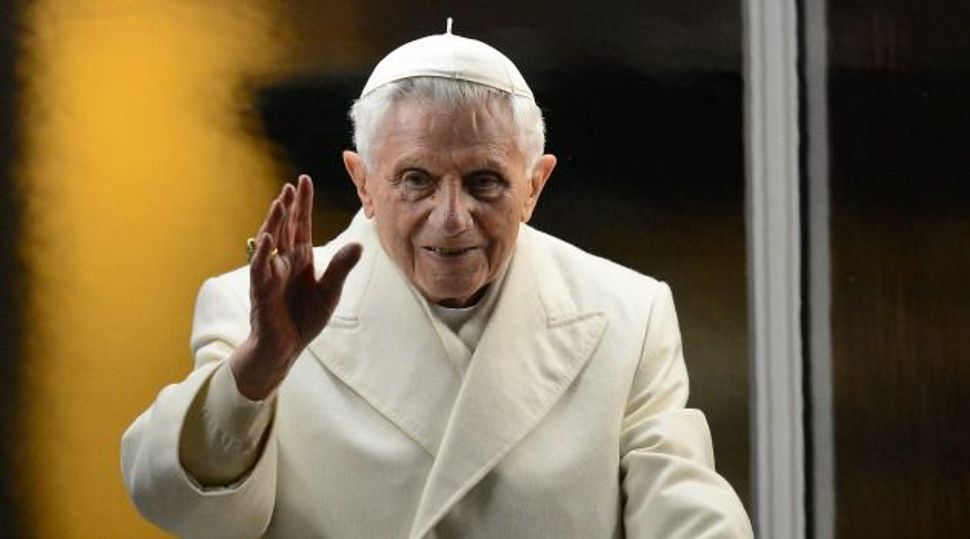
Image by getty images
Pope Benedict was cheered by conservatives for trying to reaffirm traditional Catholic identity but liberals accused him of turning back the clock on reforms and hurting dialogue with Muslims, Jews and other Christians.
The 85-year-old German-born pontiff announced on Monday he would step down at the end of the month because of the effects of old age meant he was unable to complete his ministry. It was a decision that stunned Church officials and Catholics around the world, but one that he had hinted at in the past.
Benedict’s relations with Jews had highs and lows.
Jews were offended by his decision to allow a wider use of the old-style Latin Mass and missal, which included a prayer for the conversion of the Jews.
Jews took offence again in December 2009 when he re-started the process putting his wartime predecessor Pius XII, accused by some Jews of turning a blind eye to the Holocaust, back on the road to sainthood after a two-year pause for reflection.
The Jewish world, as well as many Catholics, were outraged after Benedict lifted the excommunication of four traditionalist bishops, including one who openly denied the Holocaust.
However in 2011, he won acclaim by personally exonerating Jews of allegations they were responsible for Christ’s death, repudiating the concept of collective Jewish guilt that haunted Christian-Jewish relations for centuries.
The first German pope for 1,000 years, Benedict confronted his country’s past when he visited the Nazi death camp at Auschwitz.
Calling himself “a son of Germany,” he prayed and asked why God was silent when 1.5 million victims, most of them Jews, died there during World War Two.
Born Joseph Ratzinger, he served in the Hitler Youth during World War II when membership was compulsory. He was never a member of the Nazi party and his family opposed Adolf Hitler’s regime.
“Neither Ratzinger nor any member of his family was a National Socialist,” John Allen, a leading Church expert, wrote in a biography.
But his trip to Germany also prompted the first major crisis of his pontificate. In a university lecture he quoted a 14th century Byzantine emperor as saying Islam had only brought evil to the world and that it was spread by the sword.
After protests that included attacks on churches in the Middle East and the killing of a nun in Somalia, the pope said he regretted any misunderstanding the speech caused.
In a move that was widely seen as conciliatory, he made a historic trip to predominantly Muslim Turkey in 2006 and prayed in Istanbul’s Blue Mosque with the city’s grand mufti. Benedict committed himself to Christian unity but other religions criticised him in 2007 when he approved a document that re-stated the Vatican position that all other Christian denominations apart from Catholicism were not full churches of Jesus Christ.
He confirmed his conservative view of other religions in 2011, when an inter-faith meeting in Assisi, Italy did not include the simultaneous common prayer that was held when John Paul initiated the gatherings in 1986.
At the same meeting however, he meekly acknowledged “with great shame” that Christianity had used force in its long history as he joined other religious leaders in condemning violence and terrorism in God’s name.
In 2007 Benedict made appointed a Polish bishop who once spied for communist police. The bishop had to stand down.
Benedict made a successful trip to the United States in 2008. He apologised for the sexual abuse scandal, promised that paedophile priests would go, and comforted abuse victims.
But 2009 became an annus horribilis for the pope as he made one misstep after another.
The pope prompted international outrage again in March of 2009, when he told reporters on a plane taking him to Africa and the use of condoms in the fight against AIDS only worsened the problems.
At the Vatican, he preferred to appoint men he trusted blindly and some of his early appointments were controversial.
He chose Cardinal Tarcisio Bertone, who had worked with him for years in the Vatican’s doctrinal office, to be Secretary of State even though Bertone had no diplomatic experience.
One of the themes he often returned to was the threat of relativism, rejecting the concept that moral values are not absolute but relative to those holding them.
“We are moving towards a dictatorship of relativism, which does not recognise anything as definitive and has as its highest value one’s own ego and one’s own desires,” he said in a homily at John Paul’s funeral, which many believed convinced his brother cardinals to vote for him in the conclave that followed.
TURNING BACK THE CLOCK
His critics saw many of his actions as attempts to turn back the clock on reforms enacted by the 1962-1965 Second Vatican Council, which modernised the Church and encouraged inter-religious dialogue.
He made it easier for married Anglican priests, upset that their church was becoming too liberal, to convert to Catholicism.
Benedict wrote three encyclicals – the most important form of papal document. His first, “Deus Caritas Est” (God is Love) in 2006, was about the various concepts of love, both erotic and spiritual.
The 2007 “Spe Salvi” (Saved by Hope), was an attack on atheism and an appeal to a pessimistic world to find strength in Christian hope. The 2009 Caritas in Veritate (Charity in Truth), called or a re-think of the way the world economy is run.
Under the German’s meek demeanour lay a steely intellect ready to dissect theological works for their dogmatic purity and debate fiercely against dissenters.
Ratzinger first gained attention as a liberal theological adviser at the Second Vatican Council.
However, the Marxism and atheism of the 1968 student protests across Europe prompted him to become more conservative to defend the faith against growing secularism.
After stints as a theology professor and then archbishop of Munich, Ratzinger was appointed head of the Congregation for the Doctrine of the Faith (CDF), the successor office to the Inquisition, in 1981.
He and Pope John Paul agreed that traditionally sound doctrine and theology had to be restored in the Church after a period of experimentation.
In the CDF office, Ratzinger first turned his attention to the “liberation theology” popular in Latin America, and drew criticism for his severity in ordering the one-year silencing in 1985 of Brazilian friar Leonardo Boff, whose writings were attacked for using Marxist ideas.
Ratzinger issued a firm Vatican denunciation of homosexuality and gay marriage in 1986.
He brought pressure in the 1990s against theologians, mostly in Asia, who saw non-Christian religions as part of God’s plan for humanity.
A 2004 document sternly denounced “radical feminism” as an ideology that undermined the family and obscured the natural differences between men and women.
His combative side came out in 2000 in a dispute over a CDF document entitled Dominus Iesus. Aimed at restating the primacy of the Roman Catholic Church against the more inclusive views in Asia, it branded other Christian denominations as deficient or not quite real churches.
Anglican, Lutheran and other Protestant churches which had been in ecumenical dialogue with Rome for years were shocked. They were further upset when Ratzinger dismissed protests from Lutherans as “absurd”.
The son of a police chief, he was born in Marktl am Inn in Bavaria, southern Germany, in 1927.
In 2002, he became dean of the College of Cardinals which elected him pontiff three years later.
Benedict enjoyed relatively good health most of his life but the first sign that he was slowing down came in October 2011, when he began using a wheeled platform to move up the main aisle of St. Peter’s Basilica.
In a book in 2010, he said he would not hesitate to become the first pontiff to resign willingly in more than 700 years if he felt himself no longer able, “physically, psychologically and spiritually” to run the Catholic Church
Before he was elected pope, the former Cardinal Joseph Ratzinger was known as “God’s rottweiler” because of his stern stand on theological issues. But it became clear that not only did he not bite, but he barely even barked.
Despite great reverence for his charismatic, globe-trotting predecessor – whom he put on the fast track to sainthood and beatified in 2011 – aides said he was determined not to change his quiet manners to imitate John Paul’s style.
A professorial type who relaxed by playing the piano, Benedict sought to show the world the gentler side of the man who had been the Vatican’s chief doctrinal enforcer for nearly a quarter of a century.
But child abuse scandals hounded most of his papacy. He ordered an official inquiry into abuse in Ireland, which led to the resignation of several bishops. But the Vatican’s relations with once Catholic Ireland plummeted during his papacy, to the point that Dublin closed its embassy to the Holy See in 2011.
Victims demanded that he be investigated by the International Criminal Court but the Vatican said he could not be held responsible for the crimes of others.
Scandal closer to home hit in 2012 when the pontiff’s butler was s found to be the source of leaked documents alleging corruption in the Vatican’s business dealings, causing an international furore.
I’m personally matching all gifts to the Forward, up to $36,000. Can I match your gift now?

Hello, fellow Forward reader! I’m Joel Brown, a Forward reader and supporter for more than 15 years, and currently the chair of the board of directors.
I’m an avid Forward reader because it ticks so many of my essential boxes: excellent journalism, Jewish focus and diverse viewpoints. In today’s political climate, what I most appreciate is the Forward’s independence — made possible by the generosity of its membership.
The Forward is committed to bringing you unbiased, nuanced Jewish news. From my position as board chair, I see an exciting future as we expand our position as the definitive independent voice of contemporary American Judaism.
— Joel Brown, Forward board chair
Support our mission to tell the Jewish story fully and fairly.