



Gerald Sorin
By Gerald Sorin
-

Culture The Reformation of Morris Dickstein
● Why Not Say What Happened: A Sentimental Education By Morris Dickstein Liveright Publishing, 301 pages, $27.95 For more than 40 years, Morris Dickstein has been a dedicated, much-admired professor, scholar and author. He has achieved prominence and a wide audience for his astute essays of cultural criticism. In his first book, “The Gates of…
-

The Schmooze The Historian’s Challenge, Part 2
On Tuesday, Gerald Sorin wrote about ambivalence toward the genre of biography. Today, he considers the question: Can the biographer or their readers really know the subject fully? His blog posts are featured on The Arty Semite courtesy of the Jewish Book Council and My Jewish Learning’s Author Blog Series. For more information on the…
-

The Schmooze Author Blog: The Historian’s Challenge
Gerald Sorin’s most recent book, “Howard Fast: Life and Literature in the Left Lane,” is now available. Sorin won the 2003 National Jewish Book Award in History for I“Irving Howe: A Life of Passionate Dissent.” His blog posts are featured on The Arty Semite courtesy of the Jewish Book Council and My Jewish Learning’s Author…
-

Culture Jackie Robinson and the Jews
Out of Left Field: Jews and Black Baseball By Rebecca T. Alpert Oxford University Press, 236 pages, $27.95 Recently, the Yankees’ Derek Jeter hammered out his 3,000th career hit, only the 29th batter in baseball history to reach that exalted plateau; at the age of 37, he is the fourth-youngest player to accomplish that feat,…
-

Culture Yearning for the Past in the Future
Promised Lands: New Jewish American Fiction on Longing and Belonging Edited by Derek Rubin Brandeis University Press, 336 pages, $26 We continue to be in the tricky business of trying to define what we mean (or don’t mean) by “Jewish writer.” Any writer who is a Jew? Only a writer, Jewish or not, who includes…
-

Culture What Is This Thing We Call Jewish Literature?
Promised Lands: New Jewish American Fiction on Longing and Belonging Brandeis University Press, 336 pages, $26 We continue to be in the tricky business of trying to define what we mean (or don’t mean) by “Jewish writer.” Any writer who is a Jew? Only a writer, Jewish or not, who includes Jewish “content” in his…
-
Culture Tracking Change, and the Lack of It, In New York’s Garment Industry
A Coat of Many Colors: Immigration, Globalization, and Reform In New York City’s Garment Industry Edited by Daniel Soyer Fordham University Press, 312 pages, $75. * * *| ‘What’s the difference between a Jewish clothing worker and a Jewish psychiatrist?” an old joke goes. Answer: “One generation.” Actually it was more like two or even…
-
News Living With the Presence of Absence
The German Money By Lev Raphael Leapfrog Press, 200 pages, $14.95. * * *| Lev Raphael, a child of Holocaust survivors, widely admired for mystery novels centered around the hypocrisies and inanities of academic life, is even better represented by his short stories. His debut collection, “Dancing on Tisha B’Av” (St. Martin’s Press, 1991), which…
Explore
Most Popular
- 1

Fast Forward USC cancels commencement speech from Muslim valedictorian after she shared link to anti-Israel website
- 2

Fast Forward 2 House members lead the charge to oust the speaker. Both have been accused of trafficking in antisemitism.
- 3

Opinion The head of the largest Christian Zionist organization is no friend to Israel — he wants an apocalypse there
- 4

Opinion USC: Don’t blame Jews for canceling your valedictorian
In Case You Missed It
-

Music A pioneering Jewish rock band got its start in 1965; they’re still slowly and steadily turtling along
-

Fast Forward Israel reportedly strikes in Iran, days after fending off Iranian missile attack
-
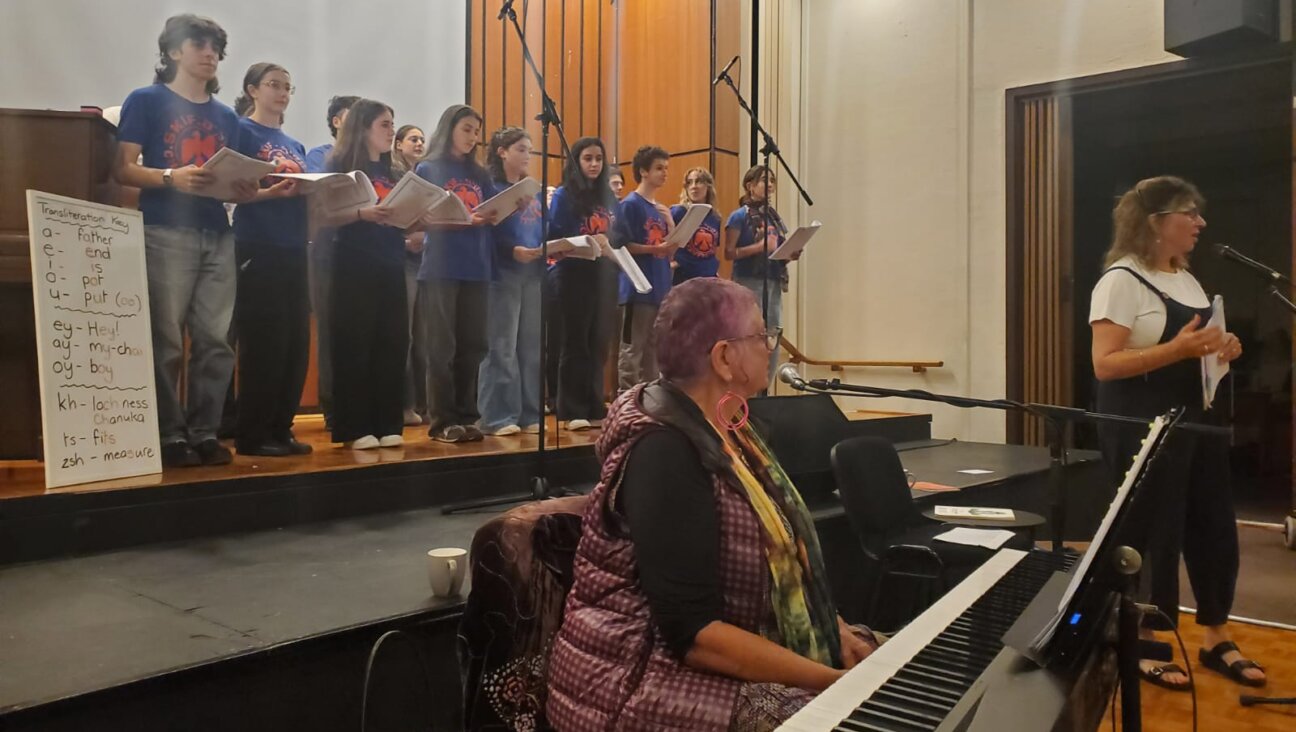
Yiddish אַ נײַע איניציאַטיוו צו פֿאַרשפּרייטן ייִדישע פּסח־לידער געשאַפֿענע אין מעלבורן A new initiative to share Yiddish Passover songs composed in Melbourne
דער קאָמפּאָזיטאָר, ברוך קאַלושינער, האָט אָנגעפֿירט מיט ייִדיש־כאָרן און געלערנט מוזיק אין די ייִדישע שולן
-

News Why did this Mormon drive 10 hours to buy whiskey? To help out a Jewish friend for Passover
Engage
-
Catch Up on Yiddish Events

-
Shop the Forward Store
100% of profits support our journalism




