Their sons are fighting for Israel, and it’s driving them mad
The films ‘Oxygen’ and ‘A Burning Man’ portray parents struggling to maintain their sanity in a country under siege
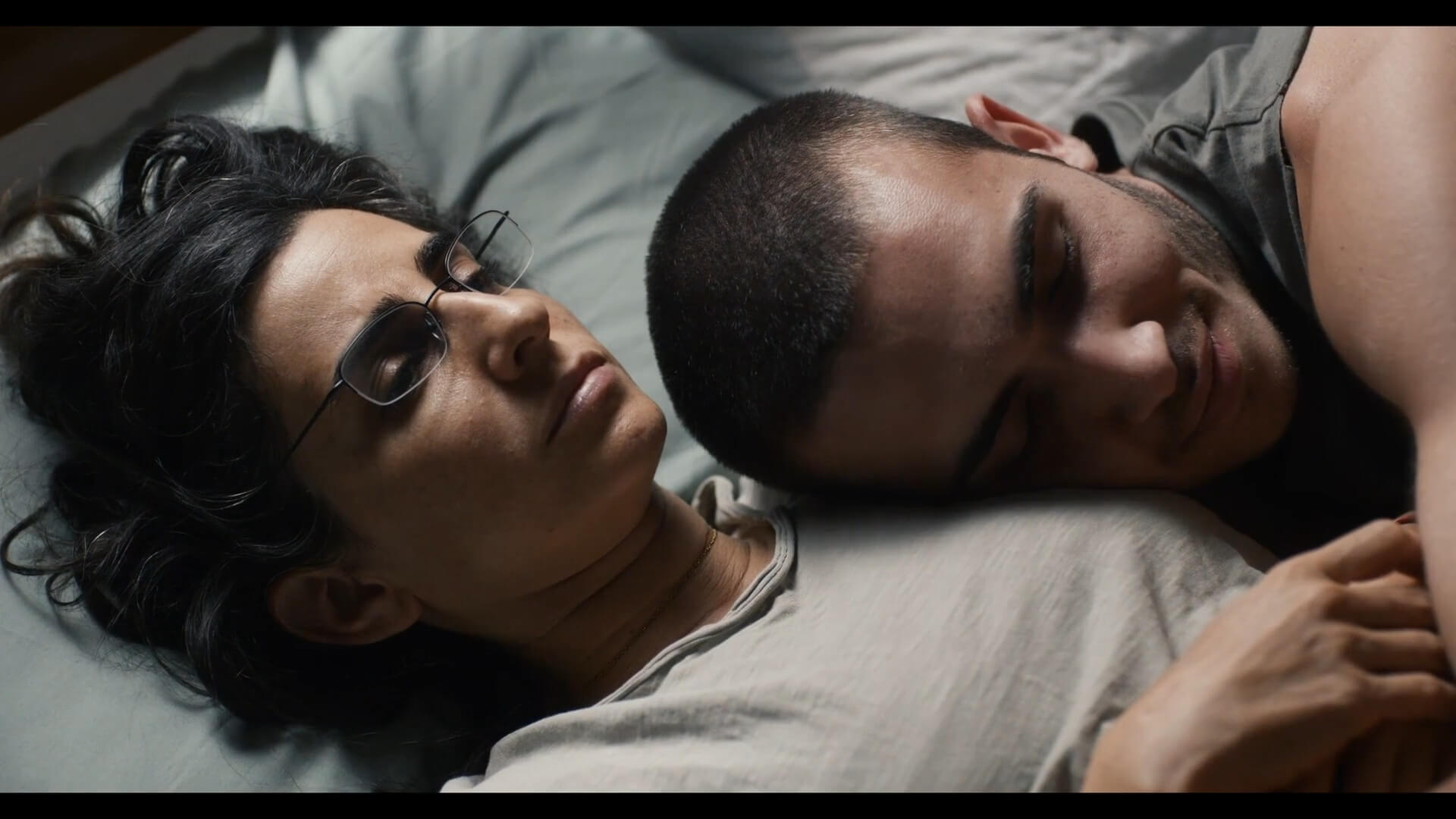
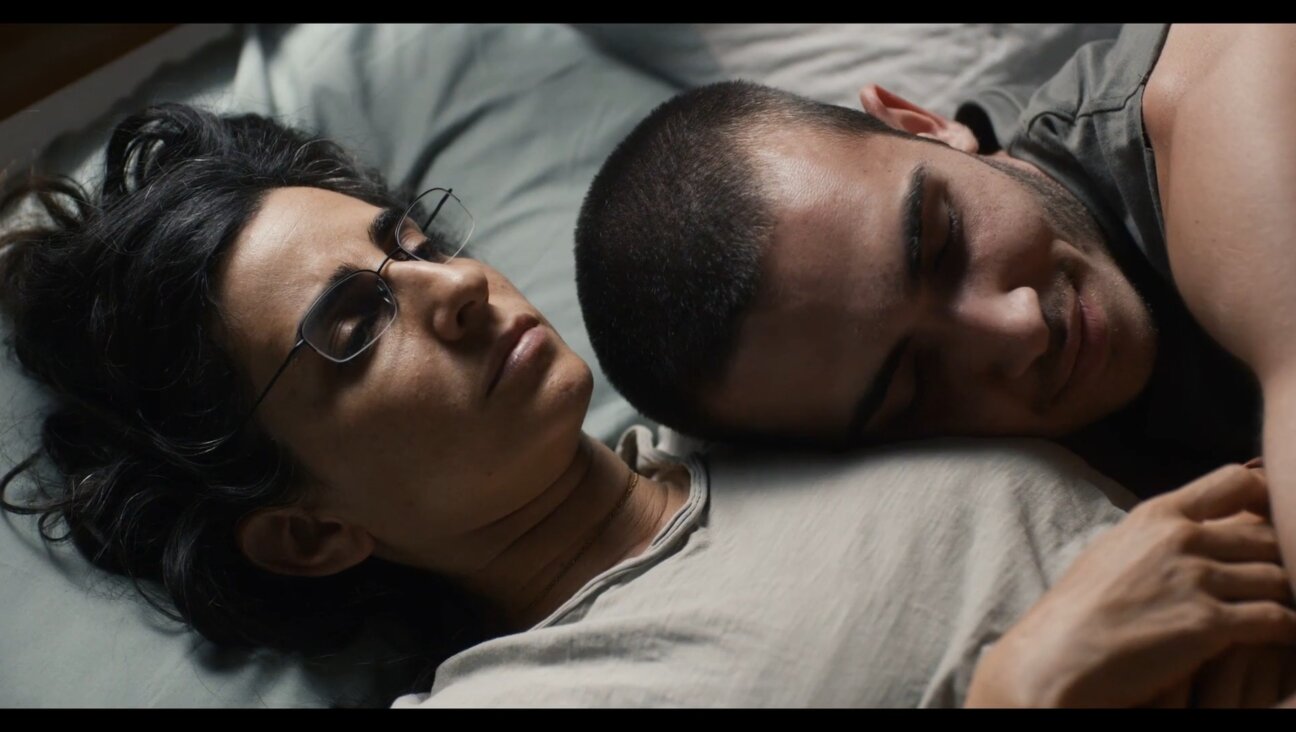
Dana Igvy and Ben Sultan play a mother and son in the film ‘Oxygen.’ Courtesy of Israel Film Center Festival
Oxygen and A Burning Man, two films showing at the Israel Film Center Festival, zero in on the deep-seated anxiety Israeli parents face when their sons are called to duty. Though both are flawed, each captures the universal experience of parents yearning to protect a child from outside forces that they cannot control, yet on some level helped create. They tell personal stories that are also political.
The films evoke a world where war and the threat of war are constants. The sound of warning sirens and drones abound. A repeated scene in Oxygen features apartment dwellers dashing down darkened stairways to the basement for shelter as the alerting alarms shriek in the distance.
Oxygen and A Burning Man are singularly Israeli films — I’m not sure they could be made anywhere else — and on many fronts they are stunners.
Netalie Braun’s Oxygen forges a claustrophobic space. Even the title summons forth the image of gasping for air.
The opening scene metaphorically hints at airless entrapment. Anat (brilliantly played by Dana Igvy) and her child are romping about in the waves. They are neck high in water and appear to be in the middle of the ocean. The moment conjures a nostalgic portrait, but a touch of surreal menace is also present. So too is the openly erotic relationship between mother and son, bordering on incest. They touch each other and their bodies intertwine. And later, when her son Ido (Ben Sultan) is an adult, Anat becomes even more obsessed with him.
Though Ido completes his tour of duty and is coming home, as skirmishes break out on the northern border, he volunteers to return to combat. Anat feels abandoned, betrayed and enraged. Her over-protective maternal instincts kick into high gear as she sets out to get her son discharged from duty. Storming onto the off-limits army base to confront the powers that be, Anat succeeds only in demeaning herself and publicly humiliating her already infantilized son.
Anat’s life is further complicated by her relationship with her larger-than-life warrior father (film producer Marek Rozenbaum) who suffers intense PTSD episodes thanks to his experiences in earlier wars. Sweating and shaking, he belly crawls across the living room floor as if heading to a foxhole. Anat blames his jingoistic furor for boosting Ido’s determination to be a military hero. “You wanted him to be a martyr,” she accuses her father.
He, in turn, reminds her that she gave her written permission for Ido to serve even though she had every right to refuse on the grounds that he was an only son. Anat has grown opposed to Israel’s policies, perhaps even moving towards pacifism, and these feelings are at odds with her own national tribalism. Duality is everywhere.
The final section of the film is enigmatic. It’s unclear to me if what we’re witnessing is real or Anat’s dreams or imaginings or combinations thereof.
She has managed to get her son a temporary leave of absence to celebrate his birthday, which slowly morphs into an explosive celebration that feels more like purgatory than a joyous occasion.
“My mother would do anything for me!” Ido bellows and the large crowd at the shindig repeats the words, growing louder with each repetition. “Anything!” “Anything!”
In a last ditch effort to save him from returning to the base, Anat drugs him, rendering him unconscious. She’s driving away with him, blindfolded and shackled in the passenger seat.
At the coda, he has shape-shifted into a child again and she’s carrying him, cradled in her arms, onto a ferry’s empty vehicle deck. No cars. No workers.
What’s happening in this flight of fancy? Anat successfully protecting her son who will always be a baby in her eyes? Still, one wonders where her adult son is at this point in the story. Perhaps I’m being too literal-minded.
I wish I could say the film’s resolution is hauntingly ambiguous, but alas for this viewer, it’s just confusing. Still, despite the shortcomings, the film starkly brings to life the anguished experiences of a parent and an adult son trying to survive and failing dismally in a war-ravaged universe that celebrates nationalism and extols sacrifice, coupled with a particularly unsettling mom-son relationship.
Eyal Halfon’s A Burning Man is the more successful of the two films. Set outside a remote army base on a stretch of endless sun-baked desert it immediately elicits an atmosphere of oppressive tedium, pointlessness and futility. It has its Beckettian elements and absurdity is never far from the surface.
Yonah (Shai Avivi who gives a complex understated performance) cannot let go of his child, Omer (Ran Kaplan) and instead of depositing his son at the bus terminal to make the trip on his own, he camouflages his own anxiety by lightly dubbing the three-hour drive across the flat no man’s land a father-son road trip. Throughout much of the ride, Omer is sleeping and when they arrive at the military outpost he departs for his tour of duty with a wave of the hand.
Driving home, Yonah sights a convoy of military vehicles on flatbeds heading towards the garrison, their presence further provoking his deepest fears. He spins around and speeds back to the base.
He asks one of the drivers what the armored carriers will be used for. “Maybe maneuvers, maybe exercises,” he shrugs, not especially interested. But in an unexpected gesture of friendship he gives Yonah a sandwich. The scene is at once comic, poignant and unexpected.
Yonah’s most trenchant and arguably least subtle encounter is with an aging motorcyclist (Benny Avni) who brags about his son having dumped the national service to make animated films instead of working for “Netanyahu’s freaks.” The usually impassive Yonah is triggered, accusing the man’s son of being a “shirker,” “a privileged leech.” It’s a confrontation many Israeli parents, especially those who have children serving tours of duty, might find all too relatable.
Yet Yonah, like Anat, is an amalgam of contradictions when it comes to politics. Later in the film, he meets up with a deserter and desperately tries to defend him when the arresting officers arrive on the scene. They lock arms with the defector, marching him down the hill away from Yonah who screams words of encouragement to him as the threesome recede into the distance.
Let’s not forget our hero’s name is “Yonah” (translation Dove, bird of peace). It’s heavy-handed. I could also have done without the repeated closeups of babblers, small desert birds, known for their cooperative social behavior. Creatures who embody life lessons I suppose.
At one point, Yonah’s zealously religious real estate agent (Vladimir Friedman) arrives on the scene sporting a yarmulke, tzitzit, and frequently quoting biblical text. He is there both to try to sell Yonah an apartment but also to help a fellow Jew who he understand is in trouble. But nothing goes right. Yonah does not welcome his company, his car has broken down and he grows increasingly terrified in the desolate desert, especially as night falls. This segment has some great comic moments.
Along the way, Yonah enjoys an erotic brush with a nubile young woman who is part of a hippie commune, and is helping to set up a “Burning Man” festival in the desert. It’s inspired, she says, by the annual countercultural event in Nevada.
In the final scene, we’re presented with a stoned Yonah dancing wildly about, first by himself in a psychedelically altered desert and then in the middle of the pop-up festival, which is even more hallucinogenic with its strobe lights flashing, music blasting and congested crowds stomping and gyrating. Jonah’s dancing becoming progressively more intense and out of control.
But in the end, it is a hollow, totally meaningless Bacchanalian eruption. The scene takes on a mythic flavor, punctuating both visually and emotionally, all the events that have led to this moment. Yonah is a burning man. He, along with Anat, both living in a neverending combat zone and forever anguished over their sons’ potential fates, have perhaps become a new Israeli archetype.
‘Oxygen’ and ‘A Burning Man’ are being shown as part of the 14th annual Israel Film Center Festival in New York City, June 9-16.
.
I’m personally matching all gifts to the Forward, up to $36,000. Can I match your gift now?

Hello, fellow Forward reader! I’m Joel Brown, a Forward reader and supporter for more than 15 years, and currently the chair of the board of directors.
I’m an avid Forward reader because it ticks so many of my essential boxes: excellent journalism, Jewish focus and diverse viewpoints. In today’s political climate, what I most appreciate is the Forward’s independence — made possible by the generosity of its membership.
The Forward is committed to bringing you unbiased, nuanced Jewish news. From my position as board chair, I see an exciting future as we expand our position as the definitive independent voice of contemporary American Judaism.
— Joel Brown, Forward board chair
Support our mission to tell the Jewish story fully and fairly.