Bob Dylan warned us about guys like Stephen Miller
Dylan’s 1983 album ‘Infidels’ contains prescient observations about contemporary politics — but something’s been lost in translation
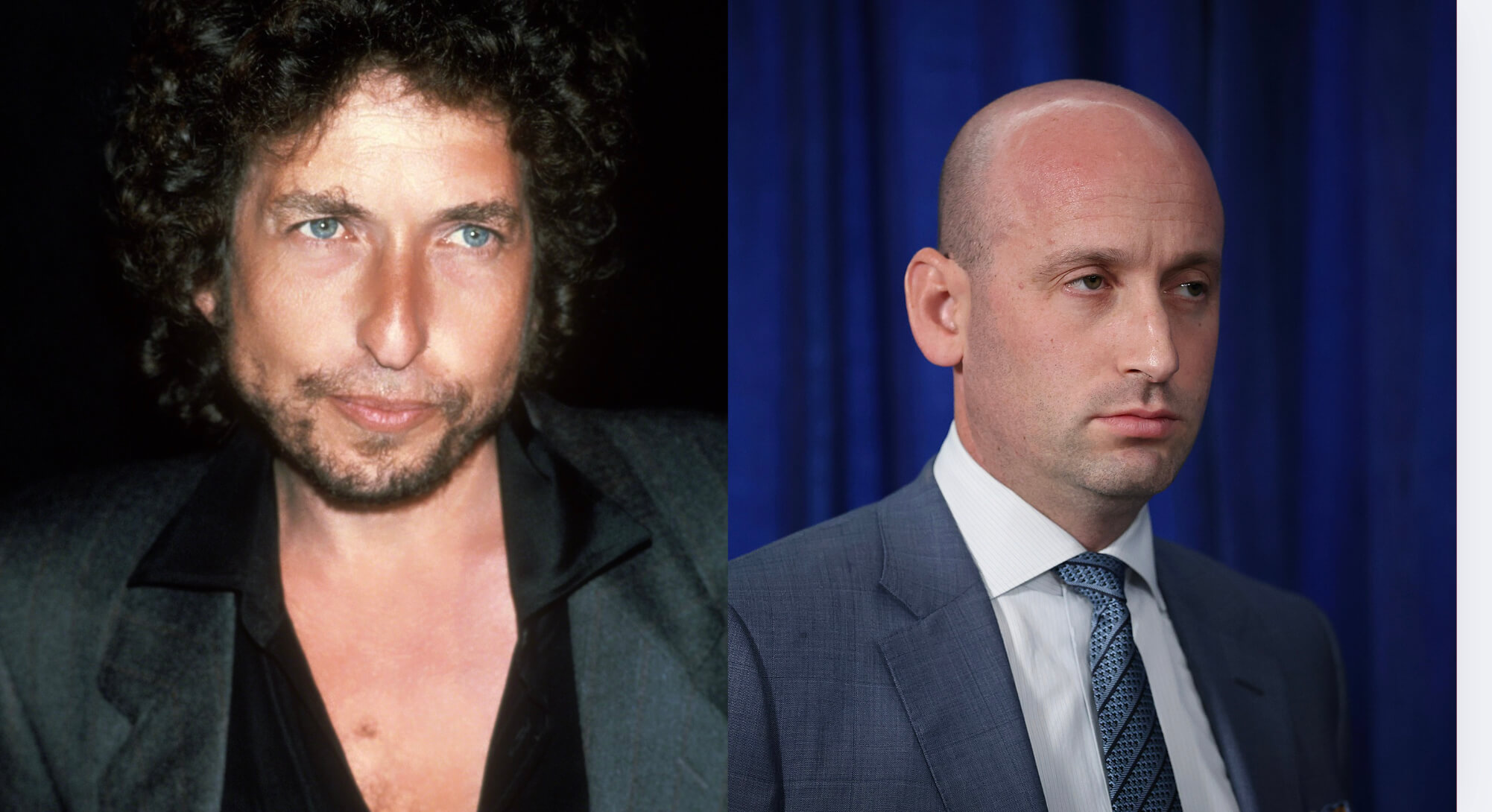
Lyrics from Bob Dylan’s 1983 album ‘Infidels’ seem to anticipate Stephen Miller’s strongman philosophy regarding Greenland. Photo by Getty Images
Is Stephen Miller a closeted Bob Dylan fan?
The question arose the other day when Miller, defending talk of a possible U.S. takeover of Greenland, said, “We live in a world, in the real world … that is governed by strength, that is governed by force, that is governed by power. These are the iron laws of the world since the beginning of time.”
While not an exact quotation, some Dylanologists hear echoes of an obscure 1983 Dylan song in the White House deputy chief of staff for policy’s remarks. In “Union Sundown,” from Dylan’s album Infidels, the Nobel Prize-winning song-poet sang:
Democracy don’t rule the world
You’d better get that in your head
This world is ruled by violence
But I guess that’s better left unsaid.
Miller’s statement shares something of a worldview with Dylan’s, albeit in a twisted way that misrepresents Dylan’s remarks. Relistening to “Union Sundown” and the rest of the songs on Infidels over 40 years after their initial release, one is struck by how Dylan’s lyrics are drenched with irony and sarcasm. You can hear it in “Man of Peace,” wherein Dylan sings:
Look out your window, baby, there’s a scene you’d like to catch
The band is playing “Dixie,” a man got his hand outstretched
Could be the Führer
Could be the local priest
You know sometimes Satan comes as a man of peace.
And the sarcasm verily drips off every line of the song “Neighborhood Bully,” a thinly veiled recounting of the entirety of Jewish history in an attempt to explain and justify Zionism, without ever using the words “Jews” or “Israel.” Dylan sings:
The neighborhood bully just lives to survive
He’s criticized and condemned for being alive
He’s not supposed to fight back, he’s supposed to have thick skin
He’s supposed to lay down and die when his door is kicked in.
The album Infidels includes a photograph of Dylan crouching down on a hillside overlooking the walled city of Jerusalem on its inner sleeve.
If Miller missed the irony in Dylan’s lyrics, he is not the first to do so. The right-wing ideologue is in good company with the erstwhile Village Voice. In its review of Infidels, the left-wing weekly called Dylan “the William F. Buckley of rock and roll,” presumably based on Dylan’s pro-Israel stance, but more significantly based on a wholesale misreading of “Union Sundown,” in which Dylan sings:
Well, it’s sundown on the union
And what’s made in the U.S.A.
Sure was a good idea
’Til greed got in the way.
The Voice and others at the time heard this as a condemnation of labor unions, when in fact the song takes to task the corporations that moved factories and jobs overseas in order to bypass the growing power of unionized workers in America. The “greed [that] got in the way” refers to the companies that exported American manufacturing abroad, as Dylan makes clear in this verse:
You know, capitalism is above the law
It say, “It don’t count ’less it sells”
When it costs too much to build it at home
You just build it cheaper someplace else.
Taking a fresh listen to the entirety of Infidels, one is struck by how many phrases and lyrics resonate strongly today, suggesting that Dylan was in full prophetic mode when he wrote and recorded these songs. The opening track, “Jokerman,” portrays an evil leader:
You’re a man of the mountains, you can walk on the clouds
Manipulator of crowds, you’re a dream twister
You’re going to Sodom and Gomorrah
But what do you care?
The song also indicts “false-hearted judges dying in the webs that they spin,” a line redolent of today’s politicization of the federal judiciary and the Supreme Court. Some have interpreted the next line — “Only a matter of time ’til night comes steppin’ in” — as a reference to Elie Wiesel’s Holocaust memoir, Night — in other words, as a foreboding prediction of the resurfacing of fascism and Nazism.
Even in “Sweetheart Like You,” ostensibly a love song, Dylan sings:
They say that patriotism is the last refuge
To which a scoundrel clings
Steal a little and they throw you in jail
Steal a lot and they make you king.
Today, in an era when the U.S. president is a convicted felon who openly fantasizes about overthrowing democracy and crowning himself king, that verse reads more like fortune-telling rather than a work of imagination.
Likewise, in the song “License to Kill,” Dylan predicts the ascension of the ultimate petulant narcissist:
Now he worships at an altar of a stagnant pool
And when he sees his reflection, he’s fulfilled
Oh, man is opposed to fair play
He wants it all and he wants it his way.
Stephen Miller was not even born yet when Infidels was first released. That would happen two years later, when Miller was born in Santa Monica, California – just 20 minutes down the Pacific Coast Highway from Bob Dylan’s home in Malibu.
But it’s certainly possible that Miller heard Dylan’s album at some point in his life. It’s also possible that he so totally missed the irony and sarcasm running through the album that he found inspiration in Infidels for Project 2025, the Heritage Foundation’s blueprint for the current presidential administration. If so, Miller ought to take another look at the album, beginning with a long meditation on its title.
But I guess that’s better left unsaid….
This is a moment of great uncertainty. Here’s what you can do about it.
We hope you appreciated this article. Before you go, we’d like to ask you to please support the Forward’s independent Jewish news this Passover. All donations are being matched by the Forward Board - up to $100,000.
This is a moment of great uncertainty for the news media, for the Jewish people, and for our sacred democracy. It is a time of confusion and declining trust in public institutions. An era in which we need humans to report facts, conduct investigations that hold power to account, tell stories that matter and share honest discourse on all that divides us.
With no paywall or subscriptions, the Forward is entirely supported by readers like you. Every dollar you give this Passover is invested in the future of the Forward — and telling the American Jewish story fully and fairly.
The Forward doesn’t rely on funding from institutions like governments or your local Jewish federation. There are thousands of readers like you who give us $18 or $36 or $100 each month or year.
Support our mission to tell the Jewish story fully and fairly.