What will become of the Dutch farm school that saved my father from the Nazis?
A plan to create housing and a new memorial center on the site of Holland’s ‘Werkdorp Wieringermeer’ is drawing mixed reviews
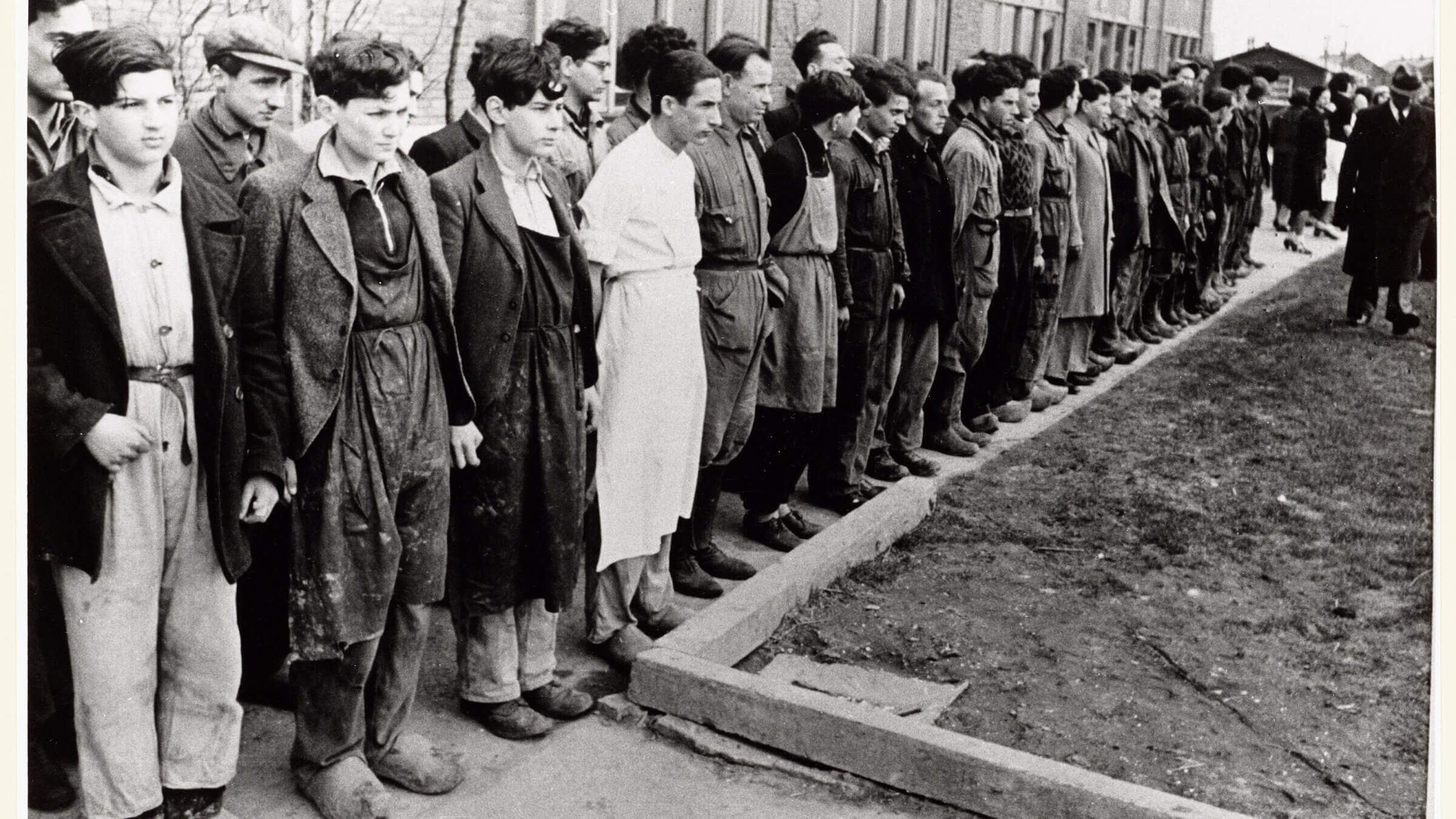
Students lined up at the Werkdorp Wieringermeer in North Holland. Courtesy of Collection Regional Archives Alkmaar
In North Holland, a grand community house rises above neighboring farms. Built in 1936 by students of Werkdorp Wieringermeer (Werkdorp means “work village”; Wieringermeer was the name of the township), the building held the dining room and classrooms of a Jewish farm school. A stunning example of Amsterdam School architecture, the Werkdorp’s brick and cobalt-blue facade dominates the polder, or land claimed from the sea.
Today, the land grows tulips. Nearby, Slootdorp (“Ditch Village”) honors the canals that carry the water away.
In 1939, the school sheltered 300 German-speaking Jewish students, including this reporter’s father, who arrived, his head shaved, on Jan. 4, from Buchenwald.
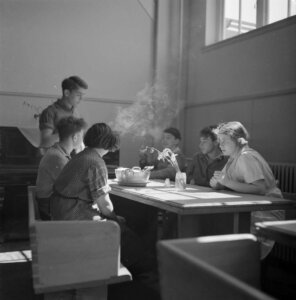
Why a Jewish farm school? In the 1930s, most young German and Austrian Jews were city dwellers and had no idea how to milk a cow, raise chickens, or plow land. But as the Nazis barred Jews from education and professions, farm laborers were the immigrants most wanted by the handful of countries accepting Jewish refugees.
Some 30 such training schools were established in Germany, modeled on the hachsharah throughout Europe that taught Jewish youth the skills to settle in what was then Palestine. The Werkdorp, the largest in Holland, was non-Zionist. Its objective was to send young farmers to any country that would take them.
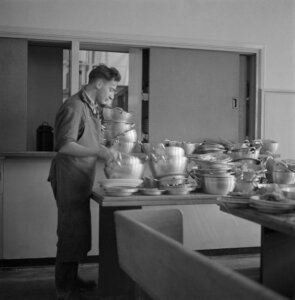
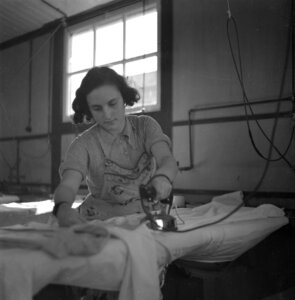
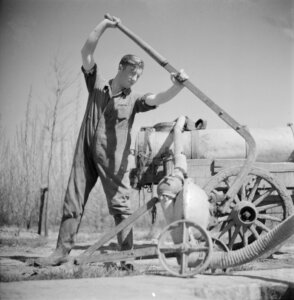
Today, volunteers have assembled a grassroots museum that showcases the Werkdorp’s years, 1934 to 1941. Pinned to the walls inside are pictures taken by the Russian-American photographer Roman Vishniac, who visited in 1938, and by the Dutch photojournalist Willem van de Poll. They show students haying, plowing, feeding chickens, baking bread.
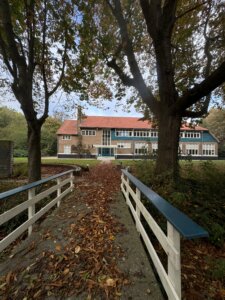
Also on the walls are images of the nearly 200 Werkdorpers who were not as lucky as my father. The Nazi official Klaus Barbie — who became known as the “Butcher of Lyon” for his harsh treatment of resistance fighters there — rounded up the Werkdorpers in 1941 and sent them east to concentration camps, where they were murdered.
A scroll of those victims’ names hangs near the entrance. In the huge kitchen, you can still see the kosher sinks, one tiled red and white for dishes for meat, the other black and white for dairy. Otherwise, the three floors of the great hall stand largely empty.
Protected from demolition by the Netherlands Agency for Cultural Heritage, the community house and its land have been owned since 2008 by Joep Karel who runs a private real estate company that builds housing. Karel pays for the building’s upkeep and opens it to cultural groups and schools.
But the developer has a grander plan. He wants to create a modern memorial center that tells the story of the Werkdorpers and the polder. To fund his venture, he would erect housing behind the community house, to be rented by migrant workers. In April 2020, the council of Hollands Kroon — the Crown of Holland, as the township is called today — approved such housing for 160 workers.
The organizers of the museum are uncertain: Will the project enhance their efforts, or thwart them?
A hero or a collaborator?
North Holland juts like the thumb of a right mitten into the North Sea. A decade before the community house was inaugurated in January 1937, the land beneath it was seabed. The first students, 11 boys and four girls, arrived in 1934 to live in barracks that had housed the polder’s builders. Their task: to build a school.
The farm school admitted refugees for a two-year course. Its purpose was to help them emigrate, the only way The Hague would allow the school to function. Residents spoke German; there was no need to learn the language of one’s temporary home.
Gertrude van Tijn, a leader of the Dutch Jewish refugees committee — tasked with finding countries that would accept thousands of Germans and Austrians forced to flee the Nazis — handled admissions. Most of the Werkdorp’s budget came from Dutch Jewish donors, with contributions from Jewish groups in Britain and America. Students’ families paid fees if they could.
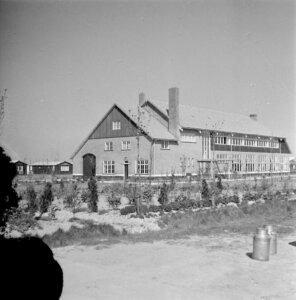
The school was internationally recognized. James G. McDonald, the American high commissioner for refugees of the League of Nations, attended its opening ceremony. The legal scholar Norman Bentwich praised the village in The Manchester Guardian. Although the school was non-Zionist, Henrietta Szold, a leader of Youth Aliyah, brought 20 German teenagers there in 1936.
Werkdorp Wierengermeer helped at least 500 German and Austrian Jews, ages 15-25, escape the Nazi regime.
It was Van Tijn, a German Jew who’d married a Dutchman, who got my father, George Landecker, out of Buchenwald. He had been arrested in Frankfurt on Kristallnacht, the November 1938 pogrom, and sent east by train to Buchenwald.
In the camp he met his friends and teachers from Gross Breesen, a farm school in eastern Germany, from which he had graduated that May. Breesen was the Werkdorp’s sister farm school. By admitting the Breeseners and my father to the Werkdorp, Van Tijn got Dutch entry permits for all.
For the Gestapo in January 1939, such proof that a prisoner could leave Germany secured freedom.
Van Tijn saved thousands of young people like my father, but she worked with the Nazis to do so. After the war, historians and people seeking to repatriate Dutch Jews called her a collaborator. She moved to the United States and wrote a memoir, in which she criticized other Jewish leaders for their decisions under German rule. According to her biographer Bernard Wasserstein, she never published the memoir because she didn’t want to make money from describing the atrocities she had seen.
When my father arrived in 1939, the Werkdorpers were cultivating 150 acres — there was wheat, oats, rye, barley, and sugar beets for the animals: 60 cows, 40 sheep, and 12 workhorses. The residents raised chickens, grew vegetables, and baked their own bread. The school taught carpentry, welding and plumbing, skills I would see my father use, not always deftly, later as a dairy farmer in New York state. (Dad was a good farmer, but he was less than expert in all the other skills a farmer needs.)
My father got a visa to America and left Rotterdam on the steamship Veendam, arriving in New York on Feb. 5, 1940. Three months later, the Nazis invaded Holland, cutting off all routes of escape.
‘Their names should be spoken’
Over the decades, Wieringer residents have found ways to commemorate the residents who died.
Marieke Roos, then a board member of the Jewish Work Village Foundation, proposed a monument of their names. She raised funds and recruited volunteers. Completed in 2021, the memorial comprises 197 glass blocks embedded in a semicircle at the building’s gateway. They mirror the layout of the dorms, now long gone, which once embraced the rear of the community house. Each block commemorates a student, teacher, or family member deported and murdered. One honors Frits Ino de Vries (1939–43), killed at Auschwitz with his mother and sister, Mia Sara, who was 5.
Corien Hielkema, also from the foundation, teaches local middle schoolers about the Werkdorpers’ fate. Each student creates a poem, painting, or website about a Werkdorper because “their names should be spoken and their stories told,” she told me.
Rent from migrant workers may sound like an unusual way to fund a memorial center. But in Joep Karel’s plan, such housing would be built behind the community house, and would be reminiscent of the dormitories where my father lived. Hollands Kroon’s biggest exports are flowers, cultivated by workers from the eastern EU. The region desperately needs housing for these temporary workers. In 2024, the province gave Karel 115,000 Euros to start the project.
Joël Cahen, who chairs the fundraising for Karel’s Jewish Work Village Cultural Center, says that attracting tourists here won’t be easy — it’s a 45-minute drive from Amsterdam, “along a boring road,” he said. Nevertheless, he said he thinks Karel’s idea will work, though “it will take time.”
Some neighbors objected to housing migrant workers, Cahen said. They feared noise pollution, traffic and drugs. Months of legal delay produced a court decision in Karel’s favor, but by then construction costs had skyrocketed.
Now, Cahen said, Karel needs an investor. The developer did not answer a question about how that search is going, except to say, via Cahen, that he would break ground “as soon as possible.” Roos says she has been hearing “soon” for years.
And if the housing were to be completed and the workers arrived, where would they hang their laundry, store their recycling, hide their trash? It would be hard to hide the chaff of daily living on the site’s four acres. Who would visit such a memorial center, and how would the owner keep it running?
Those are legitimate questions, Cahen said. But “we need people to help us push this thing forward. This is a chance.”
Kees Ribbens, a senior researcher at the NIOD Institute for War, Holocaust and Genocide Studies, in Amsterdam, told me that the community house has no “comparable examples in the Netherlands.” It is a “special building,” and a memorial center “would be appropriate.”
Most of the agricultural training centers that saved German Jewish youth have been destroyed or reused. The director’s house of a farm school in Ahlem, Germany, is now a museum. But it became the local Gestapo headquarters, so it also tells that story. The Ahlem school buildings are gone. Gross Breesen, now in Poland, is a fancy golf spa.
The Werkdorp is one of a very few farm schools in Europe whose original building is dedicated to its history.
What my father did and didn’t tell me
My father talked a lot about his first farm school, Breesen. Survivors from Breesen, in America and around the world, remained his closest friends.
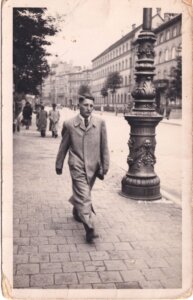
Yet he mentioned his time in the Netherlands only once. My mother had served a Dutch cheese to some guests. Dad told us how he’d been hitchhiking in Holland with a friend, when a truck carrying Edam cheeses had picked them up. They rode in the truckbed, hungry, surrounded by giant cheese wheels.
It was such a slim memory. I assumed he had lived in Holland for a few weeks. I learned only recently that Werkdorp Wieringermeer had protected him from January 1939 until February 1940.
Now I think my father didn’t want to remember his Dutch year. Because like refugees today, everywhere, he was terrified.
Dad once told an interviewer how he’d read a memoir by a man who was arrested on Kristallnacht and transported by train to Buchenwald. My father realized, “That’s me. I did that too.” He had no memory of actually doing it at all.
The brain is good at shielding us from trauma. His year at Werkdorp Wieringermeer may have been like his train ride after Kristallnacht, a time he needed to forget. He was worrying about his parents and siblings, who would not escape Germany until November. (One brother, his wife, and toddler would not survive the war.) He was anxious about the U.S. visa the Breeseners had applied for as a group (they circumvented the American quota on Germans, another story). He had been forced to watch people hanged at Buchenwald for trying to escape.
Yet my father was an optimist when I knew him, and never dwelled on suffering. And I never thought, “I should ask about his experience in the Holocaust because I will want to write about it one day.”
So the only thing I knew about his experience in the Netherlands was that he’d hitched a ride in a truck full of cheese.
An hour’s drive beyond the Werkdorp from Amsterdam, there’s a memorial to the 102,000 people deported from the transit Kamp Westerbork and murdered during the Second World War. It draws 150,000 visitors annually. Cahen hopes the Werkdorp could attract 10,000.
Like Westerbork, the Werkdorp was a transit point — but with a key difference: Many of its residents were saved.
As the daughter of one of them, I hope the tension over the future of its community house will ease, and that someone will make a grand memorial center flourish there.