How I learned to laugh at neo-Nazis
‘One Battle After Another’ was a refreshing satire of white nationalism in a world of didactic lectures
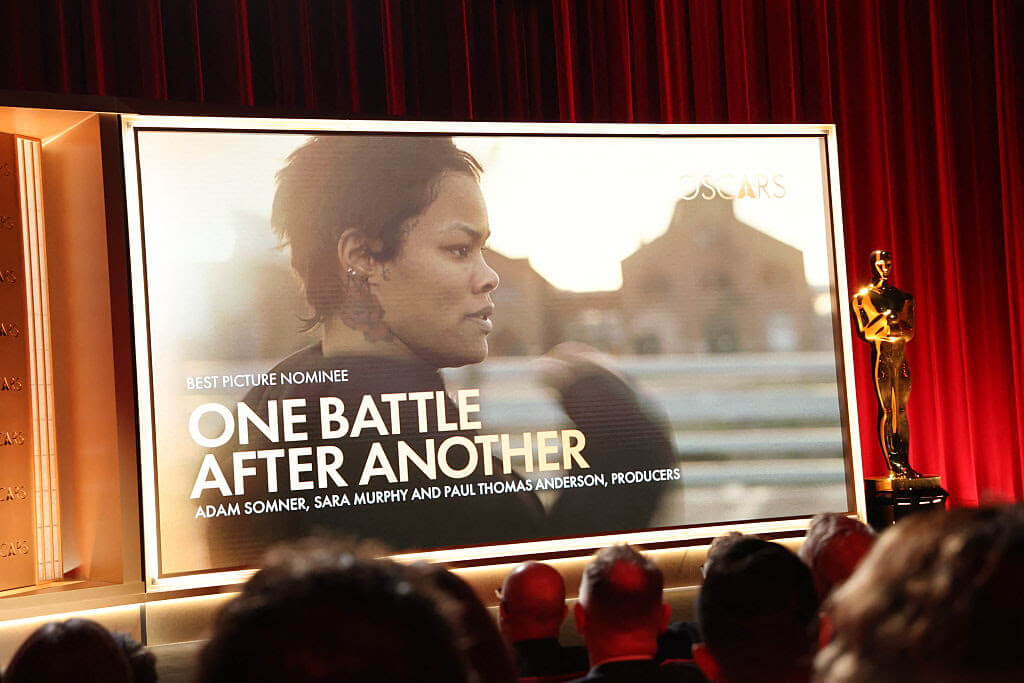
The nominee for best picture One Battle After Another during the 98th Academy Awards nominations announcement. Photo by Valerie Macon/AFP via Getty Images

By Mira Fox January 23, 2026
I write about a lot of Jewish movies and TV across a big range — shows that examine different valences of Jewish identity, like Long Story Short, or that explore Hasidic life, like Shtisel. But there’s one common genre that ticks me off: the dire warning.
This is a common form of Jewishly inflected media that crosses my desk. Maybe it’s a Holocaust movie or TV show. Maybe it’s about modern antisemitism. Maybe it’s about neo-Nazis. But the intent of all of them is clear, namely, to warn the public about the rise of extremist ideology. “We should all be very worried!” they scream at the audiences. “Nazis are everywhere!”
In Nuremberg, characters observe, in serious tones, that even seemingly normal people can be capable of great evil. Americans, they say, should watch out lest the German hatred arrive on their shores. In shows like A Little Light, about Miep Gies’ heroism in hiding the Frank family, the obvious message is about how everyday people must step up to fight evil Nazis. It’s all painfully heavy-handed.
I agree: We should learn from history, and we should be on alert for rising antisemitism. But this message also gets old. We grow numb to it. If the most effective way to prevent the return of fascism or Nazism was simply telling people “Nazi bad!” then there would never be any issue.
That’s why I was so fascinated when I finally watched One Battle After Another, after it won best picture at the Golden Globes and got a slew of Oscar nominations. Much of the movie is in fact a satire of Christian nationalism and its connection to Nazi ideology. And that satirical lens gives it a sharper, and more compelling, take than most of the movies on that topic I’ve covered.
The movie opens with the French 75, a leftist group whose exact commitments are hazy beyond a vague stance for immigration and against The Man. After some political actions — freeing immigrants at a detention center while whooping “Viva la revolución!” — they end up disbanding when a raid goes wrong. The movie picks back up years later with former French 75 explosives expert Pat (DiCaprio) and his now-teenage daughter Charlene (Chase Infiniti), who are living under the assumed identities of Bob and Willa, fearing that an old agent of The Man, Colonel Steven Lockjaw — played to perfection by Sean Penn at his most blusteringly punctilious — might be after them.

As it turns out, he is. See, Lockjaw is trying to join the Christmas Adventurers Club, a group of elite white supremacists and Christian nationalists — each member seems to be part of the billionaire class — dedicated to making the world “safe and pure.” Part of the interview process for Lockjaw involves swearing that he is “American-born by gentile” and never had an interracial relationship. But he has — he had an affair with Willa’s mother, a Black revolutionary member of the French 75. He suspects Willa may be his daughter, not Bob’s, and if she is, she could give away Lockjaw’s past sins to the Christmas Adventurers Club, who already suspect him of being “soft” in his “duty to racial purification.”
Much of the rest of the movie is a slapstick, absurdist chase. Bob, who has spent the last decade smoking weed and impotently lecturing his daughter, barely remembers his days as Pat the explosives expert. He can’t keep up with the new generation of activists, faceplanting into an alley when he tries to join three teens doing parkour across rooftops.
There’s a lot going on — examinations of masculinity in the military industrial complex, ego and political idealism, aging and activism. And, of course, the Christian nationalism and genteel racism woven into our elite institutions.
But One Battle After Another does not make a didactic parallel to the Christian nationalists in our current government; we don’t see a character, for example, brushing off praise for Hitler, as JD Vance did, or pleading for Norway to send us immigrants instead of “shithole countries” like Somalia, as Donald Trump just did. Instead, the Christmas Adventurers Club is simultaneously dizzyingly malevolent and completely ludicrous. Their solemn greeting is “All hail Saint Nick.” A motherly figure offers banana pancakes to members as they march off to their clubhouse, as though they’re going to an adult Boy Scouts meeting, not planning a murder. The secret knock to their underground bunker is tapped to the rhythm of “Jingle Bells.” Their statement of belief feels both true to the core of white supremacy, and completely, obviously unhinged: Members of the club are, they say, “superior to other human beings.”
The power of a movie or a book is that it lets someone explore and inhabit ideas through the story and characters. If you’re so worried that an audience will miss the intended message that you rush to tell them what it is, you end up preventing them from having the chance to really understand what the work is saying, or consider the questions it’s posing and come to their own conclusions. It rushes viewers to the finish line without giving them a chance to engage with the art.
It was a relief to watch One Battle After Another skewer the extremism of its villains, making them palpably freakish instead of just menacingly evil. It’s more effective to undermine an ideology by making it laughably strange than by scolding anyone who dares to agree with it.
Still, in case you missed the idea that the Christmas Adventurers were neo-Nazis, the end of the movie makes it pretty hard to miss. (Here’s your spoiler alert.) Lockjaw is told he has finally gotten approval to join the club, and is given a corner office. As he kicks his feet up on the desk and proudly leans back in his chair, a hissing noise begins; in fact, the club found out about his crime of interracial sin, and, like any good Nazis, they’re gassing him for it.
After all, there’s really no winning with Nazis.