A new exhibit honors writer Lore Segal, a child survivor and lifelong skeptic of easy truths
‘And That’s True Too’ traces the New Yorker writer’s arc from Kindertransport to Manhattan, where she dazzled with her novels, short stories and children’s books
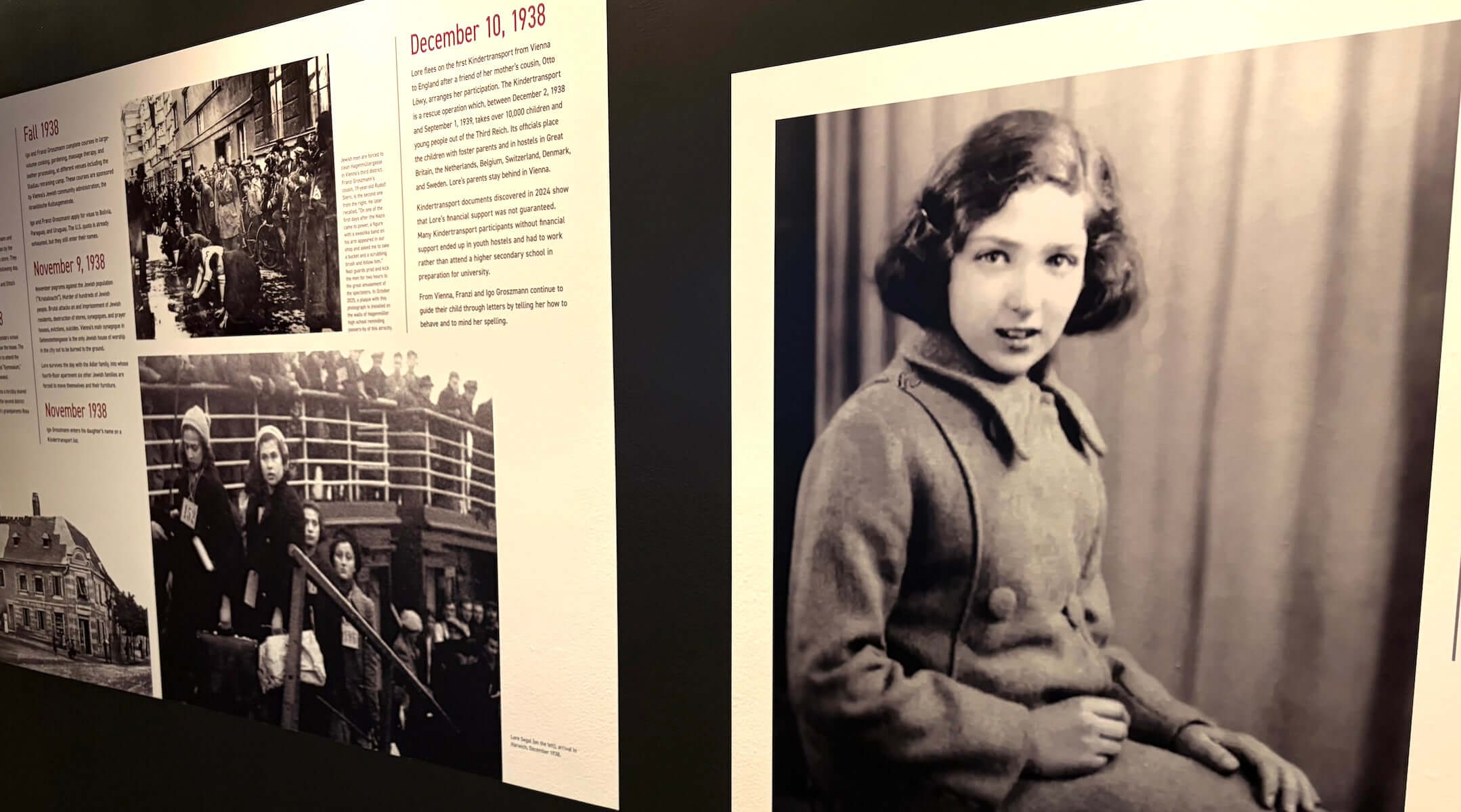
At right, a 1939 studio portrait arranged by Segal’s Liverpool foster mother is featured in the exhibit “And That’s True Too: The Life and Work of Lore Segal” at the Center for Jewish History in Manhattan. (JTA Photo)
By Andrew Silow-Carroll January 26, 2026
(JTA) — I’ve never read a Holocaust chronicle quite like Lore Segal’s autobiographical 1964 novel, “Other People’s Houses.” Mordant, unsentimental and sometimes painfully honest, it’s the story of an Austrian girl sent to England on the Kindertransport, as well as a portrait of the artist as a young refugee.
More than one of her legions of admirers have noted that Segal, who died in 2024 at the age of 96, was only one year younger than Anne Frank, and grew up to become the kind of writer Anne too might have become had she not died in Bergen-Belsen.
Segal’s work, which includes decades of stories in The New Yorker as well as a delightful children’s book, “Tell Me a Mitzi,” is also remarkable in its humility. Segal was adamant that memory — especially of traumatic events like the Holocaust — cannot be a perfect repository of truth. It’s not that authors couldn’t be trusted, but that neither the writer nor the reader should take anything for granted.
That challenge is captured in the title of a new exhibit mounted by the Leo Baeck Institute in New York: “And That’s True Too: The Life and Work of Lore Segal.” The title is a quote from “King Lear,” a favorite of Segal’s and a reminder to hold opposing truths in the same sentence, of resisting the false comfort of a single, final version.
“We tried to give you an insight into Laura’s ability to look at the world from many angles,” Karin Hanta, the exhibit’s curator, said at the exhibit’s opening on Thursday, just days before International Holocaust Remembrance Day.
At the event, actress Toni Kalem, who played Angie Bonpensiero on “The Sopranos,” read an excerpt from “Other People’s Houses.” Kalem, who met Segal years ago and discovered that their mothers shared the experience of the Kindertransport, spoke of Segal’s “unbridled curiosity” — a quality that runs through the display of photographs, manuscripts and family keepsakes.
Lore (pronounced “Laura”) Groszmann was born in Vienna in 1928; one month after the Nazi pogrom on Kristallnacht, she was sent to England and raised in a series of foster homes (her refugee parents would eventually arrive and find work as domestics). Later she would join her family in the Dominican Republic, and they eventually found refuge in Washington Heights, the Manhattan redoubt for German-speaking Jews. After she established herself as a writer, she became part of a circle of mostly Jewish writers in New York, including Cynthia Ozick, Vivan Gornick, Grace Paley, Norma Rosen and Gloria Goldreich. Her husband, book editor David Segal, was 40 when he died in 1970.
Hanta had hoped to write a biography of Segal, but when that project stalled, she pivoted. “With all the materials I had gathered,” she recalled at the opening, “why not stage an exhibition?”
The first iteration, mounted in Vienna’s Bezirksmuseum Josefstadt — located in the district where Segal grew up, and, as Hanta later discovered, near the hospital where she was born — drew thousands of visitors. The New York version, expanded and sharpened, shifts the focus westward, tracing Segal’s journey from prewar Vienna to Manhattan, where she lived for decades, taught generations of writers, and, according to the New York Times, came “closer than anyone to writing the Great American Novel.”
That novel, “Her First American,” appeared in 1985 and explored the uneasy intersection of race and Holocaust history through the relationship of a Jewish refugee and a Black intellectual. (LBI has scheduled an online event about Horace Cayton, Segal’s real-life lover and the inspiration for the novel.) “Other People’s Houses,” her first book, earned Segal a Guggenheim Fellowship, and her short-story collection “Shakespeare’s Kitchen” (2007) became a Pulitzer Prize finalist. All three books will be reissued in the spring of 2026 by the New Press, while Melville House is publishing a posthumous collection, “Still Talking.” Introduced by Gornick, it features the linked “Ladies’ Lunch” stories she wrote late in her career, about elderly Manhattan friends dealing frankly and often hilariously with the daily indignities of growing old.
The exhibit at the Center for Jewish History, where LBI catalogues the history and culture of German-speaking Jews, includes notebooks from Bedford College in London, where Segal studied after the war, filled with short stories entered into competitions. There are manuscripts marked and re-marked in a hand that never stopped revising. There are address books kept by her parents — one from England, one from the Dominican Republic — opened to pages that quietly testify to vanished worlds: cousins who hid behind kitchen curtains in France, friends who assumed false identities, children who never made it onto the trains.
One small object carries particular weight: a childhood friendship book, the sort in which relatives and friends inscribe poems and well-intentioned advice. Segal’s includes an entry from her first English foster mother, urging her to cherish friendship — advice that reads differently if you know, as Segal later wrote, that their relationship was fraught. Her father’s contribution, a drawing of a boy hiking in the mountains, echoes a story Segal drafted as a young woman about a prewar hike in the Alps with him. She revised that story at 90 and retitled it “Dandelion.” The New Yorker published it in 2019, 70 years after its first draft.
The exhibition is accompanied by a season of in-person and virtual programs, and Hanta has her own wish list of commemorative projects: She hopes that a park in Vienna where Segal played as a child might be renamed in her honor; that the exhibition might travel; that “Other People’s Houses” might be distributed free in Austria in 2028, the centenary of Segal’s birth and the 90th anniversary of the Kindertransport.
On opening night, before reading from “Other People’s Houses,” Kalem paused to apologize for the necessary cuts she made. “As you know, all her life, Lore was a master of meticulously crafting and scrupulously revising her work,” said Kalem. “So it feels like literary malfeasance on my part to attempt to edit a word of Lore’s story. It feels akin to cutting Shakespeare by shortening Hamlet’s soliloquy…. So Lore, I hope you understand and I hope you will forgive me.”
The exhibition also includes a video produced by Hanta and Segal’s grandson, Benny, which captures Segal late in life, still circling her subjects, still attentive to the elusiveness of truth. At the opening, Segal’s son Jacob spoke of his mother’s ambition and her modesty, her seriousness about art and her refusal to be undone by success or disappointment.
“She always made the world larger,” he said. “It’s smaller now.”
“And That’s True Too: The Life and Work of Lore Segal” runs through April 15 at the Center for Jewish History, 15 W. 16th St., New York, New York.
This is a moment of great uncertainty. Here’s what you can do about it.
We hope you appreciated this article. Before you go, we’d like to ask you to please support the Forward’s independent Jewish news this Passover. All donations are being matched by the Forward Board - up to $100,000.
This is a moment of great uncertainty for the news media, for the Jewish people, and for our sacred democracy. It is a time of confusion and declining trust in public institutions. An era in which we need humans to report facts, conduct investigations that hold power to account, tell stories that matter and share honest discourse on all that divides us.
With no paywall or subscriptions, the Forward is entirely supported by readers like you. Every dollar you give this Passover is invested in the future of the Forward — and telling the American Jewish story fully and fairly.
The Forward doesn’t rely on funding from institutions like governments or your local Jewish federation. There are thousands of readers like you who give us $18 or $36 or $100 each month or year.
Support our mission to tell the Jewish story fully and fairly.