This initiative is helping Israeli war survivors heal through art — and is making therapy cool
The 8 Project brings survivors to LA and NYC for an unconventional, art-based method for processing trauma
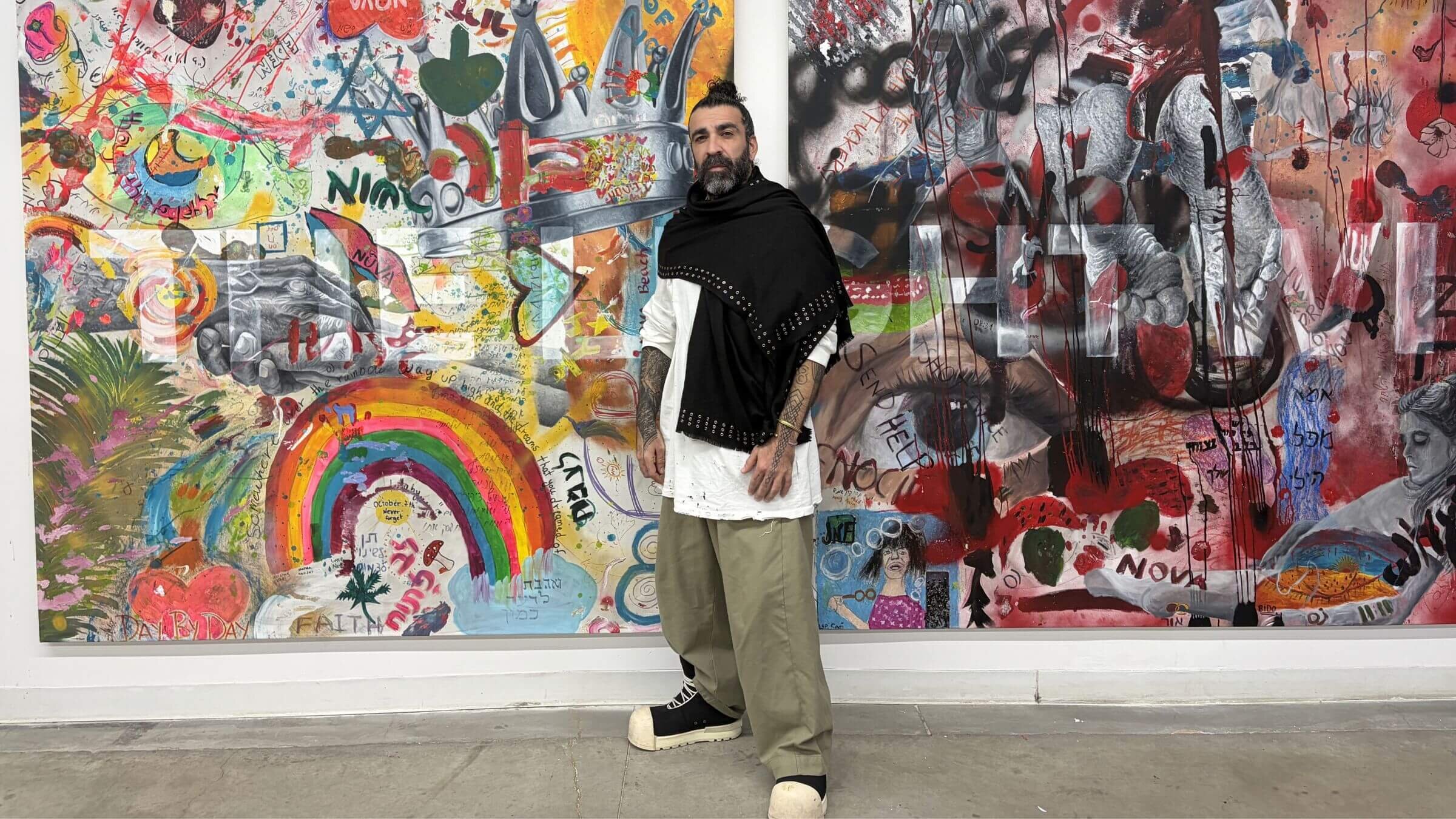
8 Project Founder, Tomer Peretz, stands in front of an art piece created by Oct. 7 survivors at his NYC gallery. Photo by Simone Saidmehr
By Simone Saidmehr March 16, 2026
Tomer Peretz opened the door to his unassuming gallery in Chelsea, draped in a studded black shawl and sporting cartoonishly large — but very cool — sneakers. It was the day after the biggest snowstorm in recent NYC history, and the shoes were, of course, the most practical option for an LA-based Israeli with limited snow experience.
The 8 Project gallery opened in New York this winter, but it is only one piece of a larger initiative. The program, founded by Peretz, brings Oct. 7 survivors, bereaved siblings, Israeli soldiers coping with PTSD, and others affected by the war to Los Angeles for a two-month therapeutic art residency. Participants spend hours each day creating art while also undergoing therapy and mentorship. Now, Peretz has brought the residency program and its accompanying art gallery, which is open only for private events, to New York City.
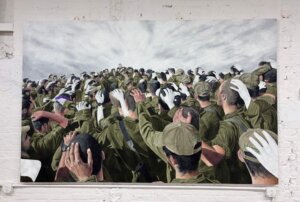
Upon entering the 8 Project gallery in downtown Manhattan, the first painting one is greeted with is Peretz’s own, a group of Israeli soldiers huddled together, accompanied by the spirits of their fallen comrades, represented by icy-white hands painted on the heads of the living. In a city where torn-down hostage posters became almost a fixture of the streets during the Gaza war, the gallery feels both out of place and deeply intentional.
Peretz receives applicants for his therapeutic residency program through rehabilitation hospitals in Israel and via social media. The only real requirement, he said, is a passion for art.
“They don’t have to have technical skills,” he told me. “Art is our toolbox to get through their soul. If they can sit every day and create, they’re already qualified.”
“We artists, we think we are so important. But if the work doesn’t do something, it’s just fucking art.”Tomer PeretzIsraeli artist
Peretz flies incoming residents to Los Angeles and covers their living expenses so they can focus entirely on healing.
Peretz was a volunteer with ZAKA, the Israeli humanitarian organization that specializes in recovering human remains after terror attacks. In the immediate aftermath of Oct. 7, he helped identify bodies at the sites of the attacks.
Once he returned to his home in LA, where he had been working as a painter for years, he found he could no longer approach his work in the same way. “I realized that everything I had been doing in my life had no real purpose,” he said. “We artists, we think we are so important. But if the work doesn’t do something, it’s just fucking art.”
He began working with artists informally and gradually developed what would become the 8 Project Residency. “I couldn’t create anything besides creating with people who were affected by the war. I cared about nothing else.”
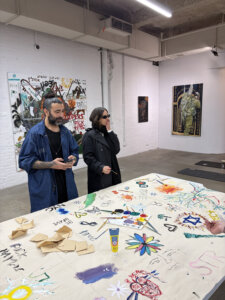
Part of the appeal for residents, he said, is the cool-factor of the program. “People get attracted to cool, fun people.” Unlike traditional therapy — “a boring therapist and psychiatrist in a room,” as he put it — the program offers something different. “We literally brought something completely new, as far as therapy and healing, that is really, really fun.”
Shaked Salton, a former 8 Project resident whose best friend was killed on Oct. 7 and who served as a sergeant in the IDF’s search and rescue unit, told me on Zoom from her new home in LA that she struggled to find motivation after the war. The residency program helped her to find it. “Every day, I needed to wake up in the morning. For someone who’s been through a war, it can be tough.” But in the program, “there is no way you’re not coming to the studio.”
Now, she told me, she’s more connected to her feelings. “I paint better,” she told me. “I came to think more creatively. My brain was blocked.”
Sahar Haba, another former resident who now works as a mentor for the project, also serves as the self-ordained de facto DJ at the gallery. As residents worked on their art in the gallery’s back room, Haba played everything from Billy Joel’s “New York State of Mind” to techno and Israeli Mizrahi music.
Haba served 15 years in the IDF and experienced the death of several of his friends on Oct. 7 and during the war, including American Hersh Goldberg-Polin, whom he met through their shared love for the Israeli soccer team, Hapoel Jerusalem. He adores fashion, evidenced not only by the sneakers and jerseys he has designed, displayed throughout the gallery, but also by his decidedly funky graphic socks.
During his residency, Peretz encouraged him to lead art workshops.
“Most of the time, the healing process is like, ‘Let’s talk about you, what do you need?’” Haba said. “Here I had the chance to do it the opposite way — to be the guide.”
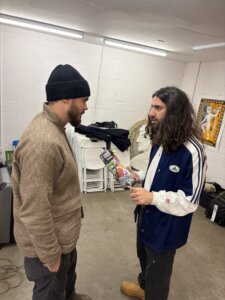
Haba led art workshops for Nova music festival survivors, soldiers, families and couples who were affected by the war.
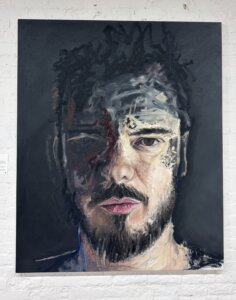
One of the most striking paintings at the 8 Project Gallery is a portrait Peretz painted of Andrei Kozlov, a freed hostage and former 8 Project resident. In the piece, half of Kozlov’s face is incomplete, streaked with black and red contours that suggest the rest of his features.
The painting hung across from where I was conducting interviews that afternoon, so his face had been staring back at me from the gallery wall for much of the day. Unexpectedly, the real Kozlov walked in and introduced himself to me — before joking that I must be interviewing Peretz for a clerk position.
Kozlov became an 8 Project resident a mere five months after he was freed from captivity in Gaza. Now, he lives in New York and spends hours a day working on his art.
Haba showed me a pair of boots he had designed during the war, covered in a collage of hostage posters and featuring a QR code linking to the Bring Them Home website on the tongue of the shoe. He showed his creation to Kozlov, joking that the QR code no longer worked before pulling him into a bear hug.
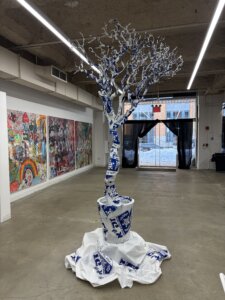
In the center of the gallery stands a giant tree that Peretz explained was sculpted out of the body bags ZAKA used to collect human remains. References to ZAKA appear throughout the exhibit. In a small side room, a video created by resident Kalia Gisele Littman shows ZAKA volunteers sitting in the ruins of the kibbutzim in Israel that were ravaged by the Oct. 7 attacks. The volunteers sat in silence, staring into the camera, resulting in a deeply unsettling film that felt almost too intimate to watch.
Peretz has a self-professed “radical” perspective on healing. “I do not like when therapists or psychiatrists like to dig too much about the past,” he said. “I’m all about shaking the hand of the devil that was with you that day. But once you shake the devil’s hand, OK, let’s move on.”
That’s why the second half of the program is dedicated to helping residents plan for their future. “It’s all about, how do we become hungry to wake up tomorrow morning?” said Peretz. “So if I’m going to speak about the past all day, I will not be hungry to wake up tomorrow.”
That concept is where the 8 Project got its name from. “God created the world in 6 days,” said Peretz. “On the 7th day, we got some rest, and on the 8th day, we started to live.” After residents leave the program, Peretz hopes that they, too, can start to live.
Peretz has remained in touch with all of his past residents. “Some of them are going to school. Some of them are building relationships. Some of them are building a career.” He said all have continued to pursue their passion for art.
The gallery is open for private events, and while staff say they have had several people walk into the gallery who are not connected to Judaism or the war in any way, they are not Peretz’s target audience.
“I like that we’re not open for the public, I don’t think we are for the public,” he said. “I’m not interested to tell my story at all. I don’t want to tell the Jewish story. I’m not trying to get more fans for the Jewish people through this exhibit.”
“I’m not for everyone,” he added. “I care only about my brothers and sisters who created this, and the next people who are gonna create more, and that’s it.”
Still, Peretz believes the project’s presence in New York matters.
“New York needs this more than any other city. I realized that the Jewish people in New York are so traumatized, and they need that connection so badly,” he said. “A lot of us, Jewish people in the diaspora, got lost. We need that connection. We want to get the hug.”
This is a moment of great uncertainty. Here’s what you can do about it.
We hope you appreciated this article. Before you go, we’d like to ask you to please support the Forward’s independent Jewish news this Passover. All donations are being matched by the Forward Board - up to $100,000.
This is a moment of great uncertainty for the news media, for the Jewish people, and for our sacred democracy. It is a time of confusion and declining trust in public institutions. An era in which we need humans to report facts, conduct investigations that hold power to account, tell stories that matter and share honest discourse on all that divides us.
With no paywall or subscriptions, the Forward is entirely supported by readers like you. Every dollar you give this Passover is invested in the future of the Forward — and telling the American Jewish story fully and fairly.
The Forward doesn’t rely on funding from institutions like governments or your local Jewish federation. There are thousands of readers like you who give us $18 or $36 or $100 each month or year.
Support our mission to tell the Jewish story fully and fairly.