It’s getting more dangerous to be a comedian — but was it ever safe?
Jacques Berlinerblau’s new book examines the limits of free speech in an era of ideological contention and internet virality
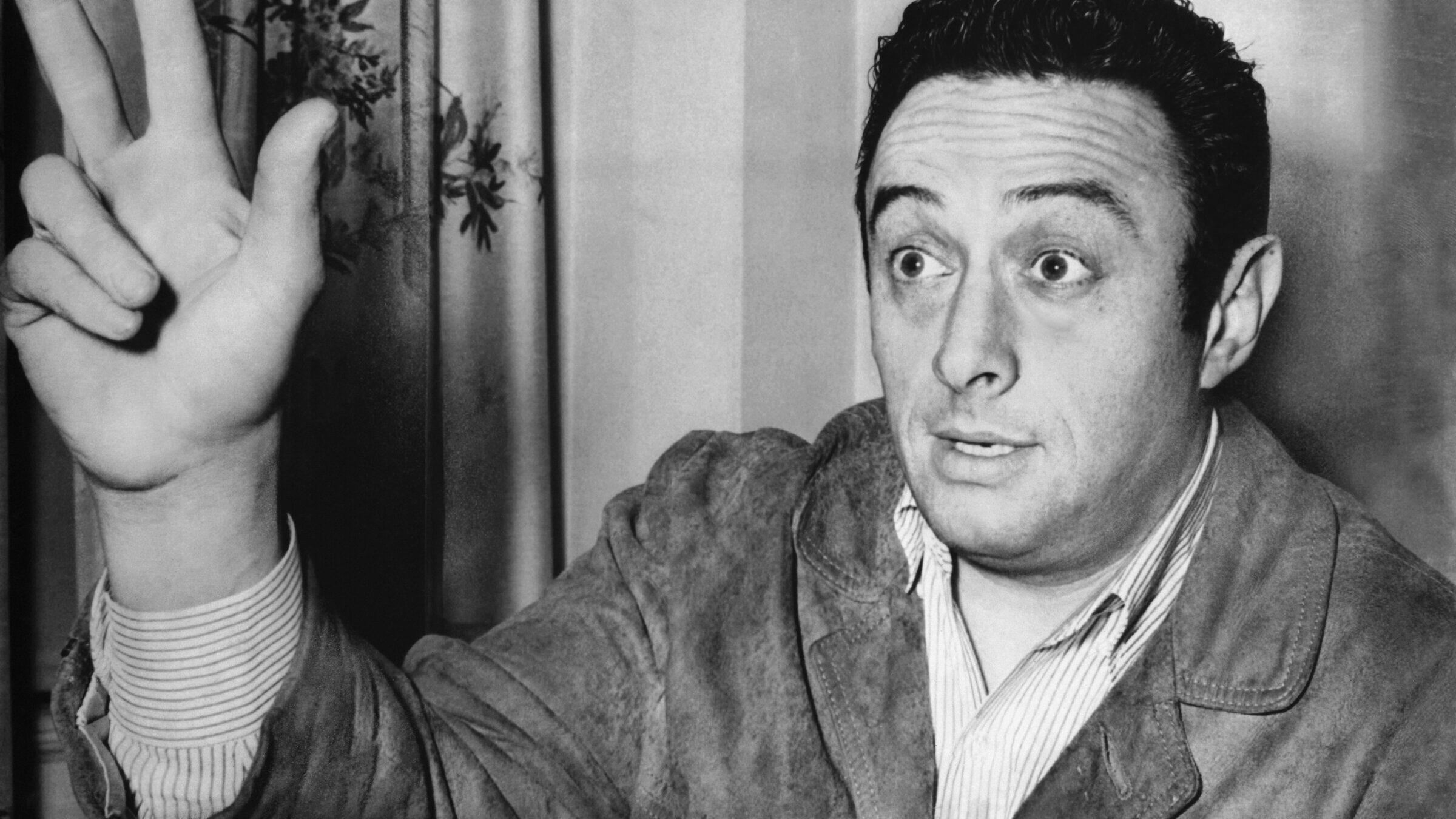
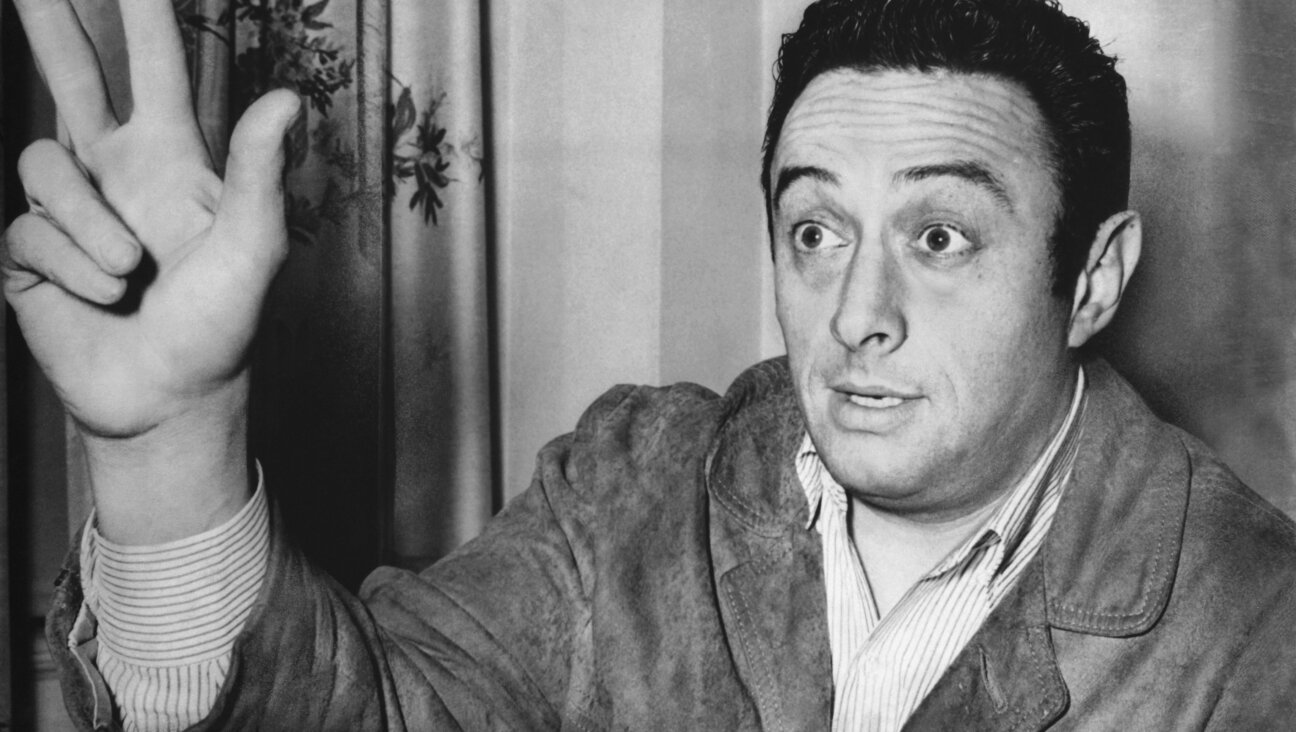
Lenny Bruce, circa 1962. Photo by Underwood Archives/Getty Images

By Julia M. Klein March 23, 2026
Can We Laugh at That?: Comedy in a Conflicted Age
Jacques Berlinerblau
University of California Press, 256 pages, $24.95
Even in these polarized, politically turbulent times, Jacques Berlinerblau argues that the United States still agrees — mostly — on the importance of free speech, in all its complexity and messiness. He calls this the Pre-Digital Free Speech Consensus, and it’s the organizing principle of his attempt at sketching a sociology of comedy in Can We Laugh at That?: Comedy in a Conflicted Age.
Berlinerblau, a chaired professor of Jewish civilization at Georgetown University, describes this agreement as normative rather than legal, overlapping but not strictly identical with legal and constitutional imperatives. He short-hands the concept this way: “The suppression of human political, intellectual, and artistic expression, either by the government or by citizens, should be avoided to the greatest extent possible.”
But this view, never universally held, may be eroding — including in the United States, traditionally its greatest bastion. Berlinerblau, perhaps because of his deadlines, doesn’t cover the Trump administration’s recent assault on late-night comedy. Even so, he worries that the so-called consensus, “noble and highly imperfect, is coming undone.”
Written in clear prose, without much academic pretentiousness, Berlinerblau’s slim volume falls short of a definitive global account of comedic controversies and their aftermath. It offers instead a rudimentary framework for assessing changing norms in an era of ideological contention and internet virality.
It is not easy being a comedian, and now less so than ever. “The disturbing truth,” Berlinerblau writes, “is that humorists the world over are being assailed in all sorts of ways. They are called out and harassed online. They are boycotted and subjected to ‘cancellation.’ They are hounded in the courts through civil suits and federal investigations. They are menaced by vigilantes, religious fundamentalists, paramilitaries, and terrorist cells.” And in extreme cases, he says, they are “forced into exile, kidnapped, imprisoned, or even murdered.”
The danger varies by location and regime. Berlinerblau divides the book into three main sections. The first, on the United States, suggests that while “cancellation” is an ongoing threat (if often less total or permanent than it initially appears), the free expression consensus is holding. Part II, on other liberal democracies, finds that consensus “under siege.” The final section, on “non-democratic spaces,” depicts humorists operating with few, if any, safeguards and subject to persecution, prison or worse. Why they still risk challenging authority is a question for another, more psychologically focused book.
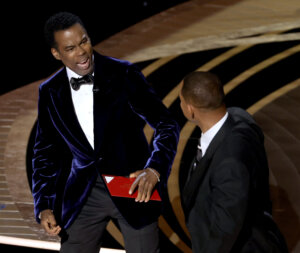
Berlinerblau begins with the slap heard round the world: the 2022 Oscars assault of Chris Rock by the actor Will Smith after the comedian insulted Smith’s wife, Jada Pinkett Smith. He also mentions the shaming and (attempted) cancellation of Louis C.K., consequences not of C.K.’s transgressive comedy, but of his self-confessed sexual misconduct. “C.K.’s reputation took a hit,” Berlinerblau writes, but he “remains a profitable artist” — an example of the limits of cancel culture.
In the U.S. section, Berlinerblau focuses on four stand-up comics who have faced what he calls “the coalition of the outraged:” Dave Chappelle, who has mocked gay and trans people; Sarah Silverman, who has offended targets across the political spectrum and apologized repeatedly; Kathy Griffin, who was criticized for tweeting a fake image of President Trump’s severed head; and Shane Gillis, whose career revived after fallout from his anti-Asian American slurs.
Berlinerblau distinguishes between “punching up” and “punching down,” based on the power position of comedic targets, while admitting that those distinctions can blur. He also discusses comic personae (whose views may not align with the actual comedian’s) and meta-comedy. Lenny Bruce famously talked about his arrests; nowadays comedians riff on their social media travails. The results can be comedic gold, or a dead-end, with comedy devolving into complaint.
Another issue is just how gender plays into audience reactions. Did Griffin suffer more career damage than Gillis because she is a woman? Berlinerblau’s sample size, as he admits, hardly warrants firm conclusions, but his supposition seems reasonable. Self-deprecation traditionally has been more familiar territory for female stand-ups than insult comedy.
In other democracies, Berlinerblau shows, comedians face more difficult terrain. He seems to admire the satirist Vir Das, who implicates his audiences in attacks on the (arguably illiberal Hindu nationalist) Indian government and Indian society more broadly. The comedian was “frequently threatened with, but never tried on, charges of sedition,” Berlinerblau writes.
Berlinerblau also explores the incitements of the French right-wing shock comic Dieudonné M’bala M’bala, whose antisemitic jibes are a particularly tough test for free speech purists. From France, too, comes the most devastating fallout from untrammeled comedic license. In 2015, the satirical magazine Charlie Hebdo’s caricatures of the Prophet Muhammad triggered an Islamist attack on its Paris headquarters that left 12 dead. Soon afterwards a gunman killed a police officer and four shoppers at a Jewish supermarket. More violence followed, including French intervention in the Middle East and deadly terrorist attacks in Paris and Nice. For Berlinerblau, the tragedies raise the question of whether comedy should ever be silenced for the sake of public safety.
Outside of democracies, he notes, comedians are often endangered. Bassem Youssef, Egypt’s answer to The Daily Show’s Jon Stewart, was ultimately exiled from his native country. Samantha Kureya (known as Gonyeti), whose “subversive comedy was virtually guaranteed to infuriate Zimbabwe’s leaders,” was kidnapped and beaten. The brazen attack, Berlinerblau speculates, was an attempt to chill other critical voices.
He concludes closer to home, with the controversial 2014 film The Interview, about the fictional assassination of North Korean dictator Kim Jong-un. Before its release, the Seth Rogen-Evan Goldberg project precipitated a massive hack of Sony Pictures Entertainment by alleged North Korean operatives. Here the free speech imperatives of the United States collided with North Korea’s paranoid authoritarianism — and the security vulnerabilities of the internet.
Berlinerblau wonders what would have happened if North Korea had issued a credible nuclear threat. More broadly, he frets that the provocations of comedians “imperil the free speech protections they claim to revere.” That’s a paradox that Berlinerblau admits he can’t resolve.