For this unconventional Jewish organization, tradition takes a back seat to community
With its mostly online and often atypical programming, Judaism Unbound wants to bring egalitarian Jewish life into the 21st century
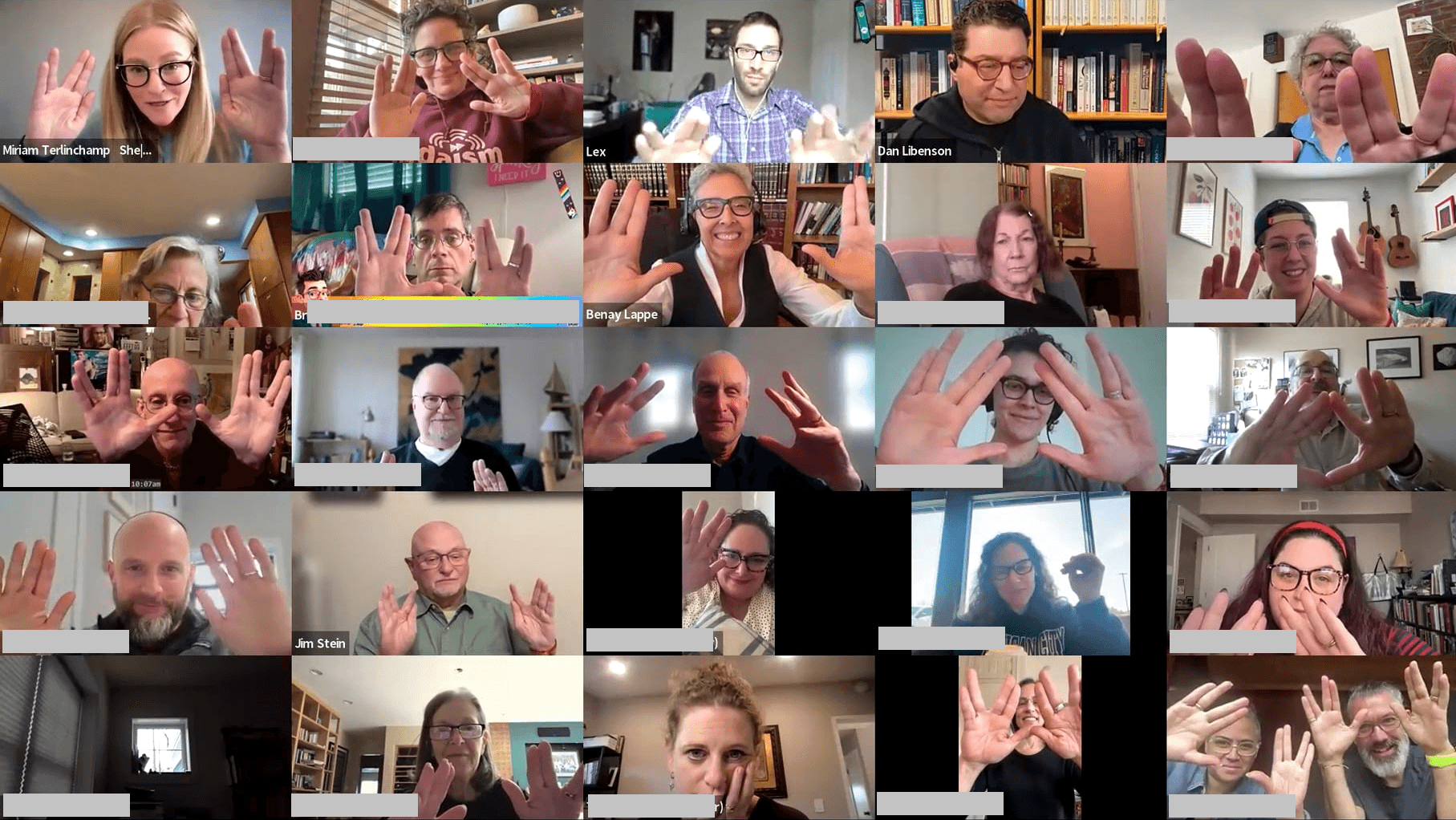
The ‘priestly blessing’ at a recent Judaism Unbound event Courtesy of Lex Rofeberg
By Noah Hirsch-Rechter March 25, 2026
Despite a temporary boost after Oct. 7 — the so-called ‘solidarity spike’ — traditional Jewish community in the United States has been in decline for at least a generation.
Synagogue attendance, regular Shabbat practice, paying congregational dues — never have these seemed less appealing to more Jews.
This isn’t all that surprising. American Jewry is evolving — interfaith households are up, support for Israel is down — and the onus, to a degree, is on the Hillels and Jewish Community Centers and large metropolitan synagogues to respond to these changes.
Yet the growth of a group like Judaism Unbound, a digitally-savvy Jewish organization founded in part as an alternative to the mainstays of American-Jewish life, would seem to suggest that, in certain quarters, the usual offerings just aren’t cutting it.
What the organization’s members share above all, said Lex Rofeberg, its senior Jewish educator, is a failure to connect meaningfully with “classic Jewish institutions.”
Unbounders — Rofeberg’s somewhat hokey name for the group’s members — are on the fringes of Jewish community for several reasons: among them, political beliefs; accessibility; interfaith dynamics; or a perceived knowledge deficit. There are, for example, a disproportionately high number of converts and Jews from interfaith backgrounds in the organization.
Lisa Heineman, a professor of Gender, Women’s and Sexuality Studies at the University of Iowa, and a longtime Unbounder, told me over email that despite her repeated efforts to get involved with Jewish institutions, she “simply felt like an outsider — I didn’t know the rituals, couldn’t play Jewish geography, didn’t fit into the ethnic Yiddishkeit.”
For many Unbounders, distance from mainstream Jewish community is not just figurative, but literal. “There’s a ton of creativity off the beaten path,” Heineman wrote. “And Judaism Unbound has been alert to what we have to gain by listening to Jews in places like Iowa, Oklahoma or Mississippi — and by really integrating them into their conception of American Jewish life.”
An unconventional approach
Judaism Unbound — or the ‘Institute for the Next Jewish Future,’ the group’s lesser-used official name — has embraced what Rofeberg calls “digital-first” Judaism, the better to reach those Jews in far-flung locations. With occasional exceptions, most events take place online. “Digitally, you are able to reach everywhere,” Rofeberg said. “People who are ostracized, people who are marginalized in whatever ways, find us. We had a lot of success very quickly online in ways that could not have happened offline.”
The events themselves — in keeping with the group’s anti-institutional bent — are sold as a departure from tradition.
“To be a Judaism Unbounder,” Rofeberg said, “is not to presume that the status quo is eternal.” One recent program, for instance, explored books from the Apocrypha, the liturgical texts that, though hugely influential, were never accepted into the biblical canon. The ‘ApocryFest,’ as the event was known, was typical of an Unbound program: zany and experimental, deeply if unconventionally Jewish, and, in truth, a little intellectually demanding.
Another of Unbound’s principal offerings is the ‘UnYeshiva’, a virtual beit knesset of sorts that offers online classes on an increasingly sprawling suite of topics, such as ‘Genesis: People and Solidarity in Bereshit’; ‘Every Body Beloved: A Jewish Embrace of Fatness’; and ‘Jews and Revolution: Socialists, Anarchists, and Radicals in the Modern World.’
The ‘UnYeshiva’ debuted in 2021 and was so well-received that Rofeberg and co. added a longer certificate program for the especially dedicated. These can take up to three years to complete, and consist of four separate classes, followed by a so-called capstone project, which the organization’s website describes as “a unique expression of each student’s holy work in the world.”
Heineman’s capstone project was a day-long, genre-spanning workshop — art, text study, meditation — that invited participants to reflect on a “path to a meaningful Jewish future.” That Heineman had had a previous capstone proposal shot down, on the grounds that her idea was too conventional, captures Judaism Unbound’s animating spirit, its insistence that participants innovate and experiment.
This programming is, suffice it to say, atypical, not least when set against the broader American-Jewish landscape. “Our premise from the get-go,” Rofeberg told me, “is that it’s very hard for existing legacy organizations to drastically change what they do in ways that will reach a new constituency, when they also have their own constituency.”
Matt Perry, another UnYeshiva graduate, agrees. “If there’s one idea that I’ve noticed many participants perhaps share,” he wrote, “it might be the belief that a revolution is unlikely to emerge from within existing Jewish structures.”
UnBound, through the airwaves
For all the UnYeshiva’s successes, the organization’s most popular venture remains its first: its eponymous podcast, hosted by Rofeberg and, until very recently, Dan Liebenson, Judaism Unbound’s founder. (Liebenson has stepped back from the organization’s day-to-day affairs to focus on a new Jewish venture.)
Both Perry and Heineman came to Judaism Unbound through the podcast, which launched in March 2016, and has since been downloaded over 3 million times. Heineman compared its array of guests and topics to “entering Narnia.”
In an era of ideological insularity, guests have run pretty much the full gamut of serious opinion. To name a few: Sarah Hurwitz, Peter Beinart, Shai Held, Danya Ruttenberg, Hey Alma founder Molly Tolsky. “Week after week,” Heineman told me, “I’d discover a new book, a new musician, a new activist organization, a new online educator — all working on this incredibly exciting project of re-thinking and re-invigorating Judaism.”
Rofeberg, for his part, wasn’t always so satisfied with the podcast. For a while, he felt it was creating a kind of epistemic distance between hosts and listeners. “Other than listening to us and emailing us,” he said, “they weren’t able to really actively participate.”
In 2023, the organization hired Miriam Terlinchamp, an Ohio-based rabbi, as executive director. Rofeberg credits her with introducing a less top-down pedagogical vision, and today the group has “more spaces where our people can come up with their own experiments,” he said. It hosts monthly Shabbat gatherings — online, naturally — during which participants explore one prayer in depth. There’s also an annual Shavuot event, Shavuot Live, a 24-hour-long Zoom gathering that draws hundreds of Unbounders and generates lengthy discussions in the event’s chatroom.
“In every respect, we’re trying to broaden who Judaism Unbound is,” Rofeberg said. “We’re not dictatorial, right?”
A post-Oct. 7 boost
The organization has grown sharply, especially of late, precisely because it hasn’t changed all that much. It’s always been a little counter-cultural and vaguely transgressive; it’s long suggested that Jewish life has passed over vital constituencies; and it’s consistently held that “the oldest Jewish tradition,” in Rofeberg’s phrase, “is upending Jewish tradition.”
The salient difference recently — read: since Oct. 7 — is that more Jews have come around to that interpretation. “We’ve had a lot of people find our work in the last few years, because more people than before feel alienated from other organizations,” Rofeberg said.
Concern over Israel’s actions in Gaza certainly helps explain this shift. As Rofeberg conceded, Judaism Unbound welcomes anti- and non-Zionists “in a Jewish world that largely doesn’t.”
The organization doesn’t have an official stance vis-a-vis Zionism. (“We’re a space that does not define itself with any ‘ism,” Rofeberg said.) One of its more impressive accomplishments, in fact, is gathering together under a single banner, albeit a virtual one, Jews who would otherwise scarcely interact.
In short, Judaism Unbound is that often-invoked-but-harder-to-realize idea of a big tent, where different beliefs mingle freely but are held together by a set of unifying values. For many, therefore, it has been a refuge from the division that has lately defined much of organized Jewish life.
Yet, for Perry, it’s more than that. “Over time, and combined with other semi-aligned efforts,” he wrote, “it has the potential to transform the Jewish world.”
This is a moment of great uncertainty. Here’s what you can do about it.
We hope you appreciated this article. Before you go, we’d like to ask you to please support the Forward’s independent Jewish news this Passover.
This is a moment of great uncertainty for the news media, for the Jewish people, and for our sacred democracy. It is a time of confusion and declining trust in public institutions. An era in which we need humans to report facts, conduct investigations that hold power to account, tell stories that matter and share honest discourse on all that divides us.
With no paywall or subscriptions, the Forward is entirely supported by readers like you. Every dollar you give this Passover is invested in the future of the Forward — and telling the American Jewish story fully and fairly.
The Forward doesn’t rely on funding from institutions like governments or your local Jewish federation. There are thousands of readers like you who give us $18 or $36 or $100 each month or year.
Support our mission to tell the Jewish story fully and fairly.