How two advice columnists with the same name counseled, comforted and inspired millions of women
America had ‘Dear Abby,’ ‘Ask Ann Landers’ and ‘A Bintel Brief.’ France had the two Marcelles.
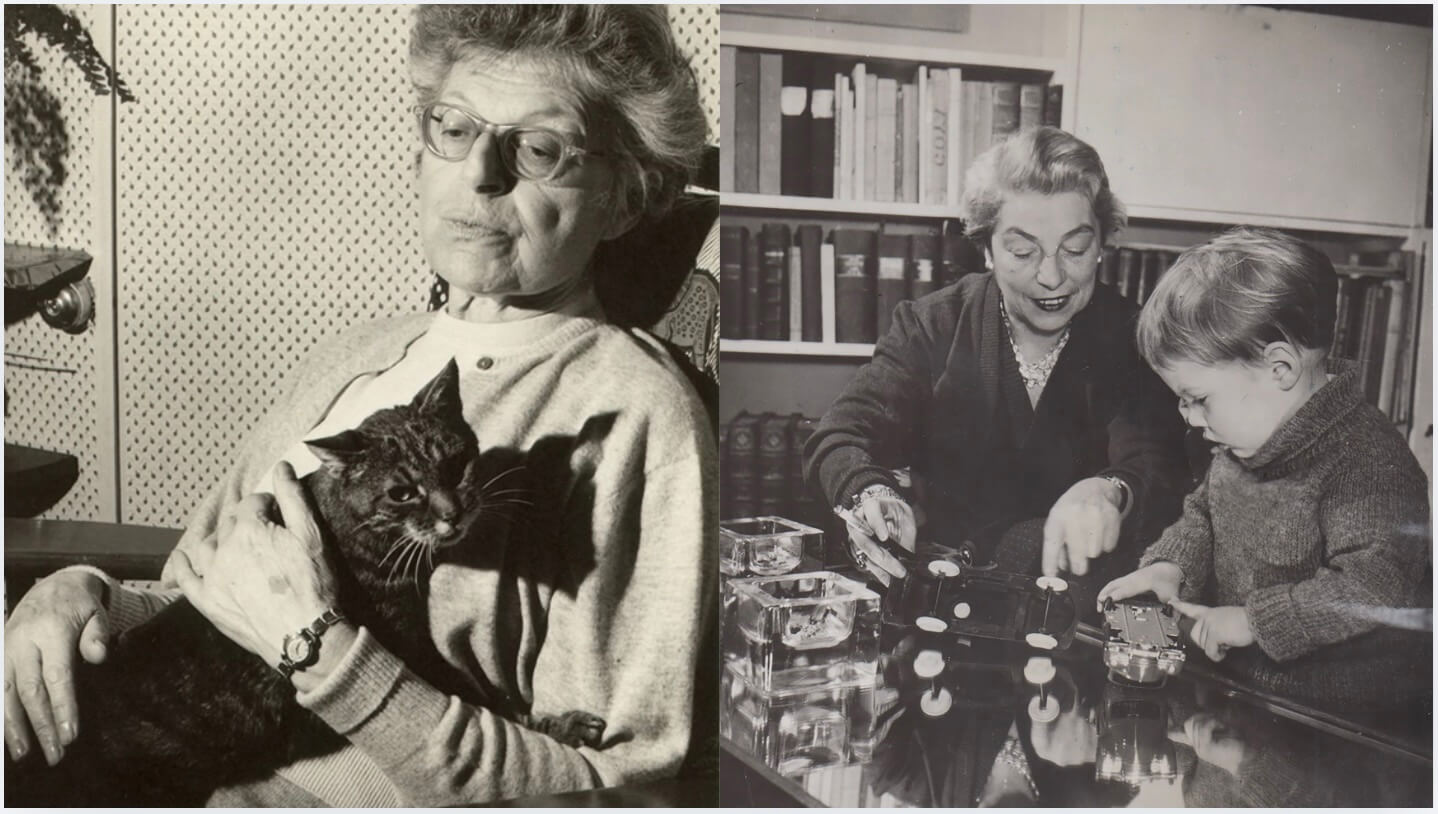
From Left: Marcelle Ségal with her cat; Marcelle Auclair with her grandson Jean-Victor. Courtesy of Oxford University Press/Jean-Victor Auclair
Though you probably know about “A Bintel Brief,” the Forward’s advice column that debuted 120 years ago, or the postwar advice columns of Esther and Pauline Friedman, better known as the authors of the advice columns “Ask Ann Landers” and “Dear Abby,” American readers might be less familiar with the work of “Les Deux Marcelles” who launched their careers as advice columnists on the other side of the Atlantic in postwar France.
They were Marcelle Auclair and Marcelle Ségal, two women whose advice columns counseled, encouraged and even emboldened countless women suddenly confronting an old world that was dying and a new world that was being born.
Unlike their American analogues, Auclair and Ségal were not related. The former grew up in Chile, where her father, an architect, assisted in rebuilding Valparaiso and Santiago after a massive 1906 earthquake. Auclair’s father encouraged her literary ambitions as she began publishing poetry and fiction. She returned to France in 1923, married author Jean Prévost and had three children. She continued publishing and moved into journalism. After noticing Auclair’s columns in the woman’s weekly Femme de France, publisher Jean Prouvost offered Marcelle a “woman’s page” in Paris-Soir (Paris Evening) in 1935 where she responded to letters asking for advice. Two years later she persuaded Prouvost to start a weekly woman’s magazine, Marie-Claire.
Like the Friedmans’ parents (and countless thousands of fellow Jews), Ségal’s mother and father fled Lithuania, then part of the Russian Empire, at the turn of the 20th century. They ended up in France, settling at first in Paris in a neighborhood near what was then the Place Daumesnil, nicknamed Domenilovka by the neighborhood’s large Russian-Jewish community. Their daughter did not start out as a journalist, but folded to family pressure and married a second cousin, the owner of a textile business with whom Ségal quickly had a daughter. Two terrible blows soon followed: In 1927, Ségal’s child died of meningitis and, shortly thereafter, her husband abandoned her.
Ségal struggled to support herself; she took in lodgers, and sold fashion house dresses to wealthy American tourists by knocking on hotel doors. She enrolled in secretarial training and landed a job at a bank where she earned enough to travel during her vacations. She began writing about her travels and eventually published her travel pieces in The Woman’s Journal, which then hired her as a regular correspondent. In 1939, she landed a job as editor and contributor at Marie-Claire shortly before the start of World War II. As the German army approached Paris in June 1940, Ségal joined the massive civilian exodus from Paris, eventually rejoining the editorial staff of Marie-Claire in Lyon.
After the Armistice of June 22, 1940, the magazine resumed publication from Lyon, and kept Ségal in spite of Vichy’s antisemitic law targeting Jews in the professions. In June 1941 Vichy passed a more severe antisemitic law extending the professional exclusion of Jews in the press beyond leadership roles; five months later, Ségal was fired. She went underground, editing and typing texts for the resistance. “About my resistance work, I prefer not to talk about it,” she wrote in her memoir. “I did too little, way too little, our group having been decimated.”
In the wake of France’s liberation in 1945, Ségal helped launch Elle magazine with two pre-war journalists and friends, Pierre and Hélène Gordon-Lazareff. As Elle sought to build its readership — a daunting challenge when most staples and goods, including paper, were still rationed in France — Hélene Gordon-Lazareff proposed that Elle solicit and respond to readers’ letters about such topics as beauty, fashion, home and love. Reluctantly, Ségal accepted, unhappy that she would be playing the “vulgar role of ridiculous auntie” — namely, an advice columnist. To her great surprise, her column became and remained a fixture in the lives of millions of French women for the next 40 years.
Like Auclair, Ségal served as a bridge to feminism, leading her readers to think for themselves, take control of their lives, and question social expectations damaging to their sense of self-worth. Rather than challenging readers — an approach that the great figure of French feminism, Simone de Beauvoir, sometimes adopts in her canonical work The Second Sex — Ségal was always conversational. She regularly downplayed the importance of physical appearance, questioned beauty standards, and insisted that whatever negative aspect a letter writer expressed about her appearance, the real problem was not how a woman looked but how she felt.
Ségal also warned against the quest for finding a husband. One writer whose boyfriend had recently broken up with her bemoaned, “I’m afraid I’ll never get married. What should I do to get married — quick quick?” “Why quick quick?” Ségal asked. “Take your time.” Similarly, she advised a young woman of 18 to resist her boyfriend’s pressure to drop out of school and marry him. Take time to live, Ségal urged, to experience life, finish her education, and establish her own career. “Take advantage of your youth,” she exhorted, and never “disregard your security and your independence.”
In her 1971 memoir, Moi aussi, j’étais seule (I Was Alone, Too). Segal, who never remarried, reassured her readers that her personal story was not one of failure, loneliness and pain. She decided to write about her single life, she explained, for all unmarried women. “Let’s go single women!” she wrote. “Get out of the house! Go for it! Don’t be afraid! Adventure Awaits!”
Such advice as “Living only for a man represents the number one cause of women’s pain,” seems positively quaint today. And yet, the reason it does so is partly due to Ségal’s trailblazing work. While she never rejected general assumptions about gender, marriage and family life, for 40 years Ségal encouraged women not to feel bound by traditional expectations. She responded to the women who wrote her with messages warning them against blindly following convention or fitting themselves into a standard mold. Ségal’s exhortation “Don’t be afraid!” is no less relevant today than it was during her own life.
This is a moment of great uncertainty. Here’s what you can do about it.
We hope you appreciated this article. Before you go, we’d like to ask you to please support the Forward’s independent Jewish news this Passover. All donations are being matched by the Forward Board - up to $100,000.
This is a moment of great uncertainty for the news media, for the Jewish people, and for our sacred democracy. It is a time of confusion and declining trust in public institutions. An era in which we need humans to report facts, conduct investigations that hold power to account, tell stories that matter and share honest discourse on all that divides us.
With no paywall or subscriptions, the Forward is entirely supported by readers like you. Every dollar you give this Passover is invested in the future of the Forward — and telling the American Jewish story fully and fairly.
The Forward doesn’t rely on funding from institutions like governments or your local Jewish federation. There are thousands of readers like you who give us $18 or $36 or $100 each month or year.

Support our mission to tell the Jewish story fully and fairly.