The original anti-Zionists have been all but forgotten. Molly Crabapple wants to change that.
in ‘Here Where We Live Is Our Country,’ the artist and journalist offers a family memoir and a history of the Jewish Bund.
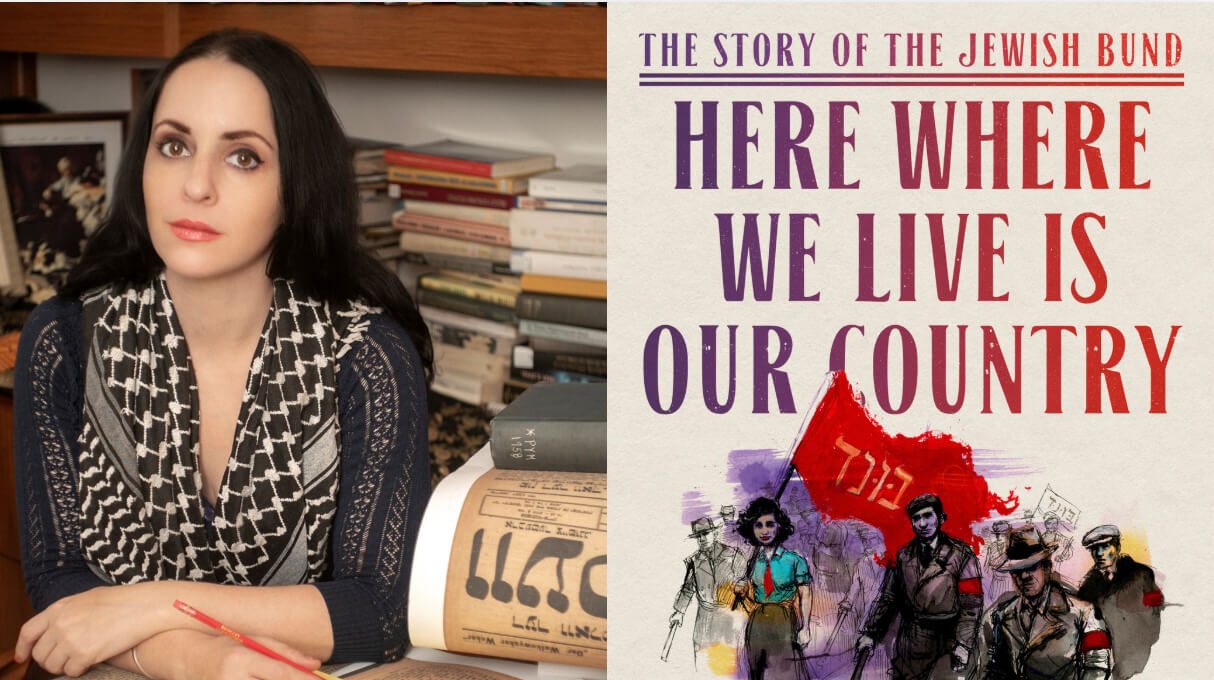
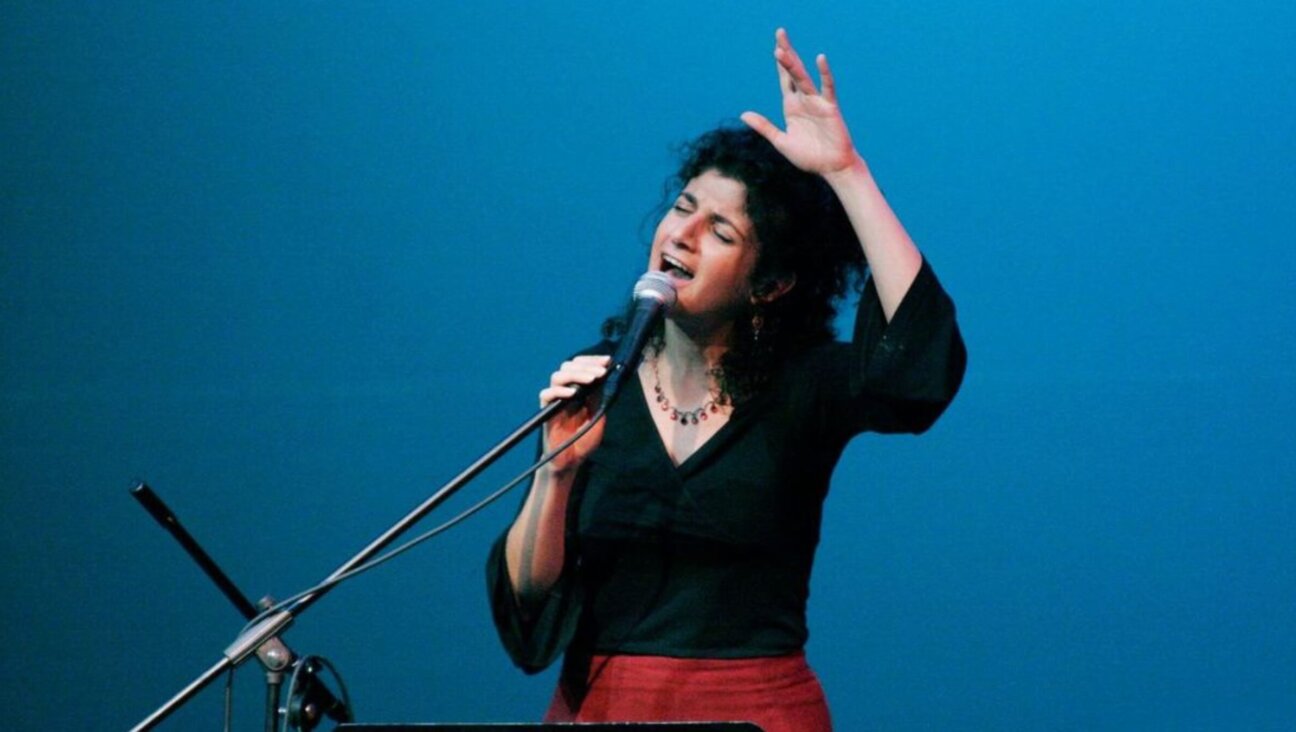
Molly Crabapple’s latest book is ‘Here Where We Live Is Our Country.’ Photo by Daniel Efram/Penguin Random House
I first met nationally acclaimed artist and journalist Molly Crabapple in 2020 during the dark days of COVID. After discovering that we had both studied Yiddish at YIVO, albeit in different classes, we did a socially distanced fresh-air visit to Mt. Carmel, the Jewish cemetery in Queens where Sholem Aleichem is buried. Many tombstones there are inscribed not in Hebrew but in Yiddish. They include the graves of people who, in life, belonged to the Bund.
Founded in 1897 in Eastern Europe, the Bund was a socialist revolutionary group whose name, translated from Yiddish to English, is General Jewish Labor Union (“bund” is Yiddish for union). By the 1930s, Bundism in Poland, where most Ashkenazic Jews lived, had grown bigger and more politically powerful than Zionism. The group was a tireless promoter of Yiddish as the linguistic and literary underpinning of Jewish peoplehood. Bundists also fiercely opposed Zionism and a Jewish state; they believed in fighting for democracy and inclusion in the countries where Jews already lived.
The organization ended up being destroyed not just by the Nazi Holocaust but also by Stalinism. Except for people like me, who’ve been ensconced in the Yiddishist world, it is nearly forgotten today by all but a few academics. But by the time we met, Crabapple was writing a book about the Bund.
Almost six years later, she has finished it. Titled Here Where We Live is Our Country, it is part hefty historical documentation, part loving family memoir, and part literary nonfiction. Thoroughly engaging throughout, it moves back and forth from the author’s lefty-artsy life in contemporary New York City to earthshaking events in vintage Jewish Europe. Crabapple has disinterred the memory of a once-vibrant movement that waned even as its nemesis, Zionism, waxed.
I met her last month in her fifth-floor walkup apartment in Williamsburg to talk about how she made her book. Our conversation is edited for length and clarity.
Here Where We Live devotes significant space to the saga of your great-grandfather, Sam Rothbort. As a young man in 1904, he immigrated from the Pale of Settlement to New York City, under somewhat murky circumstances that he barely discussed after the move. In America, he made a living as a self-taught artist, including on a dairy farm in the Catskills, an egg farm in Long Island and in a big house near Sheepshead Bay in Brooklyn. But he died over a decade before you were born. When did you first realize he’d been an interesting guy who you wanted to tell the world about?
I was fucking born knowing he was interesting! My mother and my great-aunt and my dad told me about him constantly. I was surrounded by his paintings and stuff that he said. After he died, my great-aunt Ida still lived in his house. As a child, I would visit and it was exactly like when he was alive. I remember the pigments and oils still on the palette in the basement.
How did you find out he’d been in the Bund?
I’d always known he was involved in something illegal before he came to the United States. It was a cool family anecdote. In a book from 1952 that he published about his art, he wrote that as a teenager and young man he hadn’t known much about girls because “I was in the underground.” Another book, a catalogue of his art from a show, said he’d been in the Bund. My mom had a million of those catalogues in a bookcase, and I’d been looking at them since I was 11 or 12 years old. I also saw one of his watercolors, of a woman throwing a rock. He’d titled it “Itka the Bundist Breaking Windows.”
I had very little idea then of what “the Bund” was. But as an adult, one of my bad habits has been that sometimes when I get drunk, I Google things. That might be how I first understood.
From his own unpublished writing, you later found evidence suggesting that Sam might have fled to America at age 22 because he’d joined other Bundists in shooting a Tsarist policeman during a state-encouraged pogrom. You also read the yizkor book for Volkovysk, a town in what is now Belarus. It was Sam’s hometown. He is cited in the book as having helped produce its chapter about the Bund.
Look at this! [She walks me to her bedroom and points to an antique photograph on the wall.] When I was younger I’d always only thought of this as a very cool old picture that my mom had. But this same photo is in the yizkor book! It says it’s the members of the Volkovysk Bund in 1905. It’s Sam’s friends a year after he left for America. Look at this guy in the photo — he’s hot! Which one do you like the best?
The blonde.
Ugh!
I got really obsessed trying to track down these guys. When I went to the cemetery where my great-grandfather is buried I saw the tombstone of one of them. Later, in a box of family memorabilia, I found a photo of this same person in an old Yiddish news clip about people in New York City who were in the Workmen’s [now Workers] Circle’s Volkovysk branch. I asked the cemetery who was paying to maintain the grave. It was this guy’s grandson. I contacted him and he said his own father was still alive but very old. “Can you just ask him to look at this photo and see if that’s his dad?” I asked. I said I was writing about a revolutionary group. He says, “My grandfather never would have been involved in that! He was a truck driver.” And he hung up.
Why couldn’t the grandson entertain this history about his grandfather? Why did he not know it?
The Bund was an organization incredibly devoted to Yiddish language and literature. But it was also a socialist revolutionary political party. One thing I’ve noticed about how it has been written about is that certain things are de-emphasized and certain things emphasized. In the 1950s in the U.S. in the McCarthy years, Bundist survivors of the Holocaust were terrified they would be accused of being Communists, and deported. They had no faith that Americans would know the difference between a socialist and a communist. I think that sometimes the Bund’s’ Yiddishism is emphasized far more than the fact that they were revolutionaries. To focus on linguistic and cultural things is safe. To talk about revolutionaries as internationalists — and as people who always opposed Zionism — is dangerous.
Were you raised Jewish?
My father is Puerto Rican and a Latin American studies professor who’s a Marxist. He told me about Marx’s theory of surplus value when I was 6 years old. I’ve been a leftist in a leftist family all my life! My mother — Sam’s granddaughter — is very strongly culturally Jewish. When I was a child we’d do Hanukkah lights, and she made the best latkes. We were not religious, but I identify strongly as a secular Jew. I studied Yiddish in order to do research for the book. I’m not so good at Yiddish, but I can work my way through a socialist text using a dictionary.
I remember when we were at the cemetery and you were so excited about having just discovered that the political work of some Bundists in Poland was armed self-defense. They fought in militias, with their bodies and with weapons, to protect Jews from murderous pogroms, murderous Communist Party violence against socialists, and, finally, murderous Nazis. You called these militia members “thugs.”
I loved them!
You mentioned their resistance in a piece you wrote in 2018 for the New York Review of Books about the organization. I’ve heard that many people were astounded and very happy to learn about this self-defense and to discover the Bund.
Especially young Jews, like in their 20s. They had no idea that Jews had fought back in Europe even before the Holocaust, or they had only vague ideas about the Warsaw Ghetto uprising and that Bundists played a major role in it. It was very meaningful for them.
So much for the idea that only Zionists have been modern Jewish fighters.
Zionists have tried to say that they were the only tough Jews. Which is utterly untrue.
What do you think is most original about your book?
It’s very concerned with the emotional life of being in a movement. I think that sometimes the way that leftist movements are written about is as a series of conferences and decisions that are written down as texts, and people sign onto a resolution because that’s what they are thinking. The writing doesn’t show any awareness of emotional life. The love affairs, the gossip, the beefs that are going on, the thrill of thinking that you can change the world. I was much more concerned with that.
And as I worked on the book I quickly realized that I wasn’t just writing about the Bund. I was writing a history of the 20th century from the point of view of the defeated. The work was a form of necromancy. I would go to people’s graves and take dirt, and light candles in front of it and try to ask them if I could tell their story. At Ponary Forest, [near Vilna, where at least one prominent Bundist leader, a woman, was massacred by the Nazis in World War II and dumped into a mass pit] I went to the bottom with flowers and played Di Shvue [Yiddish for “The Oath,” the Bund’s anthem] on my phone.
What do you mainly hope that your book will accomplish?
I want leftists to know about something from our shared international history as leftists. I want young Jews to get to know their ancestors.
The Bund was anti-Zionist, of course, and many young American Jews are now also rejecting Zionism.
Yes. A lot of them were sold a bill of goods about their history, and when they reject that bill of goods, there’s a big hole in them. They don’t have any actual, positive Jewish history. They just have shit they’re ashamed of, because they realize [that Zionism] was actually a history of ethnic cleansing and apartheid. One of the things my book does is give them ancestors.
I’m an anti-Zionist. Whenever you have an ethnostate project, it always does unspeakable crimes. If Jewish institutions in America keep conflating Jews here with a state that is doing a livestreamed genocide and is now primarily known for the most heinous shit possible, it’s extremely dangerous for us Jews, as a small minority in America.
Some people internationally have been starting new Bund groups. What future do you see in that? And can you imagine Yiddish being resurrected as a secular Jewish language?
It’s hard to imagine huge numbers of people adopting Yiddish. But I think about a Jewish literary figure in the 1930s whom Isaac Deutscher quotes in his book The Non-Jewish Jew. He said that Yiddish was a dying language. But he didn’t mind, because Greek and Latin are dead languages, yet many people study them anyway, to access their linguistic treasures. And God bless everyone who’s doing leftist, anti-Zionist organizing and cultural work reclaiming our heritage! But is there a future for the Bund? The thing I’ve learned both from reading history and being a participant is, you never know what the spark is going to be. So you should always avoid making prognostications.
This is a moment of great uncertainty. Here’s what you can do about it.
We hope you appreciated this article. Before you go, we’d like to ask you to please support the Forward’s independent Jewish news this Passover. All donations are being matched by the Forward Board - up to $100,000.
This is a moment of great uncertainty for the news media, for the Jewish people, and for our sacred democracy. It is a time of confusion and declining trust in public institutions. An era in which we need humans to report facts, conduct investigations that hold power to account, tell stories that matter and share honest discourse on all that divides us.
With no paywall or subscriptions, the Forward is entirely supported by readers like you. Every dollar you give this Passover is invested in the future of the Forward — and telling the American Jewish story fully and fairly.
The Forward doesn’t rely on funding from institutions like governments or your local Jewish federation. There are thousands of readers like you who give us $18 or $36 or $100 each month or year.
Support our mission to tell the Jewish story fully and fairly.