70 years ago, this Jewish choreographer predicted our epidemic of loneliness and isolation
‘Rooms,’ which premiered in 1955, was inspired by the Lower East Side tenements of Anna Sokolow’s youth
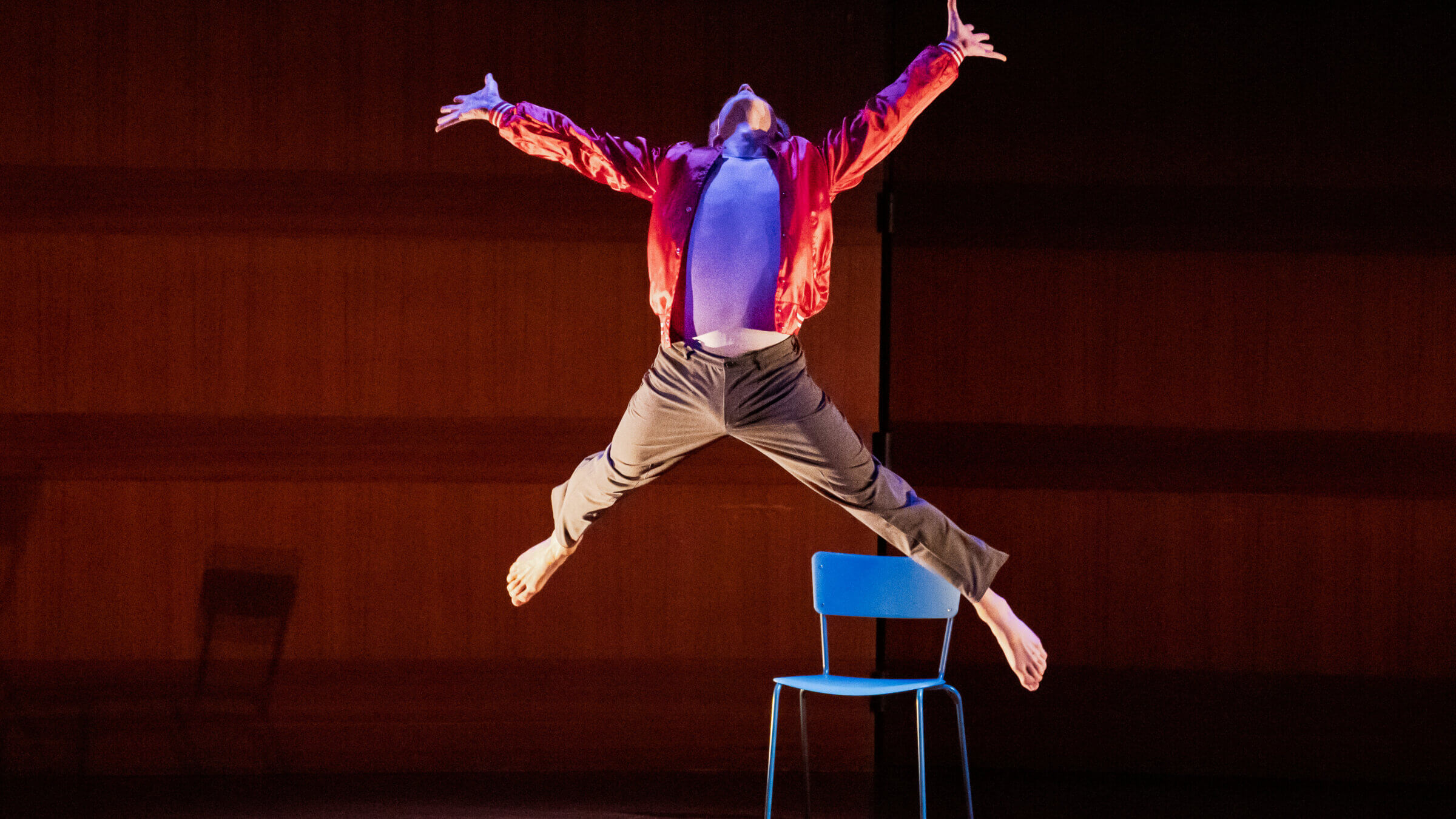
Brad Orego performing in Anna Sokolow’s ‘Rooms’ at the Museum of Jewish Heritage. Photo by Steven Pisano

By Stav Ziv April 4, 2026
When the dance begins, they are all onstage together. But they are each very much alone. In the opening vignette of Anna Sokolow’s “Rooms,” there are eight chairs scattered across the stage and eight performers who inhabit them — like city apartments squished so close together yet keeping their occupants apart.
No one makes eye contact. They stare straight ahead. They stand and sit back down. They flop to the side and fold themselves over their thighs. They stretch out horizontally, one leg extending on a diagonal before falling to the floor with a thud. One dancer sets her chin in her palms, her gaze fixed on a corner, as though willing herself to see through a brick wall.
These are people trapped in their own tiny worlds, radiating loneliness, isolation, restlessness, fear, fantasy, desire, distress, panic.
Watching them at the Museum of Jewish Heritage in New York City last month — the day after the U.S. and Israel launched attacks on Iran, 13 months into a second Trump administration that has targeted immigrants and transgender people, among others, and in the midst of what former Surgeon General Vivek Murthy’s 2023 report deemed “our epidemic of loneliness and isolation” — one could easily imagine “Rooms” was created in 2026. Or during the global pandemic and lockdowns of recent history.
But Sokolow was long gone by the time COVID forced us into our own rooms, physically and socially distant from almost everyone else. She didn’t live to see the tiny screens and tempting apps that would degrade our attention spans and become intermediaries in so many of our conversations. She missed the rise of artificial intelligence chatbots that offer alternatives to human interaction.
Sokolow, who died in 2000 at the age of 90, created “Rooms” seven decades ago, in the wake of a world war and the Holocaust, at a time when polio was rampant, and in the midst of a nuclear arms race and the Red and Lavender Scares of the 1950s.
Yet “Rooms” still feels believable, relatable and unsettling today.
‘An incredible humanity’
The daughter of Russian Jewish immigrants who arrived in the U.S. at the turn of the 20th century, Sokolow grew up on the Lower East Side of New York City — at the time, the densely packed “capital of Jewish America.” Sokolow’s mother, Sarah, a factory worker, was active in the International Ladies Garment Workers Union and was, as Sokolow later described her, “a staunch Socialist.”
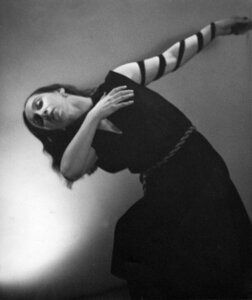
Sarah was “angered by the conditions she observed all around her,” writes Sokolow’s biographer, Larry Warren, and kept up with “socialist causes and political activities” by reading Yiddish-language newspapers such as the Forward.
Like her mother, Sokolow looked closely at what was happening around her. She took it all in and put it onstage, Samantha Géracht, artistic director of the Sokolow Theatre/Dance Ensemble, told me.
“She walked everywhere,” said Géracht, who was part of the rotation of dancers who accompanied Sokolow to rehearsals when she kept walking everywhere, slowly, into her 80s. “Every shopkeeper, every unhoused person in a doorway, everybody spoke to her, and she spoke to everyone,” Géracht said. “She looked and saw everyone and everything, and she didn’t dismiss any of them.”
Though secular, Sokolow was driven by Jewish values, Hannah Kosstrin, a dance historian at Ohio State University and director of its Melton Center for Jewish Studies, told me over Zoom. “She was most interested in making dances about the underdog,” said Kosstrin, who is also the author of Honest Bodies: Revolutionary Modernism in the Dances of Anna Sokolow. “About people who were not served by society, people who were unwanted, untouchable, and people who had been through the worst of humanitarian experiences.”
In the 1930s, she made, among other dances, the anti-fascist “Anti-War Trilogy”; “Slaughter of the Innocents,” inspired by the Spanish Civil War; and “The Exile” — which portrayed Jewish life in Europe and the arrival of Nazism. She danced “Kaddish” in 1945 as an “elegy” mourning the Jews who perished in the Holocaust, according to Kosstrin, and later choreographed “Dreams,” which Géracht describes as Sokolow’s “Holocaust nightmares onstage.”
Her work “has an incredible humanity to it,” Kosstrin said.
Kosstrin first encountered Sokolow through a film of “Rooms” as a freshman dance major. “I just remember being absolutely taken with it. It was so intense and so gritty and so real,” she said. “I felt a very particular kind of distress in a way that I had never felt watching dance before,” she added. “That was so incredibly powerful.”
“Rooms,” which had its New York premiere in 1955, was inspired by the Lower East Side tenement houses of Sokolow’s youth. It’s spare — performed with no backdrop, only lighting, chairs, and simple costumes to an original jazz score by the American composer Kenyon Hopkins. Part of its enduring potency is that it could represent any time and any place.
‘I believe you’
Introducing the performance at the museum, Géracht set the scene with one simple instruction. Picture, she told the audience, a building with its facade removed so you could peer into all the apartments and look — really look, as Sokolow would — at the people inside.
In one vignette titled “Going,” a man careens about like he’s just flipped the release valve on his pent-up energy, exploding in big jumps, sliding onto the floor, and snapping his fingers. In “Desire,” six dancers slide their feet back and forth as though caressing the ground. They reach an arm or a leg, as if yearning to entangle their limbs with a lover’s.
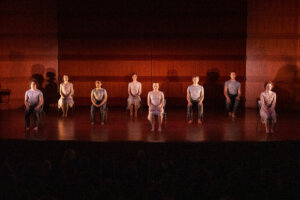
In “Escape,” I saw a woman dance with someone who isn’t there. She stands, arms thrown up high, spinning around herself. She flits around the stage. She pulls two chairs to face each other, sits down, and catches the air in an empty embrace. Later, she swipes at each of the chairs in turn and they clatter to the ground.
“She’s very different from me,” dancer Ilana Ruth Cohen told me of the character she embodies in “Escape.” “I do not escape easily, and I don’t tend to look for an escape.” What’s helped, she said, is “remembering the moments I do have where I am drifting or dreaming or imagining being somewhere else, and then trying to use Anna’s movement to expand my experience of those moments.”
There are no prescribed narratives in “Rooms,” just snippets of images and an urgency of emotion that might be read differently by every spectator. That’s OK, Cohen said. “I’m not trying to make sure that the audience knows what my experience is,” she explained. “I’m using my experience to make the movement true, and then the audience has an experience because they’re with me as that’s happening.”
Kosstrin focused her research around the idea of “honest bodies” in part as a way “to highlight Sokolow’s emphasis on believable, raw vulnerability in performance.” As such, Lauren Naslund, an associate artistic director of the ensemble, told me at a recent rehearsal, high praise from Sokolow would be: “You’re doing it in your own way, and I believe you.”
In the vignette “The End?” I saw a woman having a breakdown. Her left hand makes talking motions — thumb to fingers, open and shut — arguing with her right. Her fingers rise toward her ears and wiggle frantically as she extends her arms outward. She steps onto her chair, head tilted back, and flaps her arms like wings in slow motion. Her fragile psyche manifests in movement. She is, perhaps, hearing voices in her head. Feeling her thoughts slip out of her control. Wondering whether she wants to remain in this world.
“Rooms” concludes as it starts, with eight chairs and eight dancers — so close to each other, but still very much alone.
There’s a clip Géracht shows in her lectures with a voiceover from Sokolow speaking on top of footage from “Rooms.” “I don’t end it, because I don’t feel there’s any ending,” Sokolow says. “That’s the Jew in me. Ask the world a question and there’s no answer. All I do is present what I feel and you, you answer.”
‘A kind of beacon’
The Sokolow Theatre/Dance Ensemble was about four weeks away from presenting “Rooms” when the COVID-19 pandemic sent everyone home in March 2020 and cleared live performance calendars indefinitely. Suddenly, Géracht said, “we didn’t have to struggle with the idea of how to understand isolation.”
Relegated to their homes like everyone else, the dancers continued working on “Rooms” over Zoom. “You can’t go outside. There’s no classes. There’s no rehearsals. There’s nothing,” remembered dancer Margherita Tisato, who performs the challenging solo “The End?”. “Having a task and having time to dedicate to do this was definitely lifesaving on an emotional level, probably for a lot of us.”
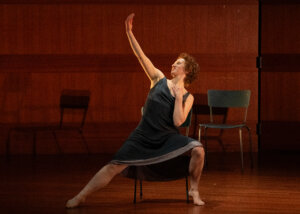
At the same time, she said, “it was asking me to dig more and more deeply into the thing that was, at the moment, really, really hard.” The project provided a creative outlet, but also forced her to grapple with her own feelings of aloneness and isolation.
Eventually, the dancers worked with their rehearsal directors to select the right angles, propped up their computers and phones, and hit record to capture themselves navigating bookcases, coffee tables, cats, and narrow hallways. Naslund edited the footage together to create “Rooms2020,” a COVID-era interpretation of the piece they couldn’t share in person. They later partnered with Madison-based Kanopy Dance to livestream a joint production from Wisconsin and New York, offered virtual workshops to college dance students, and put on a “Rooms” symposium.
“There could not have been a better dance to stage during the pandemic than ‘Rooms’ on video in people’s apartments,” Kosstrin said. Looking back, she said, it offers a social, emotional, and aesthetic window into that moment, with so many stuck in their own bubbles and thrust into each others’ living rooms through tiny squares on their screens.
Géracht said she immersed herself so deeply in “Rooms” that she needed a break before revisiting it again. Although the lockdown experiences are still embedded in the dancers’ bodies and memories, they couldn’t let the work get stuck or stale.
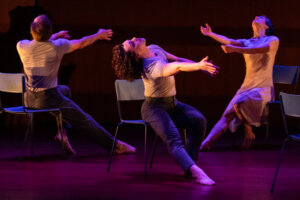
“You don’t want to replicate what you did six years ago,” said Géracht.
“It’s like going on a hike up a really high mountain. Maybe you’ve climbed that mountain,” she said. “You kind of know the way, but you still have to do the whole hike from the bottom to the top.” Every time you do it, “you’re different, the movement’s different, the world is different. And I don’t want the last version you did. I want you now. Which is why we can do the work for so long.”
Géracht is intent on breathing new life into Sokolow’s dances in 2026 and beyond. She wants audiences to experience the “wealth and range” of Sokolow’s work and “understand her genius,” Géracht said, as an artist who “shows us our entire spectrum of human emotion.”
In “Rooms,” Sokolow reminds us, in 2026 as in 2020 as in 1955, what it’s like to crave connection or touch. To conjure a loved one in our mind, only to be startled by the reality of their absence. To get lost in a daydream. To fear what’s outside our control. To feel utterly alone. To be consumed by panic. To fall apart.
Complete, live productions of “Rooms” are somewhat rare. But the ensemble has just confirmed it will perform the piece again at the Philadelphia Fringe Festival in September. Having seen — and felt — it for myself recently, I hope there will be many more shows to come.
Distressing as it may be to see this “cry of alienation and isolation” reflected back at us right now, Kosstrin said, it could also help us find our way. “We are seeing so many things happen around us that [are] making us question our humanity and other people’s humanity,” she said. Artists like Sokolow, she believes, “can give us a kind of beacon as we try to muddle through these times.”

Did you know that only 2% of Forward readers donate to support our nonprofit newsroom? That 2% make it possible for millions to read the Forward without a paywall or subscription — removing any barriers to the full and fair Jewish story.
But while the Forward is free to read, it isn’t free to produce. Big stories — like deep dives into the antisemitism data, political scoops or reporting trips to college campuses — take months of research and fact-checking. All while we keep you informed of what you need to know each day.
— Rachel Fishman Feddersen, Forward Publisher & CEO
Support our mission to tell the Jewish story fully and fairly.