Gene Shalit, a mensch with a personality as big as his mustache, turns 100
An aficionado of Jewish humor, the ‘Today Show’ personality was always more of a champion than a critic
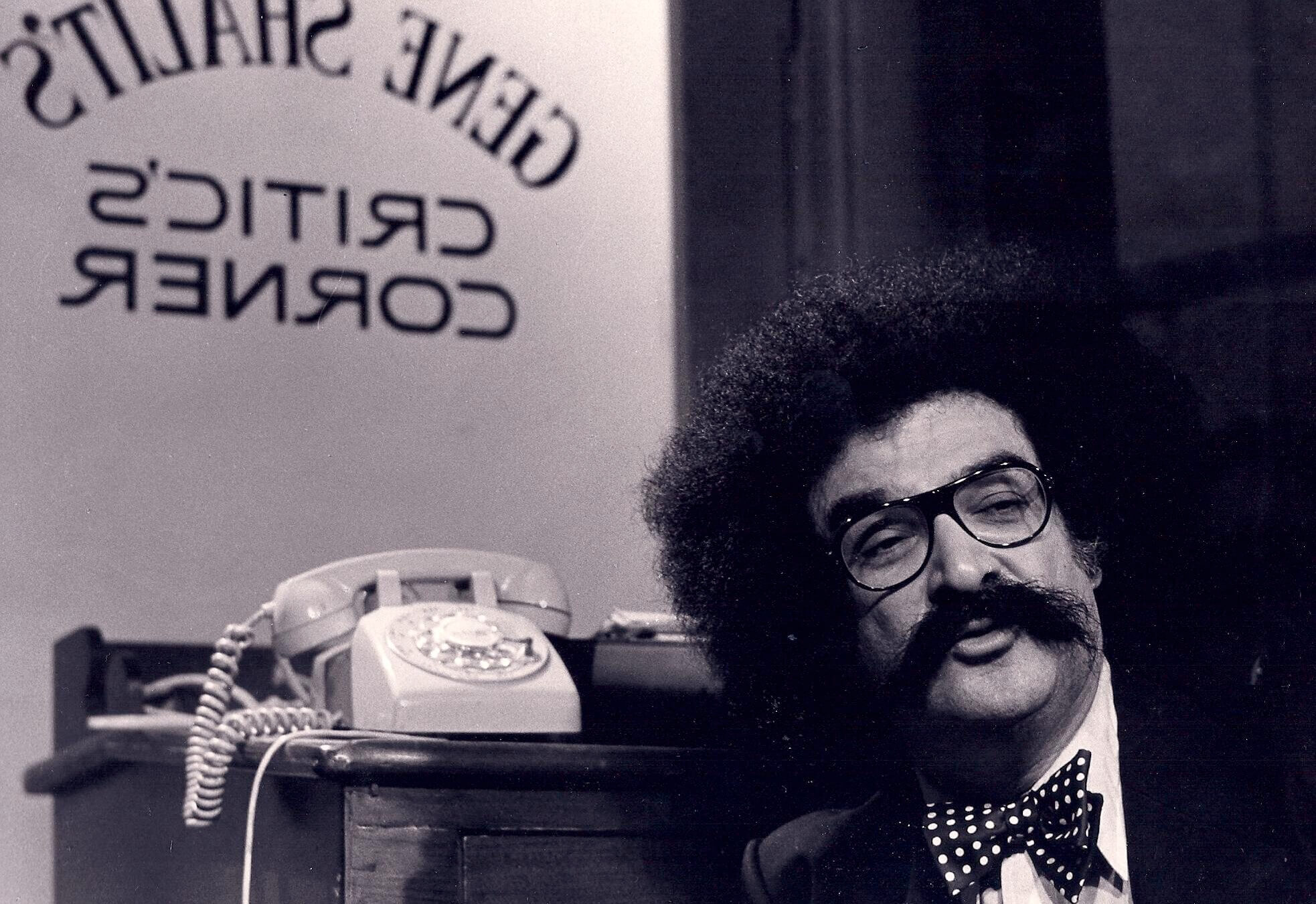
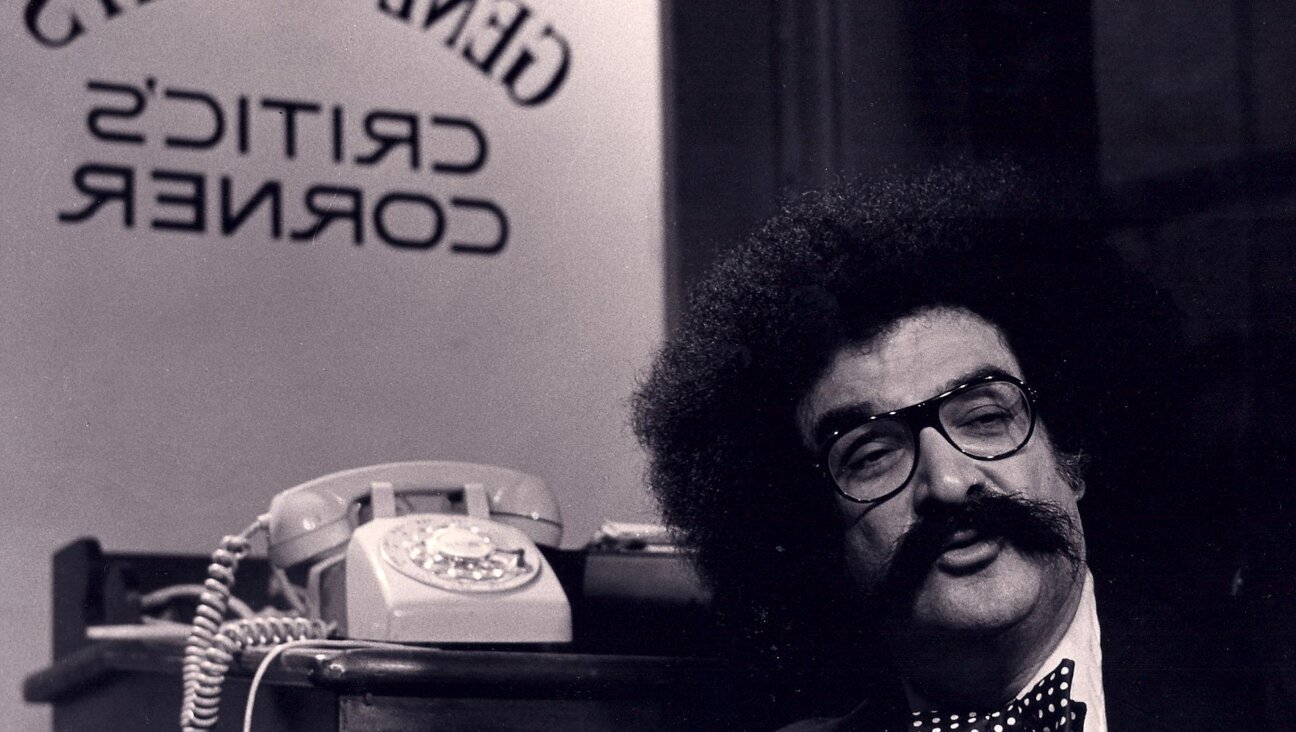
Gene Shalit, during his ‘Critics Corner’ segment, on the ‘Today Show’ set at NBC Studios, New York, New York, 1970s. Photo by Raimondo Borea/Gartenberg Media Enterprises/Getty Images

By Benjamin Ivry April 3, 2026
The television entertainment personality Gene Shalit, who celebrated his centenary on March 25, semaphored a Jewish appearance for decades to viewers of NBC’s early morning gabfest The Today Show.
With his Jew-fro hairstyle that fascinated celebrity interviewees and his abundant mustache that outdid Groucho Marx’s mere greasepaint simulacrum, Shalit was one of a kind. Born in New York City in 1926, he clearly aimed to be recognizable even through half-opened bleary eyes of half-asleep viewers. And audible too. Shalit’s precise pronunciation, always at a vigorous decibel level, sought to be comprehensible even during voiceovers. The Canadian comedian Eugene Levy, transfixed by this persona, imitated him on SCTV roaring at high decibel levels.
In one skit, Levy embodied Shalit with haimish affection, hawking a remedy for a migraine presumably caused by his own bellowing. In another, Levy spoofed Hollywood celebrities who were notorious fressers at local restaurants, including the American Jewish actress Shelley Winters (born Shirley Schrift). In still another lampoon, Levy-as-Shalit danced and also kibitzed with the late Catherine O’Hara as the Jewish gossip columnist Rona Barrett (born Burstein).
Shalit apparently kvelled at the notion that he was prominent enough in media culture to be affectionately kidded like other Jewish noteworthies Levy imitated, including Howard Cosell, Henry Kissinger, Menachem Begin, Milton Berle, Judd Hirsch, Jack Carter, James Caan, Lorne Greene, Norman Mailer and Neil Sedaka.
Years later, Levy recalled that when the SCTV comedy troupe was invited to appear on The Today Show, before the segment was filmed, chairs were arranged so that Catherine O’Hara was seated next to Shalit. Suddenly Shalit exclaimed: “Wait a minute, shouldn’t the person who [imitates] me be sitting beside me?” Another Jewish comedian, Jon Lovitz, would likewise attempt to imitate Shalit on Saturday Night Live, but without the zest of Levy’s indelible incarnation.
Shalit once told showbiz reporter Eileen Prose that at first, his looks limited him to radio jobs in more conventional times for TV talent. By the more liberated late 1960s, when long hair and a hirsute upper lip were more common, he was hired as quasi-permanent house Jew on The Today Show. Although his mustache fit the counterculture in the mode of Jewish activist Jerry Rubin’s, Shalit as an aspiring journalist may have grown his facial hair more in tribute to earlier literati like the playwright William Saroyan or the eminent humorist Mark Twain.
At times, Shalit’s appearance could be clown-like or cartoonish, so it was natural that characters inspired by him would appear on animated series such as SpongeBob SquarePants and Family Guy as well as The Muppet Show.
Famous interviewees like Peter Sellers were plainly at ease with Shalit’s persona. A conversation filmed shortly before Sellers’ untimely death was cordial, with the sometimes tetchy actor on his best behavior, acknowledging Shalit as a fellow entertainer. And with Mel Brooks in 1987, Shalit looked to be in paradise.
A warm-hearted empathizer and enthusiast, Shalit was more suited to promoting films than criticizing them. In 1989, a tzimmes occurred when a memo drafted by Bryant Gumbel, a Today Show colleague, deemed Shalit a “specialist in gushing over actors and directors” and added that Shalit’s interviews “aren’t very good.” To his credit, Shalit minimized the controversy, telling The Los Angeles Times that Gumbel’s disses were “not big whacks.”
“Listen, I’ve been interviewing people on the show for 17 years,” Shalit said. “I must be doing something right.”
Part of his inspiration was a sincere appreciation for humor, Jewish and otherwise. His 1987 anthology, Laughing Matters featured contributions by Jewish wits such as Dorothy Parker, S. J. Perelman, Woody Allen, Fran Lebowitz, Samuel Hoffenstein, Philip Roth, Mel Brooks, George S. Kaufman, Milt Gross, Arthur Kober, Leo Rosten, Allan Sherman, Max Shulman, Calvin Trillin, Rube Goldberg, Sam Gross, Roz Chast, B. Kliban, Robert Mankoff, J. B. Handelsman, Jules Feiffer and George Burns. The volume was dedicated to, among others, the Jewish screenwriter Samson Raphaelson, who was Shalit’s instructor at the University of Illinois at Urbana-Champaign.
His visceral reaction to Jewish parody was such that during one commuter train ride, Shalit admitted in a preface, Perelman’s story “No Starch in the Dhoti, S’il Vous Plait” caused a conductor to lean down with concern, stating: “A passenger says you’re crying.” To which Shalit retorted, choking and rubbing away tears: “I’m laughing.”
The subliminal message of Shalit’s book was that without Jews, America would have distinctly fewer tears of laughter. And he regretted not being able to include funny Jews like Jack Benny and Ed Wynn whose performances could not be transferred to the printed page.
Shalit also reviewed books for years. Sticking firmly to the content of cultural products with a few brief hints of value judgment, Shalit seemed to have neither the time nor presumably the inclination to subject new items to analysis of Freudian intensity. He clearly preferred boosting things to panning them, and when a film displeased Shalit, he could be uncomfortable saying so.
One occasion when Shalit raised hackles was his response on The Today Show to the 2005 film Brokeback Mountain. Shalit described one of the gay characters as a “sexual predator.” The LGBTQ media group GLAAD objected to Shalit’s characterization as a homophobic stereotype. Shalit’s son Peter wrote an open letter to GLAAD, identifying himself as a gay physician with a Seattle practice helping the gay community. Peter Shalit admitted that his father “did not get” the film in question, but was “not a homophobe.” He might have added that his father had even included an excerpt from Harvey Fierstein’s Torch Song Trilogy in the aforementioned humor collection.
Shalit followed up with his own apology, stating in a mensch-like way that he did not intend to cast “aspersions on anyone in the gay community or on the community itself.” When Shalit finally retired from broadcasting at age 84, with the Yiddish-inflected declaration: “It’s enough, already,” he left behind admiring viewers and decades of bonhomie as one of morning television’s most genial protagonists.
Mazel tov, Gene Shalit. Biz hundert un tsvantsik (May you live until 120)!
This is a moment of great uncertainty. Here’s what you can do about it.
We hope you appreciated this article. Before you go, we’d like to ask you to please support the Forward’s independent Jewish news this Passover. All donations are being matched by the Forward Board - up to $100,000.
This is a moment of great uncertainty for the news media, for the Jewish people, and for our sacred democracy. It is a time of confusion and declining trust in public institutions. An era in which we need humans to report facts, conduct investigations that hold power to account, tell stories that matter and share honest discourse on all that divides us.
With no paywall or subscriptions, the Forward is entirely supported by readers like you. Every dollar you give this Passover is invested in the future of the Forward — and telling the American Jewish story fully and fairly.
The Forward doesn’t rely on funding from institutions like governments or your local Jewish federation. There are thousands of readers like you who give us $18 or $36 or $100 each month or year.
Support our mission to tell the Jewish story fully and fairly.