Art theft, angels and neo-Nazis force a reckoning with the past in ‘The Tavern at the End of History’
The characters in Morris Collins’ novel turn to history and mysticism to grapple with tragedies
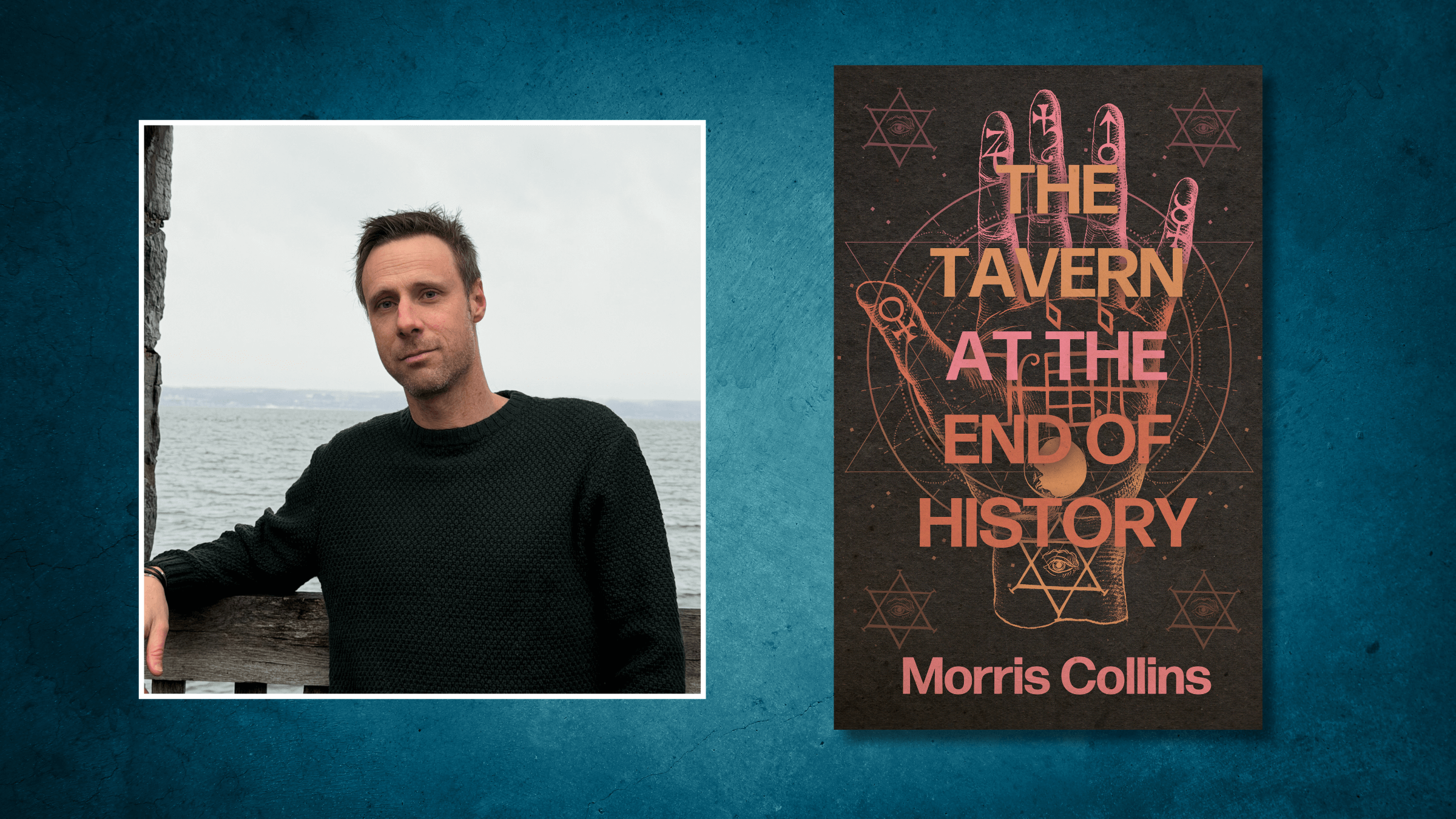
‘The Tavern at the End of History’ is Morris Collins’ second novel. Photo by Jessica Shearer/cover design by Matthew Revert/collage made by Olivia Haynie via Canvas

By Olivia Haynie February 11, 2026
The Tavern At The End of History
Morris Collins
Dzanc Books, 326 pages, $27.95
In Morris Collins’ novel about two directionless adults on the hunt for a famous work of art presumed to have been stolen during the Holocaust, one character theorizes that “the only way towards a moral life” is to let go of the past. But The Tavern At the End of History, a follow-up to Collins’ debut novel — the postcolonial thriller Horse Latitudes — is all about remembering, even that which is painful, and reckoning with it.
When readers are first introduced to Jacob, his inappropriate remarks to a student have cost him his professorship and his marriage, and he’s become an alcoholic. At a park in Brooklyn, he meets Baer, an impoverished Orthodox man living in a ramshackle apartment with only a fat orange cat to keep him company. As it turns out, they are both connected to the disgraced Kabbalah scholar Alex Baruch.
After meeting Baruch at a conference in Berlin, Jacob became a devoted follower. Even after Baruch was exposed for lying about being a German Holocaust survivor, Jacob remained loyal and has agreed to meet with Baruch at his sanitarium in Maine the same weekend Baruch plans to auction off a sketch by the deceased Jewish artist Alexander Lurio.
Baer reveals that the sketch had belonged to his family before the war, but, he says, it was confiscated by the Nazis. Jacob agrees go to Maine and look for the sketch with Baer’s cousin Rachel, an art historian still reeling from her husband’s suicide after she helped him leave the Orthodox community. But art isn’t the only interesting thing on Baruch’s private island. There are neo-Nazis, an erotic statue garden, otherworldly entities, and an eccentric group of Jews, although it’s unclear if they are fellow visitors of the sanitarium or patients.
Jacob, Rachel and the other Jews at the sanitarium are incessantly haunted by the past — for Baruch, this becomes literal, when a friend he presumed had died in the Holocaust appears at his doorstep. The oddball group spends their five days in Maine, primarily telling stories about their trauma, all linked to the Holocaust through either their own experiences or those of their parents. It may be doubtful that there is any sense to be derived from tragedy, but they try their very best.
For Baruch, this means trying to justify lying about his past and doing unspeakable things to make his life easier. Jacob funnels his confusion into philosophical debates about how — or even if — the Holocaust and Israel should be understood in relation to one another. Rachel seems to believe misfortune can be rectified as she hunts for the stolen Lurio sketch.
The book often veers into unsettling territory, sometimes painting overwhelmingly disturbing scenes from the Holocaust, but Collins’ illustrative writing keeps the story engaging, even in its bleakest moments. His world-building is so convincing it’s almost incomprehensible that the Lurio works are fictionalized. Even the enigmatic Alex Baruch and the fake writings Collins “quotes” from feel real.
Because the book takes place in 2017, some of its musings on Israel and antisemitism feel less jarring than they could be. The characters watch the Charlottesville Unite the Right rally on the television, scenes that could now easily be substituted with more alarming images of government officials cozying up to neo-Nazis. The discussions about the Holocaust and Zionism feel less edgy than they may have almost a decade ago, as so much new scholarship questioning the role of memory and trauma in the creation of Israel has come out.
The book ends with some ambiguity about what exactly transpires on the island and how our characters will be able to move on. Still, Collins crafts a compelling art mystery, buttressed by a tale of a group of lost souls trying to find meaning in a world that sometimes feels hopeless.
This is a moment of great uncertainty. Here’s what you can do about it.
We hope you appreciated this article. Before you go, we’d like to ask you to please support the Forward’s independent Jewish news this Passover. All donations are being matched by the Forward Board - up to $100,000.
This is a moment of great uncertainty for the news media, for the Jewish people, and for our sacred democracy. It is a time of confusion and declining trust in public institutions. An era in which we need humans to report facts, conduct investigations that hold power to account, tell stories that matter and share honest discourse on all that divides us.
With no paywall or subscriptions, the Forward is entirely supported by readers like you. Every dollar you give this Passover is invested in the future of the Forward — and telling the American Jewish story fully and fairly.
The Forward doesn’t rely on funding from institutions like governments or your local Jewish federation. There are thousands of readers like you who give us $18 or $36 or $100 each month or year.
Support our mission to tell the Jewish story fully and fairly.