An idyllic Jewish village, full of life and hope, just hours before its utter annihilation
The Yiddish language Holocaust film ‘Shttl’ takes place outside Kyiv prior to the Nazi invasion
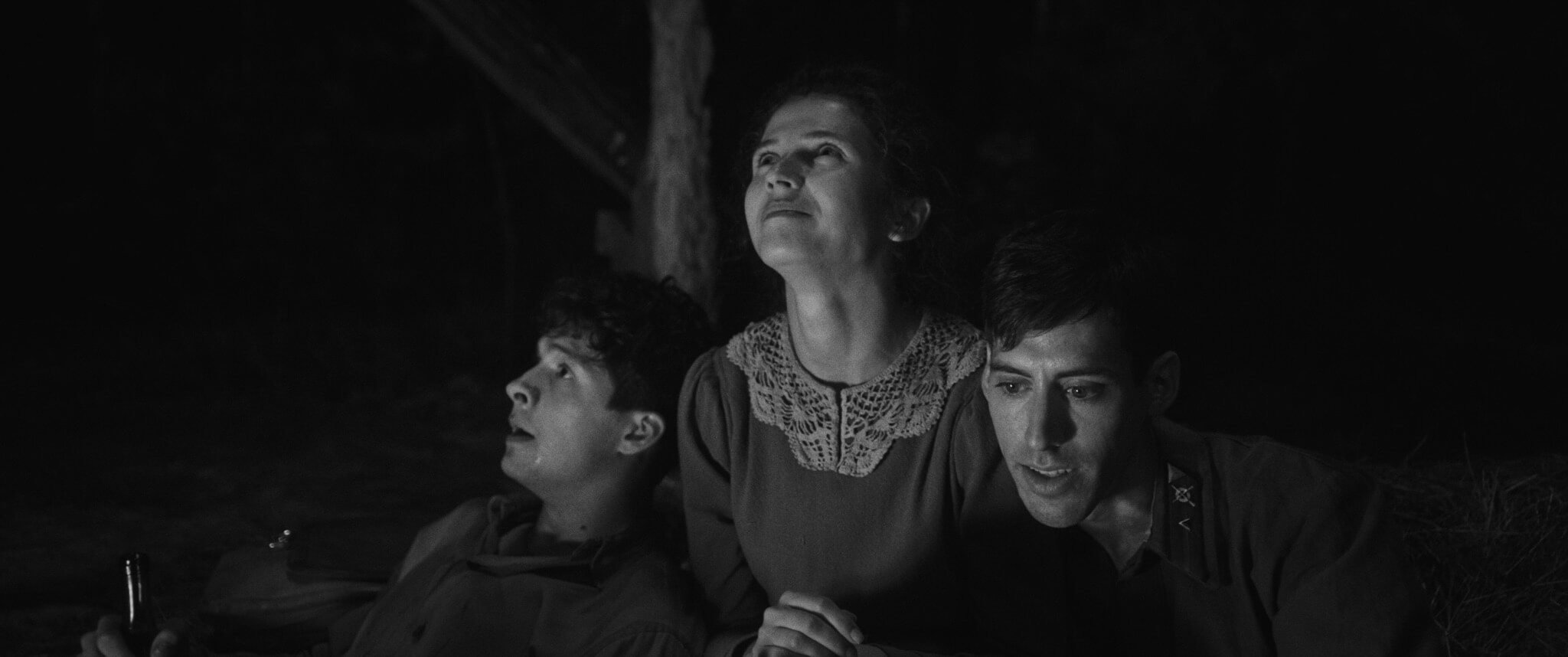
The three protagonists of ‘Shttl’ before their bright visions for the future are dashed. Courtesy of Menemsha Films
A remarkable scene in Ady Walter’s film Shttl takes place in a Jewish Ukrainian village outside of Kiev on June 21, 1941, one day before the Nazi invasion, known as Operation Barbarossa.
The Rebbe, played by the always excellent Saul Rubinek is the voice of reason; he is a thoughtful, complex, contradictory and conflicted character. He does not raise his voice, he takes time to consider what to say as he himself struggles to respond to whatever factionalism arises within the community. His sad eyes are expressive. He repeatedly rubs his thumb across his fingers. This is a master class in consummate acting.
The mostly black-and-white Yiddish language film, currently playing in New York at New Plaza Cinemas, spans 24 hours in the shtetl, whose residents remain clueless of the impending doom despite the presence of the Russian Army that has already infiltrated the village. Nonetheless the cracks are surfacing within the community. Intense arguments abound on such issues as workers rights and whether to abandon religion or commit to a devoted life. One female character espousing the need for women’s rights, anticipates the future struggle of feminism in the face of patriarchy.
At its core, the film explores Jewish identity, unity and survival. The Rebbe understands factionalism yet remains implacable as he urges the townspeople to be Talmudic in their judgments, tolerant and compassionate. He describes true Jewishness as the color gray, allowing for and even respecting differences of opinion, purpose and worldview.
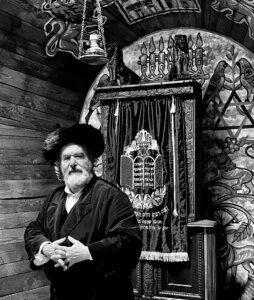
For, the Rebbe, Jews must always remain unified on some profound level. “Unity is the only thing that matters in the battle against evil,” he asserts. His second tenet is faith in God. Doubt can never enter the picture.
The central character, Mendele (Moshe Lobel in a nicely understated performance) is an aspiring filmmaker, who has long since left the shtetl to join the Red Army in Kyiv. But he returns home along with his best friend, a non-Jewish Ukrainian named Demyan (Petro Ninovskyi), so he can elope with his true love, Yuna (Anisia Stasevich), the child of The Rebbe.
But Yuna is already engaged through an arranged marriage to Folie (Antoine Millet), a cruel, autocratic Hasid who, despite his alleged religiosity, is petty, sly, cunning and ultimately violent.
Mendele remains torn between his ambitions embodied by the cosmopolitan outside world and the restrictive, confined shtetl where he is still deeply rooted. And he can’t help but feel connected to his estranged father, whom he holds responsible for the suicide of his late mother who, like Mendele, was also an outlier.
The film was shot in Ukraine in 2021 at the height of COVID-19 restrictions and at the very moment the Russian invasion was looming. Now that the president of Ukraine is a Jew at the very same time antisemitism is surging across the globe and Ukrainians and Jews are both under assault, the parallels and irony are almost implausible.
Walter, a documentary film director making his feature debut, has said his mission was to bring the shtetl universe that was totally wiped out during the Holocaust back to life. The title Shttl with its missing “e” references the 1969 novel, La Disparition by Georges Perec, whose mother died in Auschwitz. In Perec’s fictional work the letter “e” never appears in Shttl, its absence mirroring the emptiness, the void, the loss.
In this film, unlike such Holocaust classics like Schindler’s List, The Pianist, Son of Saul, death, despair, and hopelessness are not yet part of the collective experience. This is life prior to the Holocaust in an ethnically diverse community overflowing with purpose and hope for the future. Many Jews and gentiles enjoy camaraderie, and Yiddish and Ukrainian are both spoken.
Shtll’s cinematic technique is evocative, specifically the way scenes of recollection seamlessly morph into color — Mendele recalls his life as a yeshiva boy and the time his gentle mother gave him a baby rabbit as a pet. The colorful flashbacks suggest the past is so much more vivid than the black-and-white present.
Nevertheless, I found the film problematic. Though it has been praised for its one-shot cinematic approach, which purports to make the movie more immediate, real and immersive for the viewer, the set and the inconsistent performances made it feel more like a filmed stage play to me. And, more importantly, the characters don’t seem like actual human beings as they do spokespersons for various political, philosophical,and religious viewpoints. The quirky folkloric figures don’t help. There are two holy fools of various stripes — a beatific deceased mom who appears as a spectral figure, and my favorite, the butcher who has become a vegetarian.
Admittedly, my image of shtetl life is informed by a Fiddler on the Roof ethos and, by extension, the stories of Sholem Aleichem which presents a largely impoverished, insular and marginalized world, even if its residents don’t see themselves as disenfranchised. But in Shttl, the youthful characters are self-confident in their speech, gestures, and especially their wide-stride, swaggering gaits. They seemed jarringly secular and contemporary to me.
In one scene, our three protagonists, including Yuna, are happily passing back and forth a bottle of booze, each guzzling from the communal cap. The provincial virginal daughter of The Rebbe in a 1941 shtetl? Really?
In the end, though, the film makes a 180-degree turn that nearly eradicates its flaws. Mendele, Demyan, and Yuna have spent the night in the forest and have fallen asleep content in their certainty that at sunrise they will be embarking on their great adventure to freedom.
As dawn breaks and the sun begins to emerge over the trees. Mendele hears gunfire and spies the battalions of Nazis entering the shtetl en masse. The obliteration that will follow is clear. The respective politics, philosophies, not to mention petty jealousies, indeed, all the internecine fighting on the one hand and the moments of jubilation on the other have become totally meaningless. The realization is devastating.