How the Jewish Museum brought Black film history to new audiences
A revival of the 1970 series ‘The Black Film’ recounts how the museum encouraged intercultural dialogue in the wake of Black-Jewish conflict
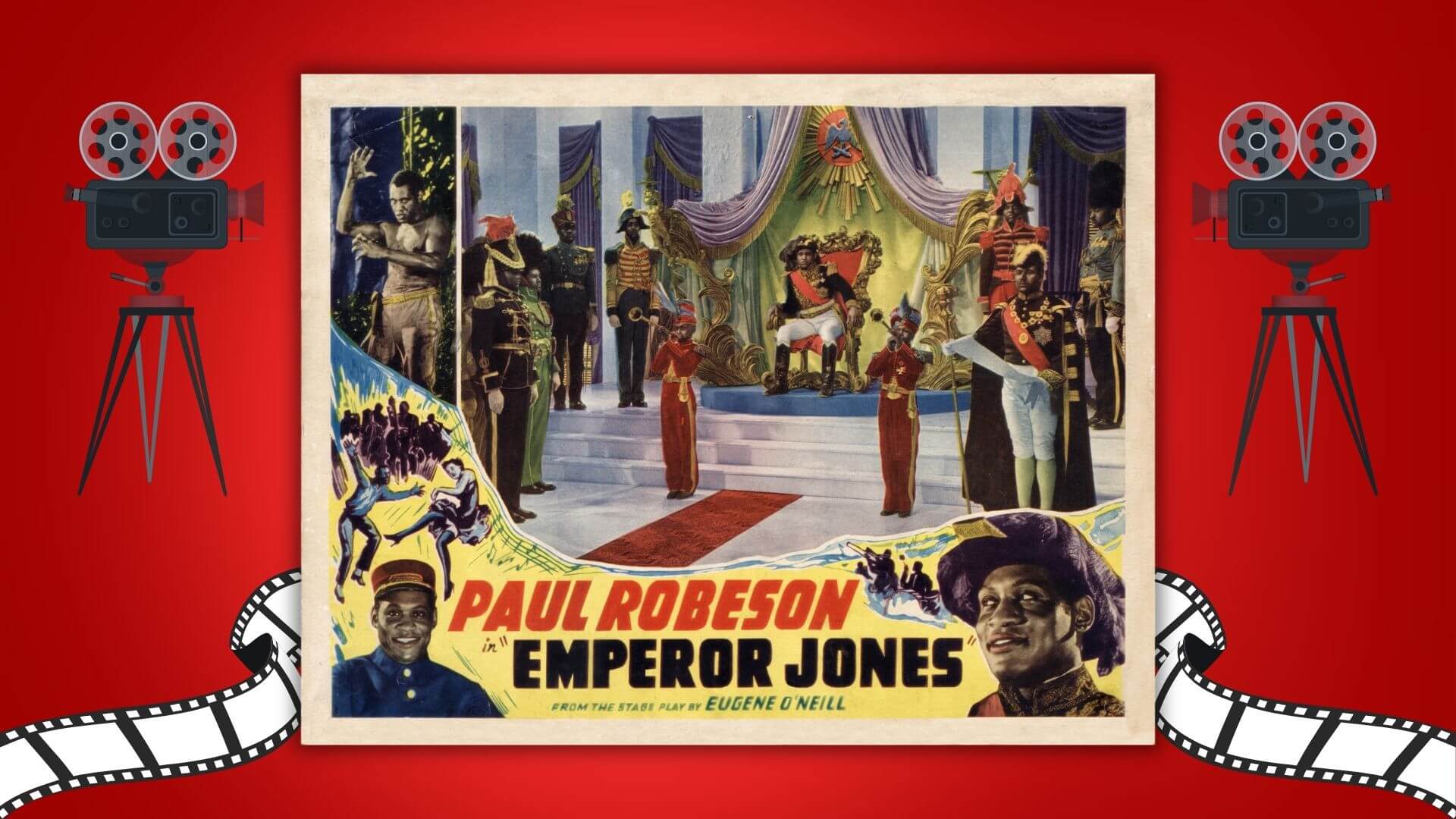
One of the films in the installation at the Jewish museum is ‘Emperor Jones,’ starring Paul Robeson. Courtesy of John Kisch Archive/Getty Images/collage made by Olivia Haynie via Canvas

By Olivia Haynie February 17, 2026
It was 1970 and Black-Jewish relations weren’t at their best. Two years earlier, the Ocean-Brownsville teachers’ strike in Brooklyn had pitted Black and Jewish New Yorkers against one another. Distrust lingered between Black artists and museums after the controversial 1969 Met exhibit Harlem on My Mind showcased life and culture in Harlem, but excluded the work of Black Harlem natives. The Art Workers Coalition had just been founded, demanding better Black and Puerto Rican representation in museums, particularly MoMA.
Karl Katz, director of the Jewish Museum, was determined to find a way to connect the museum to its “African-American neighbors.” He noted in his memoir The Exhibitionist that, although Harlem “began only a dozen or so blocks north” of the museum, their exhibitions “generally had trouble drawing a diverse crowd.” When a friend told Katz about race films — films from the early 20th century made specifically for Black audiences usually starring all Black casts — Katz knew he wanted to show them at the museum.
In 1970, the film series The Black Film — a showing of 14 Black movies made between 1925 and 1965 — opened. Curated by an interracial team — Black film scholar Pearl Bowser, color-barrier breaking TV producer Charles Hobson, and psychologist and art exhibitor Mel Roman — the event was a collaboration between the museum and the Harlem Cultural Council. A number of publications, including the Black newspaper The New York Amsterdam News, covered it.
“It’s all about this community,” said Gillian Bowser, Pearl Bowser’s daughter and a professor of ecosystem science and sustainability at Colorado State University. “And a community saving and celebrating its history. And the Jewish Museum was part of that initial effort to recognize the importance of saving the everyday voice.”
Now, over 50 years later, excerpts from the films are back on display at the Jewish Museum.
Hidden Gems
The films in the series were collected by Bowser, a former cookbook author who became known as the Godmother of Black Independent Cinema for her work in film preservation and scholarship on Oscar Micheaux, a prolific race film producer.
The museum program included Micheaux’s 1925 film Body and Soul, starring Paul Robeson in his first film role. Historians also believe it’s the only film he ever worked on with a Black director. Robeson plays twins — one a conniving criminal and the other an innocent young man who has to deal with his brother’s misdeeds.
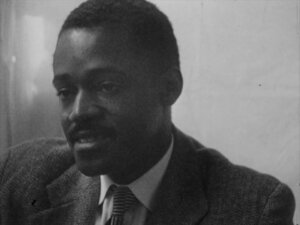
Another film is an early work by Melvin Van Peebles, director of the pioneering blaxploitation film Sweet Sweetback’s Bassdassss Song. His 1957 film in the Bowser collection, Sunlight, has some of the criminal elements of his most famous work, but is primarily a tender portrayal of young Black love.
-
-
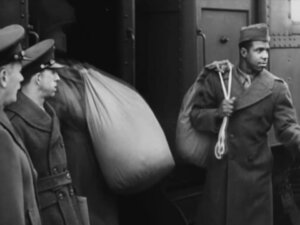
‘The Negro Soldier,’ 1944.
Courtesy of the National Archives via the Jewish Museum
-
-
Melvin van Peebles directed and starred in the 1957 film ‘Sunlight.’
Courtesy of Mario van Peebles via the Jewish Museum
The Negro Soldier, a 1944 production by the United States Department of War that celebrates Black soldiers’ valor during World War II.
“What a surprise the Nazis will get,” the narrator says as the troops march on. “Black, brown, yellow and white men from all Americans land on the airfield of Berlin.”
The 1970 series opened the year before Van Peebles released Sweet Sweetback’s and kicked off the blaxploitation movement, which often highlighted criminal lifestyles. The films Bowser showed offered a different form of Black representation. Lisa Collins, a documentarian and mentee of Bowser’s, noted that it “was so revolutionary at that time” to have films showing Black Americans as judges, scientists and working professionals.
Saving film history
Bowser preserved both American and international films, including movies from London and Senegal. Without her, it’s possible some of these films would have never seen the light of day. Her friend and collaborator Louis Massiah, a MacArthur awarded filmmaker and founder of the non-profit media center Scribe Video in Philadelphia, told me she knew where to find old reels or fragments of film strips at risk of being thrown out.
“She would go to movie theaters and she would chat up projectionists,” Massiah told me, noting that Pearl was “extraordinarily charming.”
He commented that “it was absolutely rare” for people in the general public to have films made by non-commercial Black filmmakers
“This is before the Internet. This is before the accessibility of films,” said Massiah. With money from the New York City Department of Cultural Affairs, Bowser was able to take the race films on the road. “For a lot of folks, it was a revelation.”
When Gillian Bowser was a kid, she accompanied her mother to screenings at art house theaters and public libraries, often tasked with being the projectionist at the latter.
“The people hadn’t seen Black people in Westerns, they hadn’t seen all these films that were shot that were just forgotten for a long time,” she said.
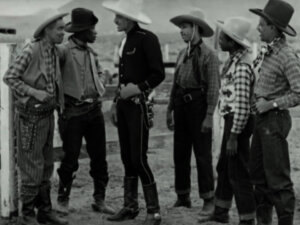
The Jewish Museum was one of the first major institutions to showcase Bowser’s work and expanded the audience she was able to reach. She was later able to take the films around the country, including on a tour to various historically Black colleges and universities.
A revival of art — and issues of the past
For the new exhibit, filmmakers Lisa Collins, Mark Schwartzburt and Anthony Jamison cut the 14 films from the 1970 exhibit into short vignettes that are projected onto a large wall on the museum’s third floor and played on a loop. Collins and Schwartzburt, mentees of Bowser who had been working with her on an Oscar Micheaux documentary until her death in 2023, conceived of the new installation through conversations with New York Jewish Film Festival Director Aviva Weintraub. Collins told me Weintraub was integral in getting the museum to agree to the project, although with one complex stipulation: that each film be cut down to 30 seconds. The process took months of editing but the three filmmakers managed to create 2-minute long vignettes of each film instead.
“At the end of the day, we always wanted to show enough of the film to keep you interested and to get you interested to see the larger version,” said Jamison.
On a smaller monitor, two short films play on rotation. One is an excerpt of a short documentary Collins and Schwartzburt made shot in 2021 when a 90-year-old Bowser returned to the Jewish Museum for the first time in 50 years and spoke to them about her memories of working there. Bowser passed away two years later. Another is a segment from a 1984 episode of Paper Tiger Television, a public access TV program based in New York. A young Bowser explains Micheaux’s legacy, crediting his genius and “chutzpah” for the strides he made in Black cinema.
Many of the films from the 1970 series are available for viewing in various places, such as Kino Lorber’s “Pioneers of African-American Cinema” collection, the Criterion Channel, and other streaming services. Bowser’s total collection includes over 500 films, which are stored at the Smithsonian institute, and are a testament to her dedication to making sure Black stories don’t disappear. For a long time, Black filmmakers struggled to have their achievements and contribution to American history recognized.
“As the Black community, we may be facing this again,” Gillian said, noting the recent removal of monuments to slavery at national parks. “Our job now is to make sure these stories get saved and retold.”
In an interview, Schwartzburt expressed a similar sentiment.
“The political environment we’re in right now, where there is so much erasure going on and backstepping — taking back civil rights — this couldn’t be more important,” he said.
The installation will be open at the Jewish Museum in New York until March 1st.
Correction: An earlier version of this article incorrectly stated the length of the film excerpts in the installation. Each film is portrayed through a 2-minute long vignette, not a 30-second long vignette.
Correction: An earlier version of this article incorrectly stated that Oscar Micheaux was the owner of the first Black-owned movie company, Lincoln Motion Picture Company.
Clarification: This article has been updated to clarify how long it took to create the vignettes. The editing process took months, according to Lisa Collins, not hours.
This is a moment of great uncertainty. Here’s what you can do about it.
We hope you appreciated this article. Before you go, we’d like to ask you to please support the Forward’s independent Jewish news this Passover. All donations are being matched by the Forward Board - up to $100,000.
This is a moment of great uncertainty for the news media, for the Jewish people, and for our sacred democracy. It is a time of confusion and declining trust in public institutions. An era in which we need humans to report facts, conduct investigations that hold power to account, tell stories that matter and share honest discourse on all that divides us.
With no paywall or subscriptions, the Forward is entirely supported by readers like you. Every dollar you give this Passover is invested in the future of the Forward — and telling the American Jewish story fully and fairly.
The Forward doesn’t rely on funding from institutions like governments or your local Jewish federation. There are thousands of readers like you who give us $18 or $36 or $100 each month or year.
Support our mission to tell the Jewish story fully and fairly.