Fox’s Bible story miniseries puts women front and center
‘The Faithful: Women of the Bible’ recounts the journeys of the matriarchs
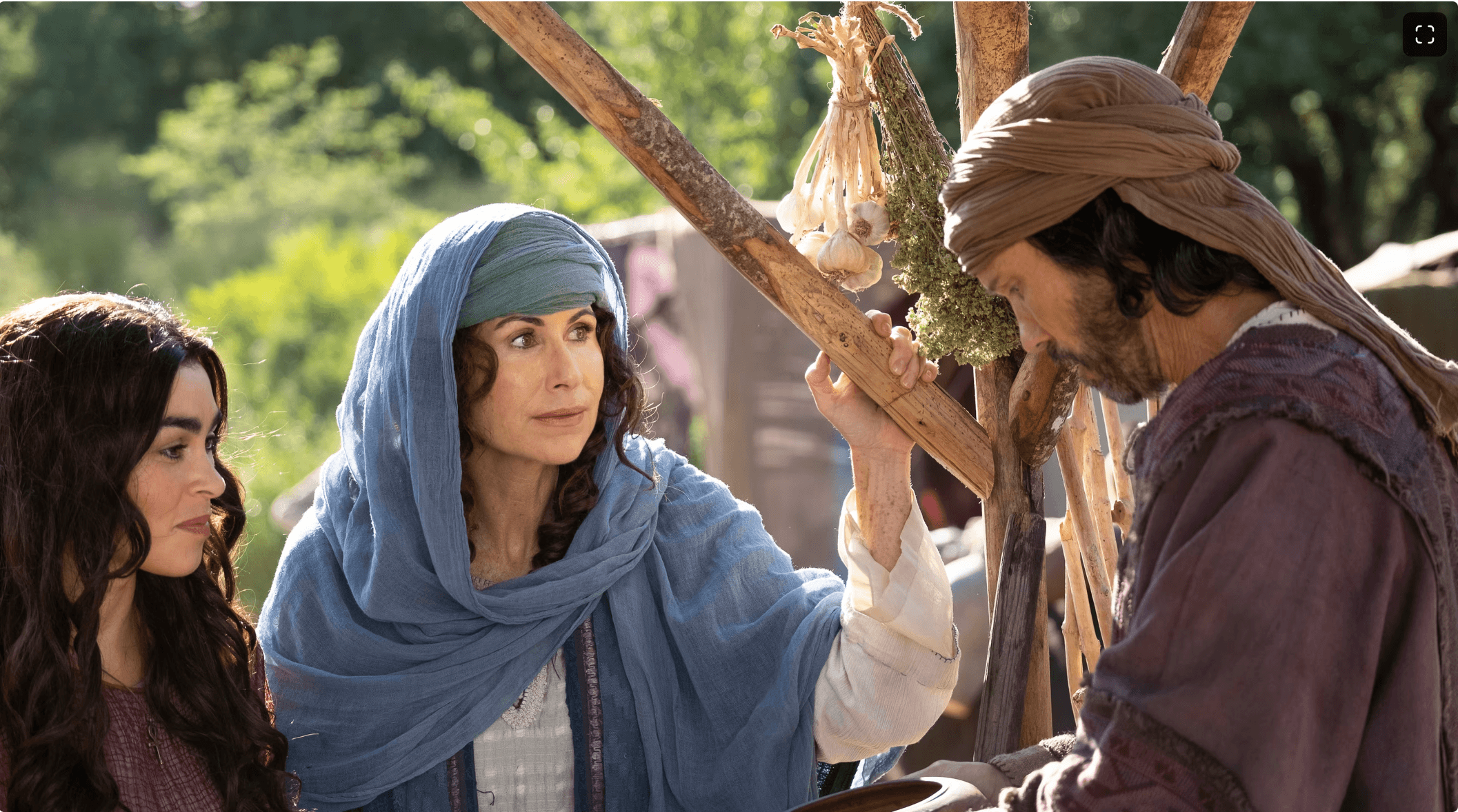
Hagar, Sarah and Abraham in Fox’s The Faithful: Women of the Bible. Courtesy of Fox
By PJ Grisar March 18, 2026
Depending on where you start the clock, the founding of the Jewish nation was partially born of an act of extreme cruelty.
When Sarah welcomed Isaac, after decades of trying for a child, she persuaded Abraham to send away her handmaiden Hagar and her son by him, Ishmael. That God provided for the child and his mother in the wilderness, and made a great nation of Ishmael’s descendants, was a worthy consolation. But could Sarah have known this blessing would come to pass?
In the first installments of Fox’s shiny new six-part, Sunday school miniseries, The Faithful: Women of the Bible, debuting March 22, it is Hagar (Natacha Karam) who narrates the story of Sarah. Though their dynamic was complicated — the OG Handmaid’s Tale — Hagar concludes that Sarah was a friend, and through the ages, “came to symbolize motherhood” as the “first of the great matriarchs.”
The mission statement of The Faithful, devised by an interfaith team and written by Star Trek alum René Echevarria and directed by Danny Cannon (CSI, Judge Dredd, Geostorm), is to foreground the stories of women in the biblical narrative. To that end, Sarah — played by Minnie Driver, using her natural British accent, forcing Yank Jeffrey Donovan’s Abraham to match her Received Pronunciation — has more agency than she did in Genesis.
It is Sarah (then still Sarai) who tells the pharaoh that Abraham is her brother and dodges the monarch’s advances with the help of some divine intervention. Leaving the palace, she manages to liberate Hagar, who was enslaved there.
Billed in the first episode title as “The Woman who Bowed to No One,” this Sarah is strong-willed, petitioning the almighty, with screams and some hurled offerings, to open her womb. As in scripture, it is her idea to give Hagar to Abraham to produce an heir. Only in this iteration there’s a quid pro quo: If Hagar gives Abraham a child, Sarah will help her return to her homeland. When the baby comes, Hagar reneges, sparking Sarah’s jealousy and the pretense that Hagar is not Ishmael’s real mother.
When Isaac arrives, heralded by three hooded strangers who stop by Abraham’s tent before firebombing Sodom and Gomorrah, the friction between Ishmael and his younger, legitimate brother is too much for Sarah.
“Cast them both out,” she tells Abraham. “We have to protect Isaac no matter the cost.”
The scene is uncomfortable. The actor playing Ishmael is brown and, while raised by Abraham and Sarah from infancy, has a different accent from Driver or Donovan. The child actor playing Isaac is blond, and Abraham hoped he’d have his mother’s light eyes.
Josephus and Jewish tradition regard Ishmael as the founder of the Arab nation. In Islam, he, not Isaac, is Abraham’s heir and the son who experienced the would-be sacrifice of the akedah. It will perhaps be difficult for some to watch white actors settle Canaan and exile people of color and not recall the narrative now surrounding Israel, and the meme of just about everything being promised to Jews 3,000 years ago.
But The Faithful is too dull to be truly provocative.
A common refrain has Abraham describing his wish to stand with his bride, “shoulder to shoulder, no matter what.” We see their early courtship beginning when Abraham (then Abram) helps her to disrupt an arranged marriage and gifts her a blue shawl — the fact that they may have been half-siblings is duly glossed over. It’s Tanakh by way of Nicholas Sparks, forgoing the most major marital challenge by skipping the binding of Isaac entirely.
Making Hagar a passive protagonist is an interesting twist, but the proceedings are too rooted in the mythic to fully capture the human drama at the story’s core. (Her journey, in which she grabs a rock from her homeland, and decades later places it on Sarah’s grave, dubiously suggests the origins of a familiar Jewish custom.)
The series has reasonable production values — which will go on to track Rebekah, Rachel and Leah — and since it’s based on the most popular book of all time, there’s a built-in audience that could certainly overlook some hackneyed writing and soap opera acting. As far as entertainment of this ilk goes, the show is of the highest caliber, admittedly faint praise.
The tales were meant to be retold, and we see Abraham developing the Jewish oral tradition, speaking of Eden and the Tower of Babel around the campfire. One night he teases the story of Sarah’s cunning escape from Pharaoh’s court.
Sarah laughs, chiding him for presenting the incident “as if it were one of the sagas.”
“Who knows,” Abraham all but winks at the viewer. “It might be one day.”
It is, but not all tellings are created equal.
This is a moment of great uncertainty. Here’s what you can do about it.
We hope you appreciated this article. Before you go, we’d like to ask you to please support the Forward’s independent Jewish news this Passover. All donations are being matched by the Forward Board - up to $100,000.
This is a moment of great uncertainty for the news media, for the Jewish people, and for our sacred democracy. It is a time of confusion and declining trust in public institutions. An era in which we need humans to report facts, conduct investigations that hold power to account, tell stories that matter and share honest discourse on all that divides us.
With no paywall or subscriptions, the Forward is entirely supported by readers like you. Every dollar you give this Passover is invested in the future of the Forward — and telling the American Jewish story fully and fairly.
The Forward doesn’t rely on funding from institutions like governments or your local Jewish federation. There are thousands of readers like you who give us $18 or $36 or $100 each month or year.

Support our mission to tell the Jewish story fully and fairly.