This Christian conversion comedy should have left Jews out of it
In ‘Premarital,’ a Christian family tries to convert their secular son-in-law
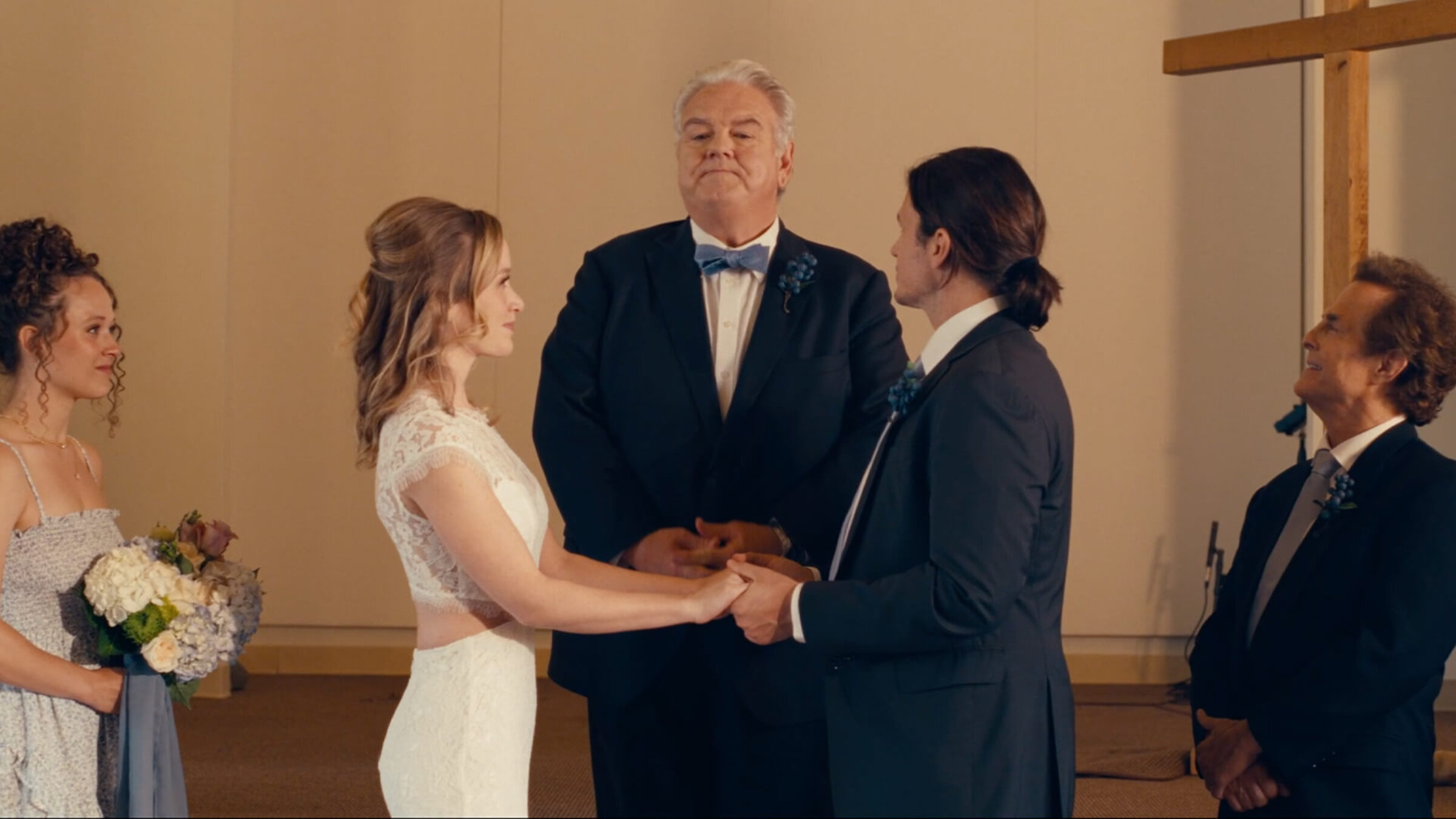
Moments after this, Allan stomped on a plastic cup of communion wine for, I guess, Judaism. Courtesy of Premarital Movie

By Mira Fox April 6, 2026
It’s a classic Guess Who’s Coming to Dinner set-up: A family’s first meeting with their daughter’s beau turns sour when they learn he’s not who they imagined.
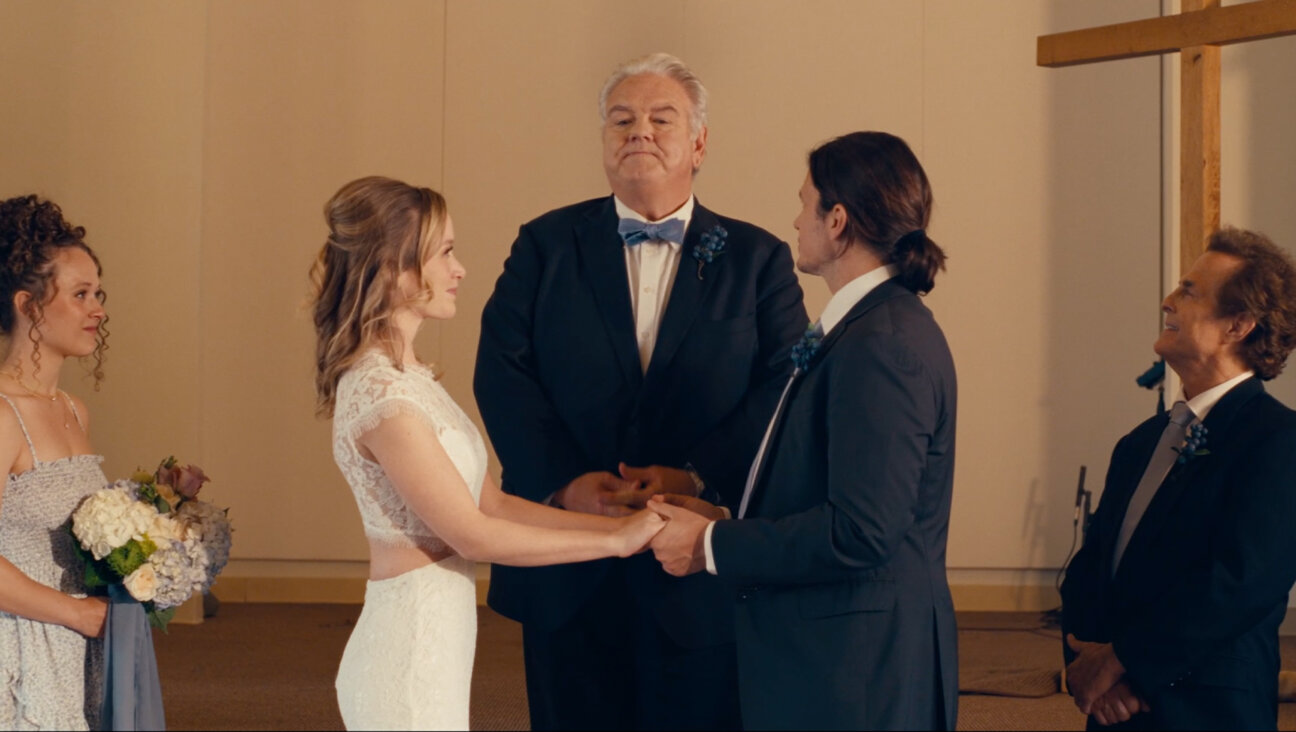
In Premarital, a new movie starring Jim O’Heir of Parks and Recreation, Sophie (Kelley Jakle), a pastor’s daughter, returns from New York City to her anonymous midwestern town to get married in the family church. This, the week of their wedding, is apparently the first time anyone in the family has met Allan (Mark Hapka). And, as they sit down to say grace over dinner, the issue is revealed.
“Oh, oh — you’re a Catholic,” says O’Heir as Pastor Stewart, nodding sagely.
“I’m not an anything,” Allan, who is an evolutionary biologist, replies. “I’m not religious at all.”
Hijinks ensue. The family gathers to formulate a plan to convert the scientist — this mostly involves playing baseball and mini golf while debating the truth of the bible, and faking several disasters to try to get him to consider God’s power.
Though Premarital is, on the surface, a warm comedy about understanding each other, it’s undergirded by a clear sense of derision towards religion, which is the butt of every joke, though the jokes are more light-hearted eye-rolls than sharp jabs.
“Science got us to the moon — where has religion gotten us?” asks Allan. “Western civilization!” yells Pastor Stewart as fireworks explode behind him, underscoring what the movie’s creators clearly think religion has actually done. (Writer and director Robert Ingraham’s bio says he required “therapy” to get over his upbringing in the “rigid structures of conservative religion.”)

Still, Sophie — who stopped attending church long ago — repeatedly pleads with Allan to just lie to smooth things over with her family. Would it be so bad to just say he’s accepted Jesus? Especially since he doesn’t believe religion holds any power, saying he is Christian shouldn’t change anything.
The thing is — spoiler alert — Allan isn’t just an atheist; he’s Jewish, a fact which might inform his particular level of resistance to telling this white lie. But that reveal is left until nearly the end of the movie, when Allan’s parents come into town for the wedding and bring along a ketubah, saying that they’re not religious but thought it would be a nice nod to tradition.
“Wow, the seed of Abraham in my own daughter,” Stewart murmurs in a reverential tone. (Not incidentally, he makes random Holocaust references throughout the movie, usually connected to his belief that Christians are being persecuted in modern American society.)
“Why didn’t you tell me?” Stewart asks Allan, clearly chuffed. “The Old Testament is, like, my second favorite testament!”
And that’s about it for Judaism in Premarital. One has to wonder why it’s there at all.
The movie focuses on Allan’s scientific background when examining his issues with Christianity. He debates Stewart on religion’s rationality, making points about evolution and the historical development of the biblical text. Judaism never comes up — even though many Jews have a particular resistance to converting to Christianity given, you know, the centuries of persecution.
Similarly, we don’t explore why Stewart is so relieved to realize Allan is Jewish. After all, Allan’s entire family is secular, and Allan is no less an atheist than he was before. The moment could have been fodder for some insight into Christian fetishization of Jews, or at least a few more jokes, but it’s quickly left behind.
Premarital, in the end, feels like a Hallmark movie. It is sappy, it’s goofy, it’s cliché, but its jokes are low stakes and O’Heir brings his perfect comedic timing. It’s a pleasant watch. Sure, Hallmark would never sneer so openly at Christianity, but Premarital is still a Christian movie. Most of the movie is devoted to unraveling each family member’s apparent piousness, and outlining a vision of a more accepting Christianity. Stewart realizes that he has to learn to be flexible in his beliefs, and find space to appreciate his children for who they really are — to be, in short, a true Christian who, like Jesus, doesn’t judge. The movie may poke fun at religion, but ultimately its message affirms Christianity — at least a particular read of what it should be.
But Judaism is reduced to a quickly-forgotten prop in that message — which is, in a way, a sharp commentary on Christianity’s tokenizing relationship with Jews. Maybe Premarital has something deep to say after all.
This is a moment of great uncertainty. Here’s what you can do about it.
We hope you appreciated this article. Before you go, we’d like to ask you to please support the Forward’s independent Jewish news this Passover. All donations are being matched by the Forward Board - up to $100,000.
This is a moment of great uncertainty for the news media, for the Jewish people, and for our sacred democracy. It is a time of confusion and declining trust in public institutions. An era in which we need humans to report facts, conduct investigations that hold power to account, tell stories that matter and share honest discourse on all that divides us.
With no paywall or subscriptions, the Forward is entirely supported by readers like you. Every dollar you give this Passover is invested in the future of the Forward — and telling the American Jewish story fully and fairly.
The Forward doesn’t rely on funding from institutions like governments or your local Jewish federation. There are thousands of readers like you who give us $18 or $36 or $100 each month or year.
Support our mission to tell the Jewish story fully and fairly.