3,600-Year-Old Pharoah’s Skeleton Found in Egypt
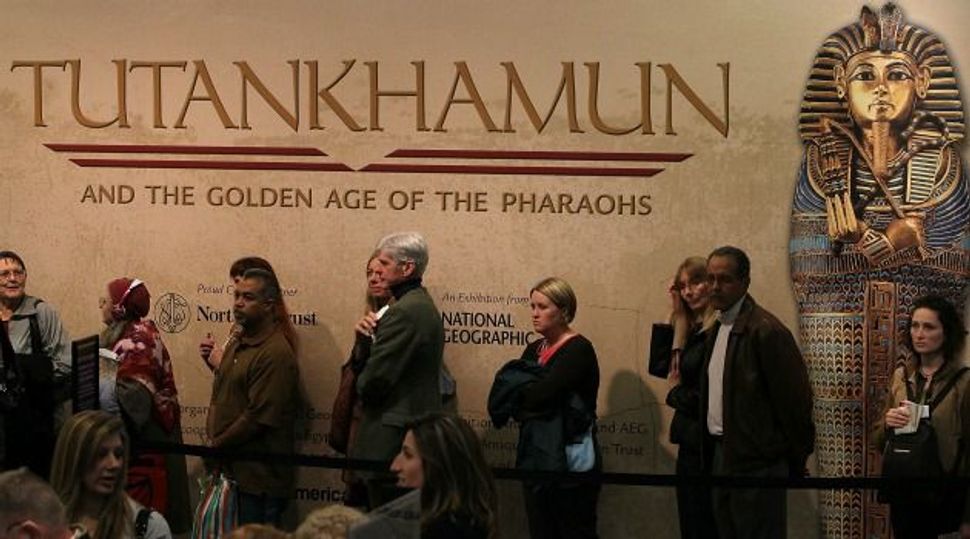
New Tut? A research team has uncovered the skeleton of a previously unknown pharoah named King Senebkay. Image by getty images
Archaeologists in Egypt believe they have discovered the remains of a previously unknown pharaoh who reigned more than 3,600 years ago.
The skeleton of King Senebkay were uncovered at South Abydos in Sohag province, about 500 km (300 miles) south of Cairo, by a University of Pennsylvania expedition working with the government, the Egyptian antiquities ministry said.
Never before heard of in ancient Egyptian history, King Senebkay’s name was found inscribed in hieroglyphics written inside a royal cartouche – an oval with a horizontal line at one end signalling a royal name, the ministry said in a statement.
Photographs released with the statement showed what appeared to be a heavily damaged sarcophagus in a burial chamber with no roof. Its stone walls were decorated with painted images.
The photos also showed the pharaoh’s skeleton laid out on a white sheet. “He was originally mummified but his body was pulled apart by ancient tomb robbers,” said the caption.
“No funerary furniture was found in the tomb, confirming it had been robbed in the ancient pharaonic ages,” the statement said, quoting Ali al-Asfar, an antiquities ministry official.
In the statement written in Arabic, Joseph Wegner, head of the expedition, added: “The modesty of the size of the tomb points to the decline of economic conditions in this period”.
The statement dates King Senebkay’s rule to 1650 BC during a time known as the second intermediate period when central authority collapsed and small kingdoms sprung up between the end of the Middle Kingdom and the start of the New Kingdom.
This is a moment of great uncertainty. Here’s what you can do about it.
We hope you appreciated this article. Before you go, we’d like to ask you to please support the Forward’s independent Jewish news this Passover. All donations are being matched by the Forward Board - up to $100,000.
This is a moment of great uncertainty for the news media, for the Jewish people, and for our sacred democracy. It is a time of confusion and declining trust in public institutions. An era in which we need humans to report facts, conduct investigations that hold power to account, tell stories that matter and share honest discourse on all that divides us.
With no paywall or subscriptions, the Forward is entirely supported by readers like you. Every dollar you give this Passover is invested in the future of the Forward — and telling the American Jewish story fully and fairly.
The Forward doesn’t rely on funding from institutions like governments or your local Jewish federation. There are thousands of readers like you who give us $18 or $36 or $100 each month or year.
Support our mission to tell the Jewish story fully and fairly.