Iconic Brazilian Jewish conductor Henrique Morelenbaum dies at 90
In addition to directing some of the country’s largest orchestras, he led a Jewish organization’s choir and composed a song for a Rio Jewish summer camp
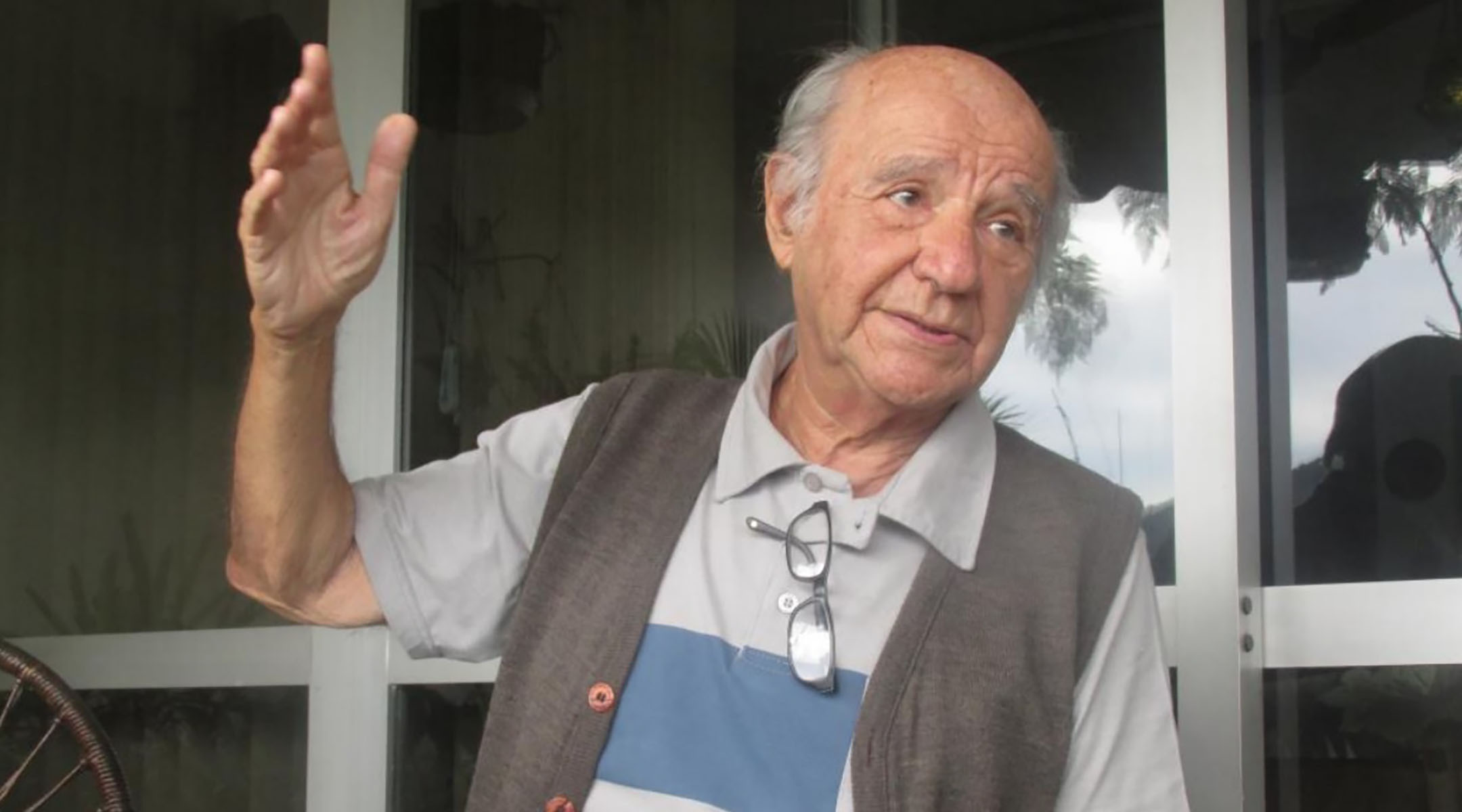
Henrique Morelenbaum, one of Brazil’s most prominent conductors, lost his extended family in the Holocaust. (Courtesy of Interludio)
RIO DE JANEIRO (JTA) — Henrique Morelenbaum, considered one of Brazil’s most prominent conductors and music directors, died Friday of natural causes in Rio de Janeiro at 90.
“He was one of the most important personalities in Brazilian musical life over the last 70 years, as an instrumentalist, conductor, teacher and administrator. He left his mark on the institutions where he worked,” read a tribute posted by the Brazilian Academy of Music, of which Morelenbaum was an active member.
Born in Poland in 1931 as Saul Herz Morelenbaum, Henrique Morelenbaum arrived in Rio at the age of 3, where his name was changed. At 16, he became a Brazilian citizen.
The rest of his extended family was killed in the Holocaust.
“From both my father and mother’s huge families, there was no one left,” he said in an interview with Interludio magazine in 2017.
After attending a public school, Morelenbaum received a scholarship to attend the local Sholem Aleichem Jewish school, later studying violin, viola, conducting and composition after high school.
His conducting career began suddenly in 1959 during a ballet performance in which he took over the baton because the scheduled conductor could not perform. By 1962, he became conductor of Rio’s Municipal Theater orchestra. Later, he became music director of the city’s Cecilia Meireles Hall theater.
Over the course of an intense career, Morelenbaum often conducted symphonic concerts, operas and ballets. As part of his vast international contemporary repertoire, he was responsible for the Brazilian premiere of the famed composer Arnold Schoenberg’s “Kol Nidre,” an orchestral piece named after the Yom Kippur prayer.
Morelenbaum also led the Brazilian Israelite Choir and composed the anthem of the Kinderland Association, a well-known Rio Jewish summer camp founded in 1952.
He served as the head of various musical institutions, at different times directing Brazil’s main orchestras, and he also conducted across Latin America and Europe.
Morelenbaum’s death made headlines in several Brazilian media outlets.
“He is widely recognized for the work of promoting Brazilian composers abroad,” wrote the Folha de S.Paulo newspaper. “His death was mourned by the Brazilian classical music niche, generating expressions of sorrow and tributes from several institutions,” added the G1 news portal’s obituary.
Morelenbaum is survived by his wife Sarah, three children, six grandchildren and two great-grandchildren.
“My dear father passed to a softer environment of the spiritual realm. I thank him for the affection, the legacy of the incessant search for knowledge and evolution, for justice and love, for the love of music and art in general as a way of building spiritual beauty,” wrote his son Jaques Morelenbaum, who is also a prominent conductor.
This article originally appeared on JTA.org.
This is a moment of great uncertainty. Here’s what you can do about it.
We hope you appreciated this article. Before you go, we’d like to ask you to please support the Forward’s independent Jewish news this Passover. All donations are being matched by the Forward Board - up to $100,000.
This is a moment of great uncertainty for the news media, for the Jewish people, and for our sacred democracy. It is a time of confusion and declining trust in public institutions. An era in which we need humans to report facts, conduct investigations that hold power to account, tell stories that matter and share honest discourse on all that divides us.
With no paywall or subscriptions, the Forward is entirely supported by readers like you. Every dollar you give this Passover is invested in the future of the Forward — and telling the American Jewish story fully and fairly.
The Forward doesn’t rely on funding from institutions like governments or your local Jewish federation. There are thousands of readers like you who give us $18 or $36 or $100 each month or year.
Support our mission to tell the Jewish story fully and fairly.