In the Netherlands, a majority do not know the Holocaust affected their country
Researchers also found that 12% of Dutch people think the Holocaust was a myth or greatly exaggerated
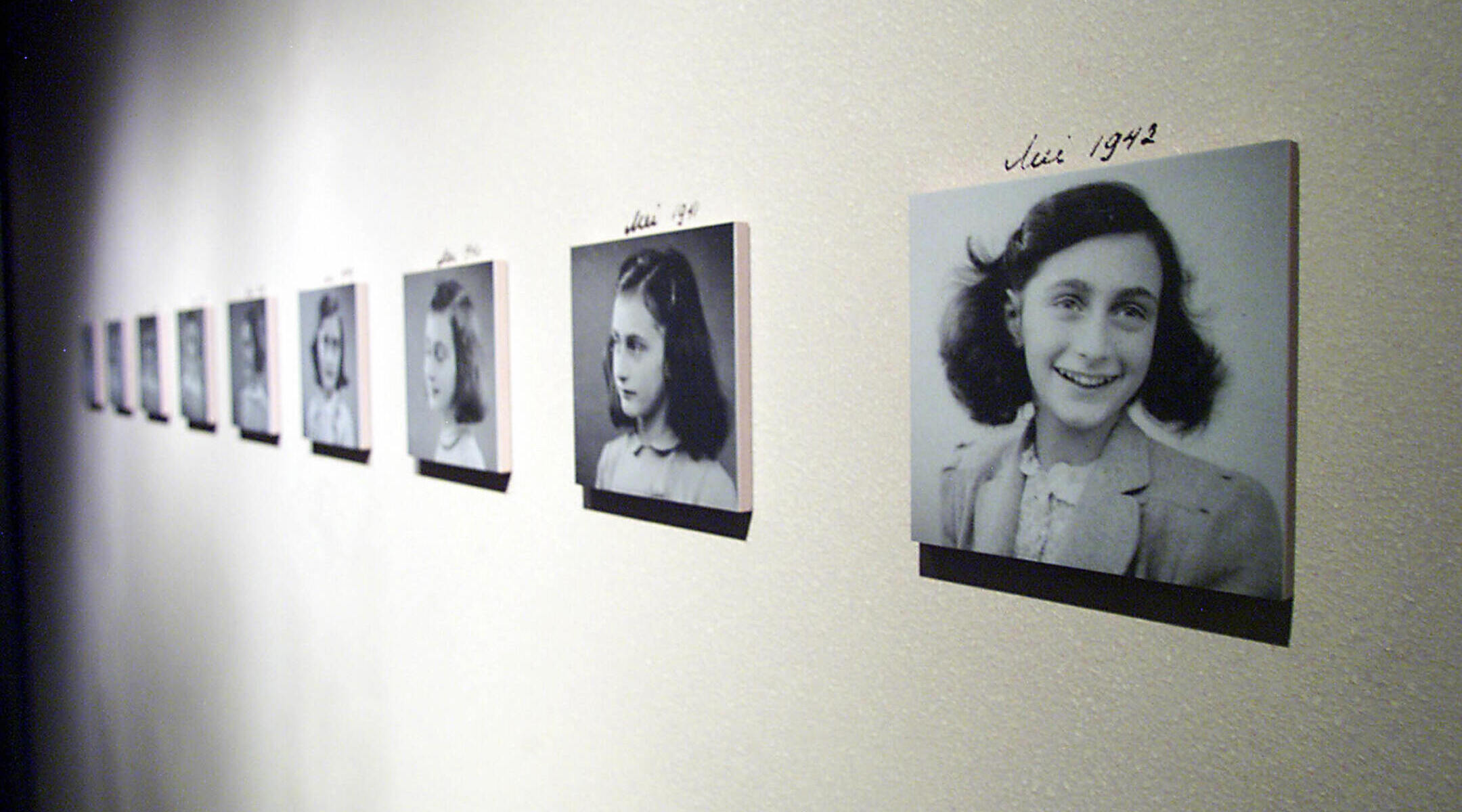
Part of an Anne Frank exhibit is seen at the U.S. Holocaust Memorial Museum in Washington, D.C., in 2003. (Tim Sloan/AFP via Getty Images)
(JTA) — A recent study of the Dutch population conducted by the Conference of Jewish Material Claims Against Germany showed an alarming lack of education around the Holocaust in the Netherlands.
For one, a majority of Dutch respondents, across all age groups, did not cite their own country as a place where the Holocaust took place, despite the fact that the Netherlands was the setting of the world’s most widely-read Holocaust memoirs — Anne Frank’s “The Diary of a Young Girl,” which has been translated into over 70 languages. About 75% of the country’s Jews were killed during the Holocaust, one of the highest rates in Europe.
The study, for which Schoen Cooperman Research surveyed 2,000 people across the country of over 17 million, also found that a majority of respondents (54%) and a slightly larger share of those in the millenial and Gen Z generations (59%) did not know that the number of Jews murdered by the Nazis totaled 6 million. Many said the total was as little as 2 million or fewer.
“Survey after survey, we continue to witness a decline in Holocaust knowledge and awareness. Equally disturbing is the trend towards Holocaust denial and distortion,” said Gideon Taylor, the Claims Conference president, in a statement about the study released on Wednesday. “To address this trend, we must put a greater focus on Holocaust education in our schools globally.”
The Netherlands is not in a category of its own with such numbers. A study published Tuesday by the American Jewish Committee found that a similar proportion of Americans — 47% compared to 54% in the Netherlands — did not know that 6 million Jews were murdered in the Holocaust.
However, researchers also found that the percentage of Dutch people who thought the Holocaust was a myth or greatly exaggerated (12%) was higher than in any other nation previously surveyed by the Claims Conference, an organization that advocates for and distributes restitution funds to Nazi victims and their descendants. Nearly a quarter of those in the younger generations believed it acceptable to hold neo-Nazi views.
“One of the more troubling trends we continue to see in these surveys is the rise in numbers of people who believe the Holocaust was a myth or that the number of Jews murdered is exaggerated,” said Greg Schneider, the Claims Conference’s executive vice president.
Despite those findings, a majority of Dutch respondents (77%) said that they felt that Holocaust education was increasingly necessary in the country.
“While many of the historical facts related to the Holocaust in the Netherlands are not known, I am encouraged by the number of respondents to this survey that believe Holocaust education is important,” said Emile Schrijver, the general director of Amsterdam’s Jewish Cultural Quarter and one of the people who conducted the survey. “We know that we can work together with educators to ensure the trends we see in Holocaust denial and distortion and the rise in antisemitism are countered by a robust curriculum of Holocaust education.”
This article originally appeared on JTA.org.
This is a moment of great uncertainty. Here’s what you can do about it.
We hope you appreciated this article. Before you go, we’d like to ask you to please support the Forward’s independent Jewish news this Passover. All donations are being matched by the Forward Board - up to $100,000.
This is a moment of great uncertainty for the news media, for the Jewish people, and for our sacred democracy. It is a time of confusion and declining trust in public institutions. An era in which we need humans to report facts, conduct investigations that hold power to account, tell stories that matter and share honest discourse on all that divides us.
With no paywall or subscriptions, the Forward is entirely supported by readers like you. Every dollar you give this Passover is invested in the future of the Forward — and telling the American Jewish story fully and fairly.
The Forward doesn’t rely on funding from institutions like governments or your local Jewish federation. There are thousands of readers like you who give us $18 or $36 or $100 each month or year.

Support our mission to tell the Jewish story fully and fairly.