U.S. opposes settlement expansion, annexation, Blinken says in Jerusalem
‘All sides must take steps to prevent further escalation’ after surging violence, says Secretary of State Blinken, adding that members of his team will stay on in the region to promote ‘practical steps’ toward peace
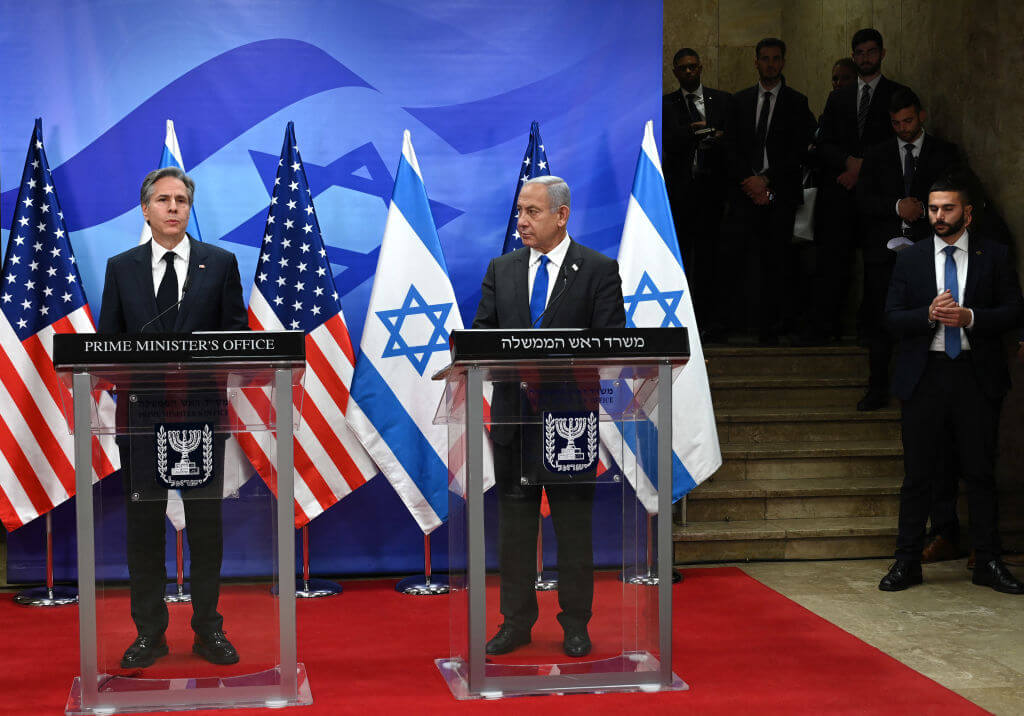
Secretary of State Antony Blinken and Prime Minister Benjamin Netanyahu at a press conference in Jerusalem in January, 2023. Photo by Getty Images
This article originally appeared on Haaretz, and was reprinted here with permission. Sign up here to get Haaretz’s free Daily Brief newsletter delivered to your inbox.
U.S. Secretary of State Antony Blinken said the United States opposes any moves that run counter to efforts for a two-state solution, including settlement expansion, moves towards annexation, demolitions and evictions, and changes to the status quo at holy sites, in a press conference summing up his two-day visit to Israel and the West Bank on Tuesday.
Blinken said he had discussed “constructive ideas and practical steps” to lower the flames during his meetings with officials in Egypt, Israel and the West Bank, and added that he asked senior members of his team to “stay on in the region and continue discussions on how these steps might actually be advanced.”
The officials remaining in Israel are Barbara A. Leaf, Assistant Secretary of State for Near Eastern Affairs and Hady Amr, Special Representative for Palestinian Affairs.
Their presence could complicate efforts to “strengthen” settlements which were approved by Israel’s cabinet following two terror attacks in Jerusalem that left seven dead. The attacks followed an army raid in Jenin that devolved into clashes, killing nine Palestinians.
“We support measures that promote peace and that expand the horizon of hope,” Blinken said, adding that the Biden administration was consistent in its statement that “no side will take unilateral steps.”
“All sides must take steps to prevent further escalation and restore calm” instead, he said, noting that the U.S. pledged $50 million in new funding for the United Nations Relief and Works Agency (UNRWA), bringing the two-year total to nearly $940m.
Invoking Russia’s war in Ukraine, Blinken said “Tehran’s deepening ties with Moscow and the sophisticated weaponry that they’re exchanging to enable one another’s aggression are among the many reasons that we raised with Israel the importance of providing support for all of Ukraine’s needs: humanitarian, economic and security.”
Earlier on Tuesday, Blinken met with Palestinian President Mahmoud Abbas in Ramallah, where the two discussed surging violence in the West Bank and Jerusalem, with Abbas laying the blame on Israel.
In a statement, Abbas called for the “cessation of Israeli aggression and the implementation of signed agreements,” and reiterated his prevailing demand for an end to Israel’s occupation.
Abbas also condemned Israel’s “policy of unilateral measures” listing settlement construction, annexation, daily West Bank raids and home demolitions.
“We are ready to act with the U.S. administration and the international community to return to political dialogue aimed at ending the occupation and establishing a Palestinian state within the 1967 borders, with East Jerusalem as its capital,” Abbas said.
Blinken, who is the second senior U.S. official to visit Israel this month since U.S. National Security Advisor Jake Sullivan’s visit, also met with Prime Minister Benjamin Netanyahu, President Isaac Herzog, Foreign Minister Eli Cohen, Defense Minister Yoav Gallant and leader of the opposition Yair Lapid. Notably, Blinken also met with civil society leaders in Israel.
This is a moment of great uncertainty. Here’s what you can do about it.
We hope you appreciated this article. Before you go, we’d like to ask you to please support the Forward’s independent Jewish news this Passover. All donations are being matched by the Forward Board - up to $100,000.
This is a moment of great uncertainty for the news media, for the Jewish people, and for our sacred democracy. It is a time of confusion and declining trust in public institutions. An era in which we need humans to report facts, conduct investigations that hold power to account, tell stories that matter and share honest discourse on all that divides us.
With no paywall or subscriptions, the Forward is entirely supported by readers like you. Every dollar you give this Passover is invested in the future of the Forward — and telling the American Jewish story fully and fairly.
The Forward doesn’t rely on funding from institutions like governments or your local Jewish federation. There are thousands of readers like you who give us $18 or $36 or $100 each month or year.
Support our mission to tell the Jewish story fully and fairly.