Bill to criminalize egalitarian prayer and immodest dress at the Western Wall is shelved after outcry
Israeli Prime Minister Benjamin Netanyahu said the legislation ‘will not be brought up at present.’
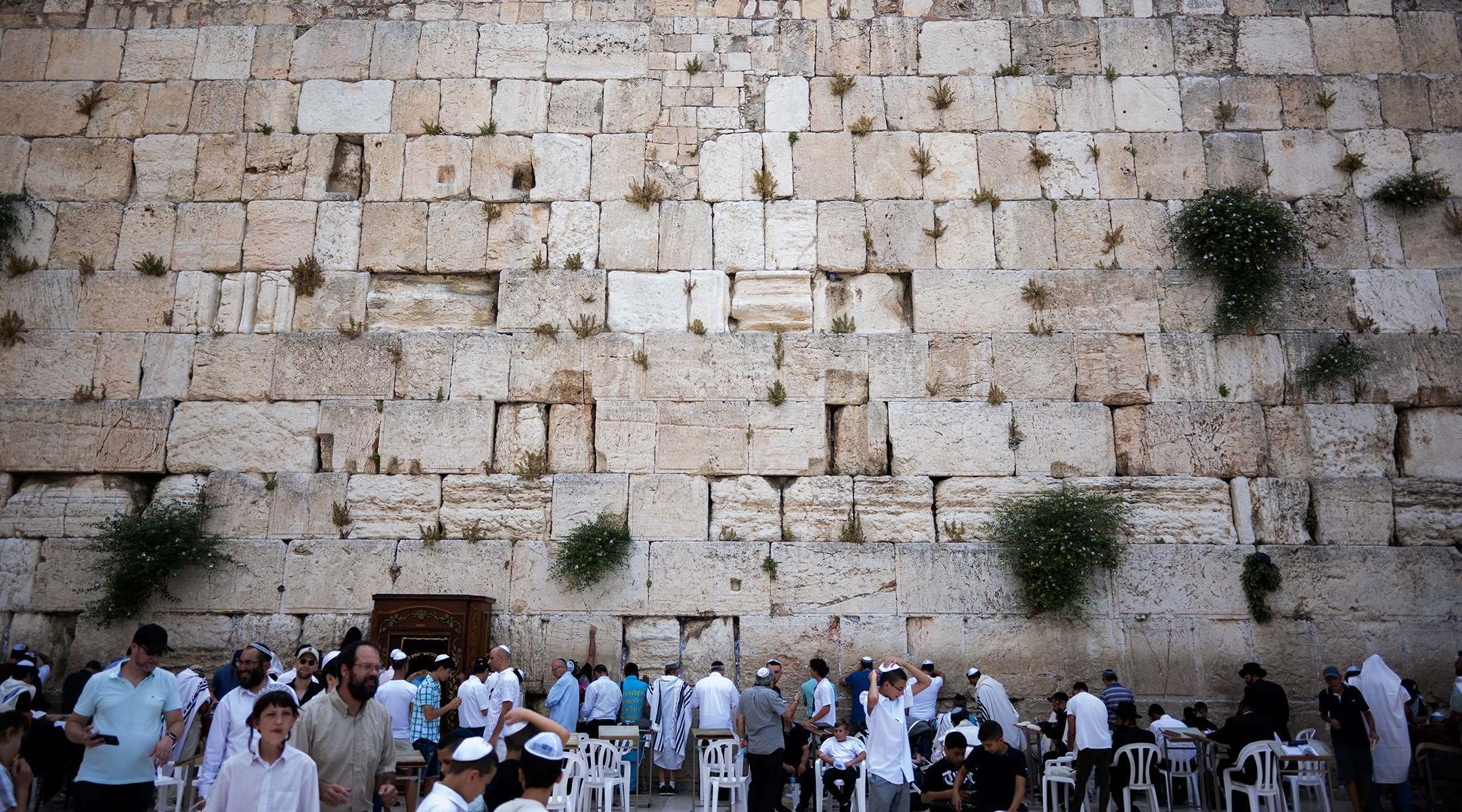
Jewish worshipers pray at the Western Wall in the Old City of Jerusalem, June 13, 2022. Photo by Alexi Rosenfeld/Getty Images
(JTA) — A proposed Israeli law that would sharply curtail the rights of women and non-Orthodox Jews at the Western Wall sparked alarm on Thursday, leading Israeli Prime Minister Benjamin Netanyahu to pledge that regulations at the holy site would “remain exactly the same” as they are now.
The bill was submitted by a lawmaker from Shas, the Sephardi haredi Orthodox party that is a member of Netanyahu’s governing coalition. It would have criminalized mixed-gender prayer at the site, as well as immodest dress and the playing of musical instruments. Women would also be forbidden from reading from a Torah scroll or blowing a shofar at the site. Women would also not be allowed to don prayer shawls or tefillin, the leather boxes and straps traditionally worn by Jews during morning prayers, and historically worn only by men.
The bill’s provisions would have also applied to the Wall’s non-Orthodox section, adjacent to the main plaza. Offenders would have faced a fine of approximately $3,000, or six months in prison.
The legislation is the latest salvo in a decades-long battle over policy at Judaism’s holiest prayer site and who gets to determine it. Non-Orthodox groups, and American Jewish organizations, have long advocated for egalitarian and women-led prayer to be allowed at the wall. Orthodox groups have pushed for worship at the site to remain exclusively under their purview.
An agreement approved by the Israeli government in 2016 would have expanded a non-Orthodox prayer area adjacent to the main plaza. That deal, however, was suspended the following year after backlash from haredi parties. The Israeli Supreme Court, which the current government wants to disempower, is due to discuss whether the agreement must be implemented at an upcoming hearing.
Thursday’s bill, however, appears to be a dead letter. In a video posted to Twitter, Netanyahu said the legislation “will not be brought up at present.”
“The status quo at the Wall, which is dear to all of the Jewish people, will remain exactly as it is today,” he said, adding that the law’s provisions outlawing immodest dress or musical instruments “are not acceptable to anyone.”
Diaspora Minister Amichai Chikli, a member of Netanyahu’s Likud Party and the son of a Conservative rabbi, tweeted that the Western Wall, known in Hebrew as the Kotel, “is a national and religious symbol that belongs to the whole Jewish people: secular and religious, left-wing and right-wing, women and men in Israel and abroad. The legislation that would change the status quo and threaten sanctions due to sleeves or instruments is unnecessary and damaging.”
Even haredi voices rose up against the proposed legislation. Kikar HaShabbat, Israel’s largest haredi news site, published an editorial saying the bill “does not befit the sanctity of the Western Wall.”
The bill would have outlawed the activities of Women of the Wall, a prayer group that meets monthly at the wall’s women’s section and that advocates for women’s rights at the site. In the past, the group’s members have been harassed by haredi activists and detained by police for their activities. On Thursday, the group sent an email blast on with the subject line, “It’s off to jail we go?”
“If we have to sit in jail, we will sit in jail,” the email said. “Arrests did not stop us in the past, and they won’t stop us in the future. We will not give up our fight for women’s rights at the Kotel.”
This article originally appeared on JTA.org.
This is a moment of great uncertainty. Here’s what you can do about it.
We hope you appreciated this article. Before you go, we’d like to ask you to please support the Forward’s independent Jewish news this Passover. All donations are being matched by the Forward Board - up to $100,000.
This is a moment of great uncertainty for the news media, for the Jewish people, and for our sacred democracy. It is a time of confusion and declining trust in public institutions. An era in which we need humans to report facts, conduct investigations that hold power to account, tell stories that matter and share honest discourse on all that divides us.
With no paywall or subscriptions, the Forward is entirely supported by readers like you. Every dollar you give this Passover is invested in the future of the Forward — and telling the American Jewish story fully and fairly.
The Forward doesn’t rely on funding from institutions like governments or your local Jewish federation. There are thousands of readers like you who give us $18 or $36 or $100 each month or year.
Support our mission to tell the Jewish story fully and fairly.