Germany’s far-right AfD party scores first district victory, alarming Jewish leaders
The victory marks the first time the party will have administrative control of an area
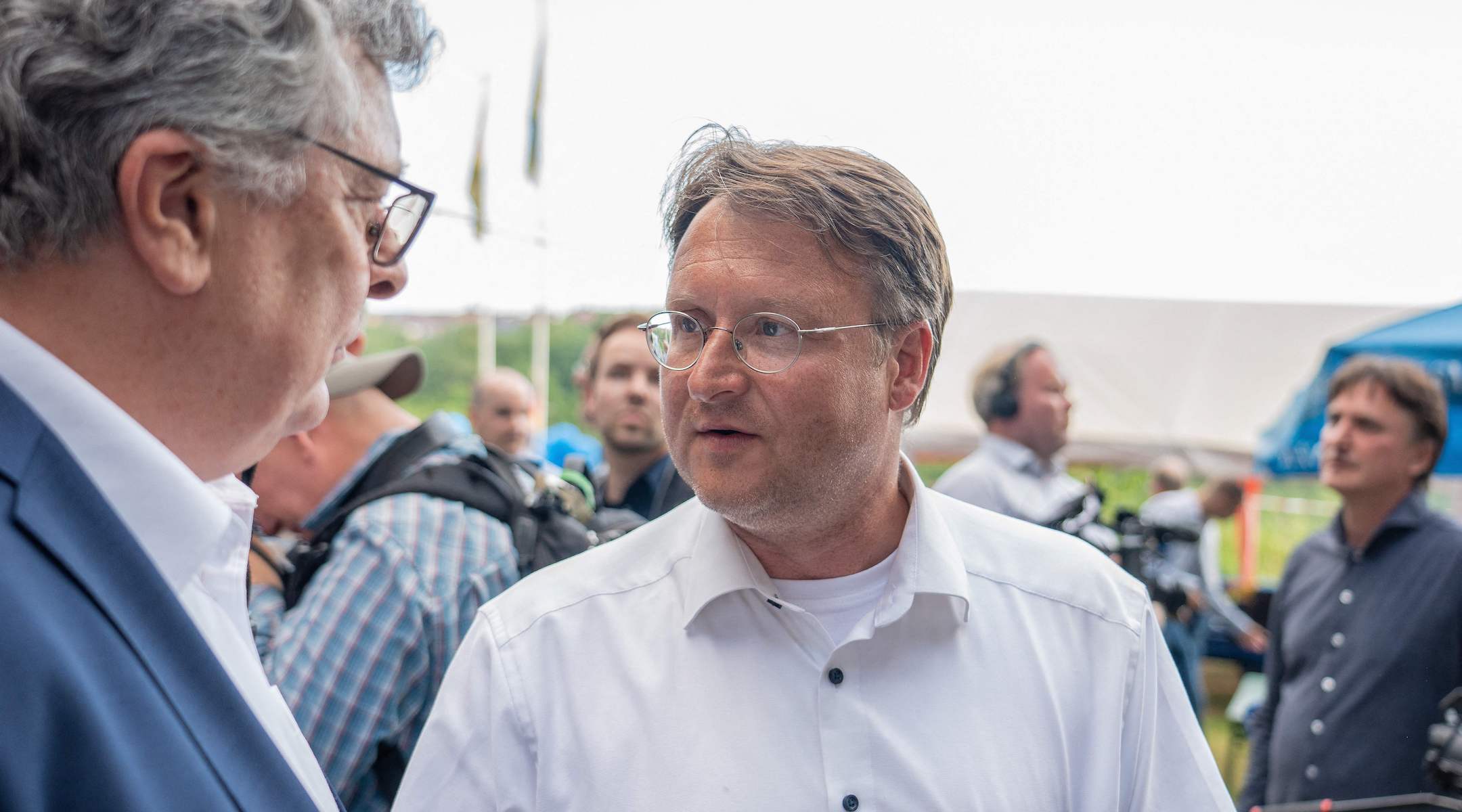
Robert Sesselmann, in white, attends an AfD election event in Sonneberg, eastern Germany, June 25, 2023. (Ferdinand Merzbach/News5/AFP via Getty Images)
BERLIN (JTA) — Jewish leaders are reacting with alarm to a local election in the former East German state of Thuringia, where for the first time in Germany a far-right Alternative for Germany (AfD) candidate has won the top political post in his district.
Robert Sesselmann won Sunday’s district council run-off election in Sonneberg, with 52.8% of the vote, unseating district administrator Jürgen Köpper of the center-right Christian Democratic Union (CDU). The area, one of Germany’s smallest districts, reportedly has about 48,000 voters, but the victory marks the first time the party will have administrative control of an area.
Critics say any win for the party chips away at the security of Germany’s democracy. Polls show the party is supported by 18%-20% of voters across Germany.
Launched in 2013 on an anti-immigrant, anti-European Union, ultra-nationalist platform, the AfD won its first seats in the national parliament in 2017, after then-Chancellor Angela Merkel welcomed more than one million mostly Syrian, Afghan and Sudanese refugees into Germany. One of the party’s current themes is criticism of German support for Ukraine.
Across Germany, mainstream political parties have vowed not to create governing coalitions with AfD representatives. Germany’s domestic intelligence agency considers the Thuringian branch of the AfD and its leader, Björn Höcke, to be far-right extremists.
Josef Schuster, president of the Central Council of Jews in Germany, said the election “could open the floodgates” for a party that espouses xenophobic and anti-democratic values. Some of its leaders also have belittled the Holocaust. In 2019, the Buchenwald memorial in Thuringia barred party representatives indefinitely from attending memorial ceremonies there.
“Not every AfD voter has extreme right-wing views,” Schuster told the weekly Jewish newspaper Jüdische Allgemeine. “But they voted for a candidate whose party is extreme right-wing, according to the State Office for the Protection of the Constitution.”
Those voters “are knocking out another pillar of support for stable democracy in Germany,” said Charlotte Knobloch, head of the Jewish community of Munich and Upper Bavaria, in a statement.
In 2017, Höcke lamented Germany’s national Holocaust memorial as “a memorial of shame.”
Sesselmann won on Sunday despite the fact that all mainstream parties – from Conservative to Greens to the Left Party – urged their voters to rally behind the incumbent, after the initial run-off vote brought Sesselmann within a few percentage points of winning.
The results in this small district may be a bellwether: Höcke called Sunday’s vote a good sign for upcoming state parliamentary elections in the eastern states of Saxony, Thuringia and Brandenburg.
This article originally appeared on JTA.org.
This is a moment of great uncertainty. Here’s what you can do about it.
We hope you appreciated this article. Before you go, we’d like to ask you to please support the Forward’s independent Jewish news. All donations are still being matched by the Forward Board - up to $100,000 until April 24.
This is a moment of great uncertainty for the news media, for the Jewish people, and for our sacred democracy. It is a time of confusion and declining trust in public institutions. An era in which we need humans to report facts, conduct investigations that hold power to account, tell stories that matter and share honest discourse on all that divides us.
With no paywall or subscriptions, the Forward is entirely supported by readers like you. Every dollar you give is invested in the future of the Forward — and telling the American Jewish story fully and fairly.
The Forward doesn’t rely on funding from institutions like governments or your local Jewish federation. There are thousands of readers like you who give us $18 or $36 or $100 each month or year.
Support our mission to tell the Jewish story fully and fairly.