Australia will refer to West Bank as ‘Occupied Palestinian Territories’ in policy change
The Zionist Federation of Australia and the Executive Council of Australian Jewry issued a joint statement calling the change ‘inaccurate, ahistorical and counterproductive’
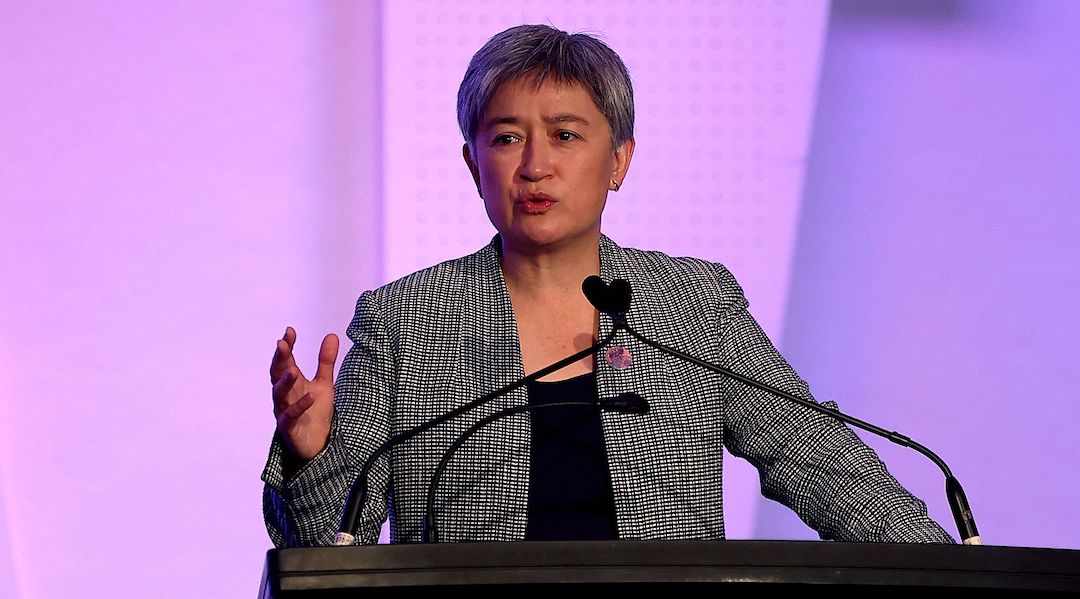
Australian Minister for Foreign Affairs Penny Wong speaks at a symposium in Brisbane, July 28, 2023. (Pat Hoelscher/AFP via Getty Images)
(JTA) — Australia will resume referring to the West Bank, East Jerusalem and Gaza as the “Occupied Palestinian Territories,” an unofficial policy change after the term fell out of favor over the past decade.
At the Labor Party’s caucus briefing on Tuesday, Foreign Minister Penny Wong said the government was strengthening its opposition to Israeli settlements in the West Bank by “affirming they are illegal under international law and a significant obstacle to peace.” The West Bank, East Jerusalem and Gaza were occupied by Israel following the 1967 Six-Day War.
Most Australian ministers have avoided using the words “occupied” and “occupation” since 2014, according to the Australian Broadcasting Corporation. In a Senate hearing that year, then-Attorney General George Brandis said the phrase “‘occupied’ East Jerusalem” was “freighted with pejorative implications which is neither appropriate nor useful.”
Wong’s announcement was criticized by members of the parliamentary opposition, who questioned her timing just before the Labor Party’s national conference next week.
Simon Birmingham, the opposition’s foreign affairs spokesman, said the decision had “everything to do with managing factional differences ahead of their national conference and nothing to do with advancing a lasting two-state outcome,” according to the Sydney Morning Herald.
The decision also drew ire from the Zionist Federation of Australia and the Executive Council of Australian Jewry, which issued a joint statement calling the change in language “inaccurate, ahistorical and counterproductive.”
“Describing East Jerusalem, the West Bank and Gaza as ‘occupied Palestinian territories’ effectively denies any Jewish claim to the West Bank and Jerusalem,” said the groups.
However, Wong said the language is consistent with United Nations Security Council resolutions and used by Australia’s key partners, including the United Kingdom, New Zealand and the European Union.
The U.N. Security Council’s resolution 2334 states that “the establishment by Israel of settlements in the Palestinian territory occupied since 1967, including East Jerusalem, has no legal validity and constitutes a flagrant violation under law.”
Last month, the Australian government issued a joint statement with Canada and the United Kingdom to express “grave concern” about Israel approving over 5,700 new settlements in the West Bank, after changing the approval process to allow for faster construction of settlements. A similar statement from the governments of Australia, Germany, Italy, France, the United Kingdom and the United States condemned Israel’s plan to build 10,000 settlements in the West Bank earlier this year.
After announcing her government’s change in nomenclature, Wong said that she had briefed the Israeli ambassador and Australia remained “a committed friend of Israel.”
The controversy over language comes amid the bloodiest period the West Bank has seen in decades. More than 190 Palestinians have been killed in Israeli military raids and settler violence this year, setting 2023 on track to be the deadliest year for Palestinians since the U.N. began recording fatalities in 2004. Over two dozen Israelis have also been killed in Palestinian attacks this year.
This article originally appeared on JTA.org.
This is a moment of great uncertainty. Here’s what you can do about it.
We hope you appreciated this article. Before you go, we’d like to ask you to please support the Forward’s independent Jewish news this Passover.
This is a moment of great uncertainty for the news media, for the Jewish people, and for our sacred democracy. It is a time of confusion and declining trust in public institutions. An era in which we need humans to report facts, conduct investigations that hold power to account, tell stories that matter and share honest discourse on all that divides us.
With no paywall or subscriptions, the Forward is entirely supported by readers like you. Every dollar you give this Passover is invested in the future of the Forward — and telling the American Jewish story fully and fairly.
The Forward doesn’t rely on funding from institutions like governments or your local Jewish federation. There are thousands of readers like you who give us $18 or $36 or $100 each month or year.
Support our mission to tell the Jewish story fully and fairly.