The Lancet recommends mandatory Holocaust education to improve medical ethics
British medical journal says doctors’ roles in carrying out Nazi atrocities are a cautionary tale for today
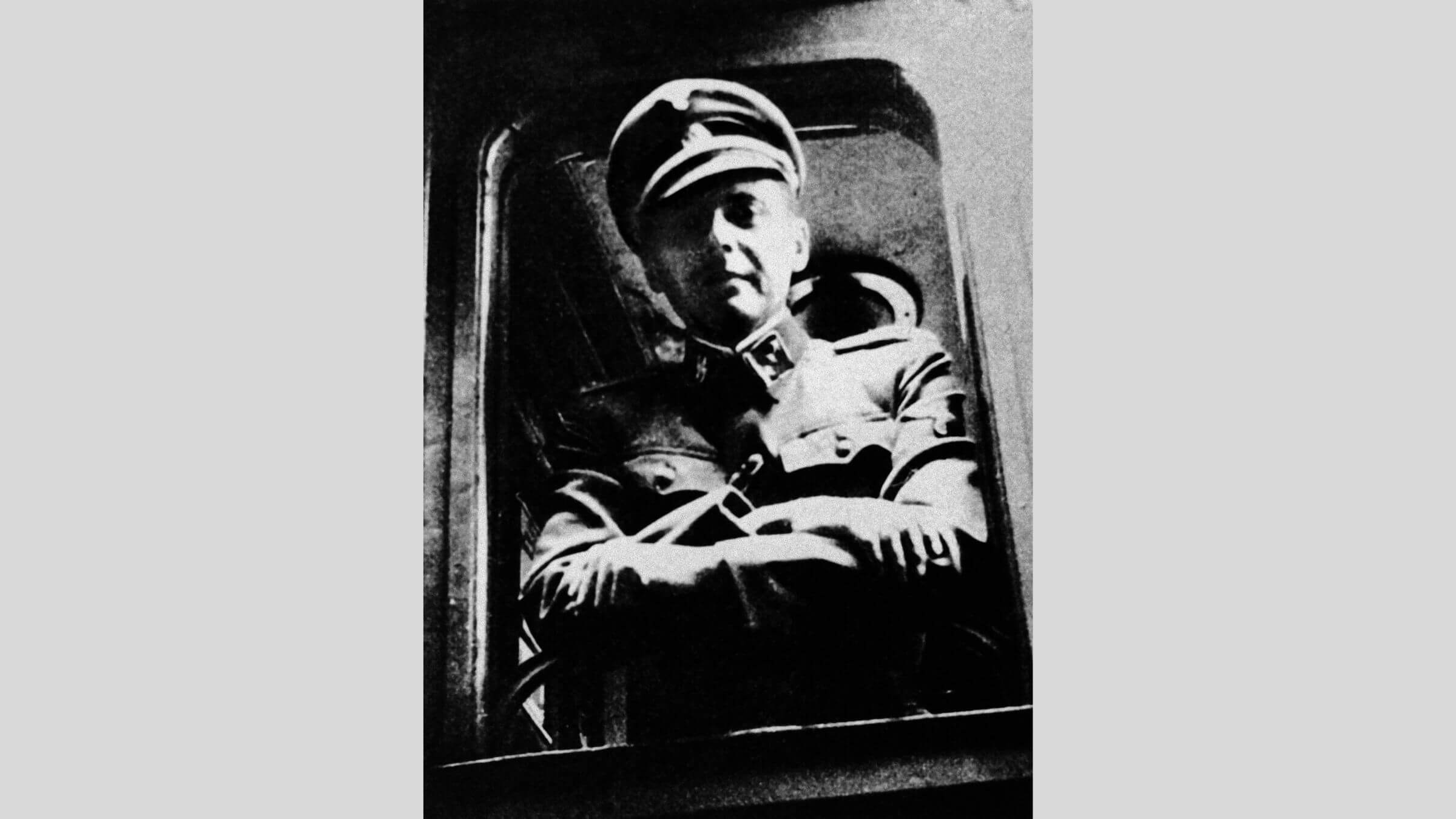
Dr. Josef Mengele, nicknamed the Angel of Death, performed experiments on prisoners at Auschwitz and decided which prisoners would be sent to the gas chambers. He fled to Argentina after the war and drowned in 1979, having escaped Nazi hunters. Photo by Hulton Archive/Getty

By Beth Harpaz November 9, 2023
The Lancet is recommending mandatory Holocaust education in health science curricula as a way to improve medical ethics.
Every training program for health professionals worldwide should “include learning about the history of medical involvement in Nazism and the Holocaust,” said a report issued Wednesday by The Lancet’s Commission on Medicine, Nazism, and the Holocaust.
The Lancet, a prestigious peer-reviewed medical journal founded in 1823, is one of the most-cited and most influential publications of its kind.
The report said teaching about Nazi medical crimes should focus on “implications of this history for present and future health-care practice, including the responsibility of medical professionals and their institutions to uphold human rights within clinical practice, research, and public policy.”
The commission noted that a “distinctive and disturbing feature” of Nazi atrocities was the role played by health care professionals in “formulating, supporting and implementing” the Third Reich’s “inhumane and often genocidal policies.”
Victims of Nazi medical atrocities
Victims of those policies included 230,000 people with disabilities who were murdered; as many as 350,000 people deemed “genetically inferior” who were sterilized; and concentration camp prisoners who underwent horrific medical experiments resulting in “suffering, maiming and death.” Victims’ bodies were also used for research and teaching “long after World War II,” the report added.
Health science curricula “rarely cover this topic,” the report said. The commission cited “the surge of Nazi tropes deployed in anti-vaccination propaganda during the COVID-19 pandemic” as a “striking” contemporary example of inaccurate and misused references to Nazi medical crimes.
“Virtually every debate about health professional ethics can gain from an understanding of this shameful history — from questions regarding the beginning and the end of life, to health professionals’ roles as economic actors or as agents of the state,” the report said. The authors cited antisemitism, racism and other forms of bigotry as contributing to an urgent need for health practitioners to safeguard human rights, along with wars in “Israel, Gaza, Syria, Ukraine, and Yemen.”
Recommendations
The report called for the creation of an international professional association focused on medicine, Nazism, and the Holocaust; a digital library of related resources; and the identification and memorialization of individual victims at universities, hospitals and other institutions in Germany and elsewhere.
Twenty international scholars served on the commission and consulted student advisers from 10 countries. The commission was announced in 2021.
The commission noted that Nazi medical policies did not arise “in a vacuum.” International networks promoting eugenics “lent an air of legitimacy to German scientists, who pushed the tenets of medical racism and eugenics to their extremes.”
Few refused to collaborate
Looking back at Third Reich history, the report found “few health professionals openly refused to collaborate in any of these activities, though those who did not collaborate were rarely sanctioned.” It also recognized the “resistance efforts of Jewish and other persecuted health professionals — particularly the struggles of physicians, midwives, and nurses to provide medical care in the ghettos and concentration camps.”
Most health professionals involved in Nazi medical crimes were not prosecuted after the war, the report said, but the Nuremberg Doctors’ Trial, also known as the Nuremberg Medical Trial, led to the creation of the first code of ethics for human research, emphasizing voluntary consent.
Perhaps the most notorious Nazi doctor was Josef Mengele, nicknamed the Angel of Death, who performed experiments on prisoners at Auschwitz and decided which prisoners would be sent to the gas chambers. He fled to Argentina after the war, lived under a different name and drowned in 1979.
This is a moment of great uncertainty. Here’s what you can do about it.
We hope you appreciated this article. Before you go, we’d like to ask you to please support the Forward’s independent Jewish news this Passover. All donations are being matched by the Forward Board - up to $100,000.
This is a moment of great uncertainty for the news media, for the Jewish people, and for our sacred democracy. It is a time of confusion and declining trust in public institutions. An era in which we need humans to report facts, conduct investigations that hold power to account, tell stories that matter and share honest discourse on all that divides us.
With no paywall or subscriptions, the Forward is entirely supported by readers like you. Every dollar you give this Passover is invested in the future of the Forward — and telling the American Jewish story fully and fairly.
The Forward doesn’t rely on funding from institutions like governments or your local Jewish federation. There are thousands of readers like you who give us $18 or $36 or $100 each month or year.
Support our mission to tell the Jewish story fully and fairly.