Rabbi Laurie Phillips, founder of a Manhattan ‘synagogue without walls,’ dies at 55
Starting in 2014, Beinenu (which means “between us” in Hebrew) offered Jewish worship and celebrations in intimate spaces
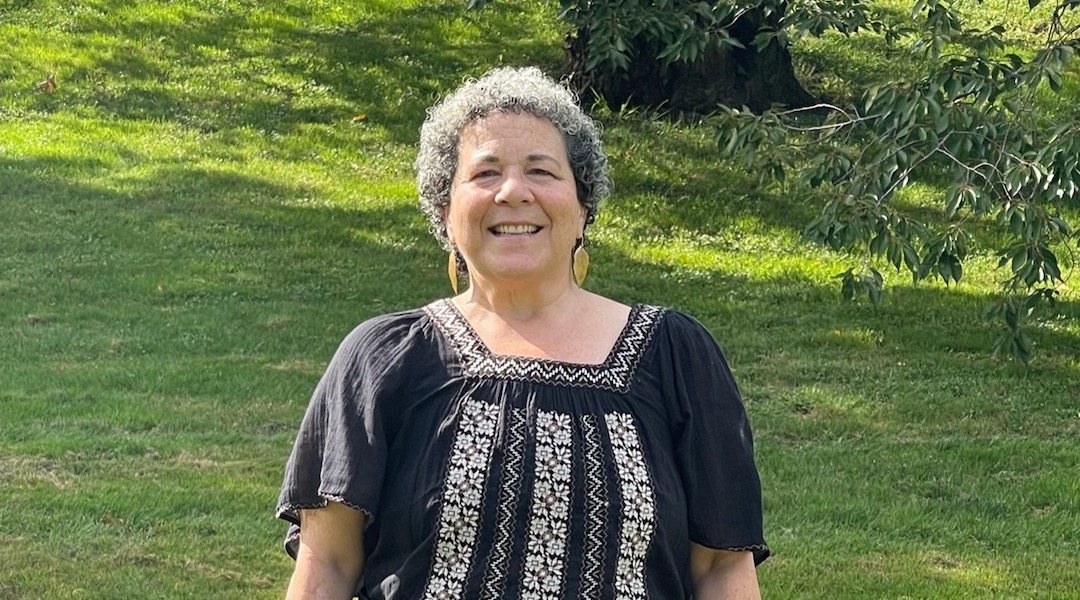
Rabbi Laurie Phillips founded the New York-based “synagogue without walls” Beinenu. (Courtesy Debbie Mukamal and Rabbi John Franken)
By Andrew Silow-Carroll December 4, 2023
(JTA) — Rabbi Laurie Phillips, whose search for a new model of Jewish engagement led her to found the New York-based “synagogue without walls” Beinenu, died Nov. 26 at her childhood home in Southfield, Michigan. She was 55.
The cause was complications from leiomyosarcoma, a rare cancer, according to an obituary prepared by her friends Debbie Mukamal and Rabbi John Franken.
Starting in 2014, Beinenu (which means “between us” in Hebrew) offered Jewish worship and celebrations in intimate spaces. Phillips and her co-director, the musician Daphna Mor, also led High Holidays services at the JCC Harlem, which had begun catering to a growing number of Jews, including Phillips, who were living in the Manhattan neighborhood.
“Ever sure of herself, she preached from her heart, without notes, sometimes sharing some of her rawest life experiences, such as undergoing chemotherapy and the benefits of wearing good red lipstick,” according to the obituary by Mukamal, who was Phillips’ neighbor when she lived in Brooklyn, and Franken, rabbi of Temple Adas Shalom in Havre de Grace, Maryland.
“Her blunt truth-telling could unleash uproarious laughter as well and many thought she should moonlight in stand-up comedy,” they added.
Phillips also initiated, in 2017, the “Be Kind” campaign, distributiing bright red pins with the slogan and urging those who wore it to use it as a conversation-starter with friends and strangers.
Before launching Beinenu, Phillips served as the associate director for the Mandel Center for Jewish Education at the JCC Association of North America, where she co-created Lechu Lachem, an immersive program for Jewish camp directors. She also helped create, with the JCC Manhattan and three nearby synagogues, the Jewish Journeys project, which provides personalized alternatives to synagogue-based supplementary Jewish schooling.
Growing up in her Detroit suburb, Phillips attended Hillel Day School and was active at Temple Adat Shalom of Farmington Hills. She majored in special education at Michigan State University and later earned a master’s degree in educational leadership from the College of Notre Dame of Maryland. She was ordained at Hebrew Union College in Los Angeles in 2003 and served as director of education at Wilshire Boulevard Temple in Los Angeles and at Congregation Habonim in Manhattan.
Phillips said her participation in the mid-1990s as a counselor at what is now known as the Ziering Brandeis Collegiate Institute, a West Coast summer retreat program for young adults, inspired her “to merge her passion for Judaism and education,” according to the Beinenu web site.
In spite of her illness, Phillips was officiating at b’nei mitzvah as recently as mid-November, according to Mukamal and Franken.
“I am so lucky to have found a partner with whom I could create my dream version of a Jewish community in NYC, led through the heart, held by music, genuine love, and joy,” Mor said in statement to JTA. “Laurie’s legacy of light, love and kindness keeps shining through all the people whose lives she touched.”
Phillips is survived by her father Dennis, siblings Beth Phillips and Michael Phillips, and her stepson, Adam Cohen. Here marriage to Howard Cohen ended in divorce. Her mother, Judith Caplan Phillips, died in 2007.
This article originally appeared on JTA.org.
This is a moment of great uncertainty. Here’s what you can do about it.
We hope you appreciated this article. Before you go, we’d like to ask you to please support the Forward’s independent Jewish news this Passover. All donations are being matched by the Forward Board - up to $100,000.
This is a moment of great uncertainty for the news media, for the Jewish people, and for our sacred democracy. It is a time of confusion and declining trust in public institutions. An era in which we need humans to report facts, conduct investigations that hold power to account, tell stories that matter and share honest discourse on all that divides us.
With no paywall or subscriptions, the Forward is entirely supported by readers like you. Every dollar you give this Passover is invested in the future of the Forward — and telling the American Jewish story fully and fairly.
The Forward doesn’t rely on funding from institutions like governments or your local Jewish federation. There are thousands of readers like you who give us $18 or $36 or $100 each month or year.
Support our mission to tell the Jewish story fully and fairly.