Guy Stern, WWII ‘Ritchie Boy’ who became renowned Holocaust scholar, dies at 101
As a refugee-turned-intellignce operative, Stern grilled Germans in their native tongue
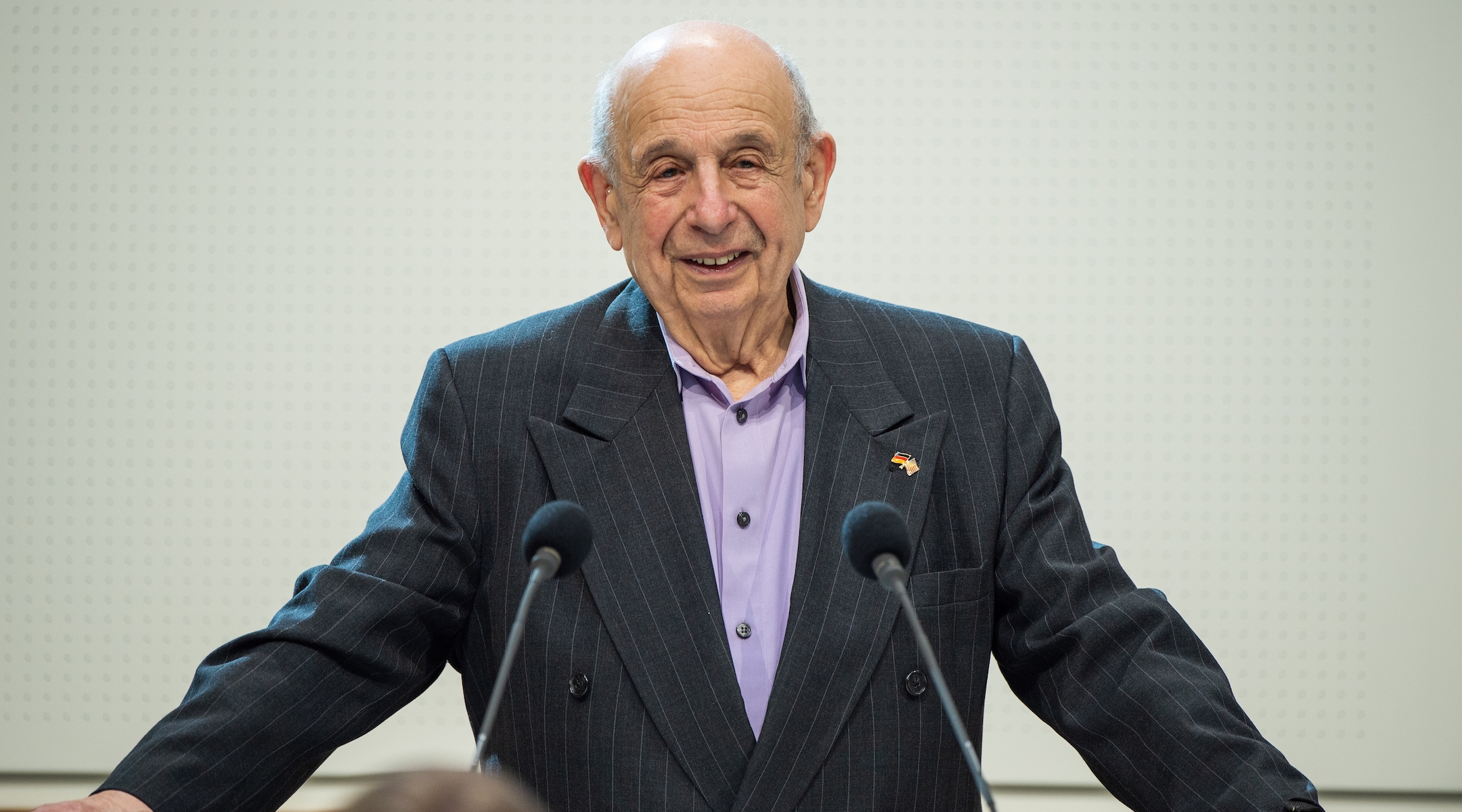
Guy Stern, who escaped Germany in the run-up to the Holocaust, speaks to a group of lawmakers in Hanover, Germany, May 14, 2019. (Christophe Gateau/picture alliance via Getty Images)
(JTA) — Guy Stern, a German Jewish refugee who was one of the last known surviving members of the celebrated World War II military intelligence unit known as the “Ritchie Boys” and who became an accomplished Holocaust scholar after the war, died Dec. 7, a little over a month shy of his 102nd birthday.
Sent to live in St. Louis by his family as a teenager, Stern became a U.S. citizen and was drafted into the Army in 1943, joining a select group of Jewish refugee soldiers-turned-intelligence operatives who trained at Fort Ritchie in Maryland. As a native German speaker, his skillset was especially valuable for interrogating Nazi prisoners of war.
The so-called Ritchie Boys, who included around 2,000 Jewish refugees, would come to be responsible for what was later estimated as around 60% of the U.S.’ usable intelligence during the war. Their work was classified as top-secret and largely remained under wraps for decades; many veterans, unlike Stern, died without fully telling their stories.
Stern most recently was a central figure in the 2022 PBS documentary The U.S. And The Holocaust, directed by Ken Burns, Sarah Botstein and Lynn Novick, and he also appeared in a “60 Minutes” special earlier that year. In 2021, the U.S. Senate honored the Ritchie Boys’ service with a bipartisan resolution.
After the war, Stern further explored his bilingual identity and became a comparative literature scholar and university administrator. He served several top roles at Detroit’s Wayne State University, including provost, and at the University of Cincinnati, along the way receiving various honors for his service, including the French Knight of the Legion of Honor in 2017. His widow, the Polish-born German writer Susanna Piontek, is also a frequent explorer of Holocaust memory and translated her husband’s memoir into German.
Stern was memorialized by many Jewish institutions both in and out of his adopted home of Detroit, including the Zekelman Holocaust Center in Farmington Hills, Michigan, where Stern was the director of its International Institute of the Righteous.
“Guy was such an important part of not just The HC but of the entire understanding we have of the war, what was done to win, its significance, and the importance of education to prevent recurrence,” said Alan Zekelman, executive member of the museum’s board, in a statement. “There is no question that his work in this world was important, will be remembered, and that we are all blessed because of him. He will be incredibly missed.”
Stern was born Günther Stern in 1922, in Hildesheim, Germany. Throughout his life he would retain vivid memories of seeing former friends sign up for the Hitler Youth. At 15, he became the only member of his family to escape death at the hands of the Nazis when his parents pooled their resources and sent him to stay with a relative in St. Louis.
In a story Stern would later tell many times, including in his 2020 memoir “Invisible Ink,” he tried in vain to secure a stateside sponsorship for his parents and siblings. Owing to what he said was largely the fault of a duplicitous lawyer, he was unable to find a sponsor who would grant them secure passage, and the rest of his family was later murdered in the Holocaust.
Staying with his aunt and uncle in St. Louis, Stern would often tune into the broadcasts of the fascist American priest Father Coughlin on the radio, who had embraced the same poisonous ideology as the Nazis Stern had fled.
“I was taken aback when I heard Father Coughlin and I thought, ‘Well, I parted with all that when I left Germany,’” Stern told this author in 2019. “I did not project that America would be misled in the same way by demagogic slogans and propaganda the way it had happened in Germany.”
After the war, Stern studied Romance languages at Hofstra University on Long Island, earning his bachelor’s degree in 1948. He received a master’s degree and later a Ph.D in German at Columbia University.
Stern spoke frequently about his experiences as a refugee, sitting for various survivor testimonies and being interviewed in a number of documentaries and TV programs.
Stern remained spry and gregarious into his years as a centenarian, with near-total recall of his life experiences, and would gamely sit down with most anyone who asked for his story. Throughout his life, he maintained a sharp wit.
“If you live long enough,” he told “60 Minutes,” “honors are being showered upon you.”
Stern is survived by Susanna Piontek of West Bloomfield. His first marriage, to Margith Langweiler, ended in divorce. His second wife, Judith Edelstein Owens, died in 2003. A son, Mark Stern, died in 2006.
This article originally appeared on JTA.org.
This is a moment of great uncertainty. Here’s what you can do about it.
We hope you appreciated this article. Before you go, we’d like to ask you to please support the Forward’s independent Jewish news this Passover. All donations are being matched by the Forward Board - up to $100,000.
This is a moment of great uncertainty for the news media, for the Jewish people, and for our sacred democracy. It is a time of confusion and declining trust in public institutions. An era in which we need humans to report facts, conduct investigations that hold power to account, tell stories that matter and share honest discourse on all that divides us.
With no paywall or subscriptions, the Forward is entirely supported by readers like you. Every dollar you give this Passover is invested in the future of the Forward — and telling the American Jewish story fully and fairly.
The Forward doesn’t rely on funding from institutions like governments or your local Jewish federation. There are thousands of readers like you who give us $18 or $36 or $100 each month or year.
Support our mission to tell the Jewish story fully and fairly.