Cabinet ministers heckled and soldiers wounded as Israel marks a somber Memorial Day
This is the rare Memorial Day when Israel is actively at war
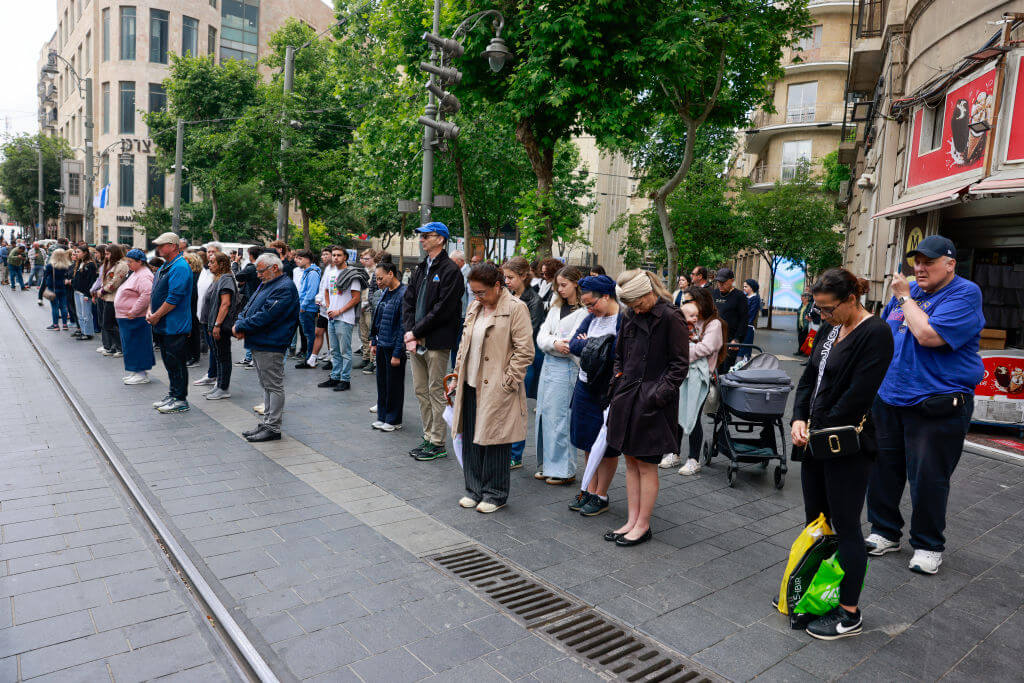
Israelis observe two minutes of silence on a street in Jerusalem to mark the Memorial Day for fallen soldiers on May 13. Photo by Getty Images
(JTA) — Government officials confronted protesters crying “Shame!” and “Criminal!” as they spoke at cemeteries across Israel. Shortly afterward, four Israeli soldiers were wounded by missile fire from Lebanon.
Memorial Day in Israel, which the country began observing Sunday night, is always a solemn occasion. But this year’s day of mourning for Israel’s soldiers and terror victims is like few others in the country’s 76-year history: Israel is actively at war, facing conflict on two fronts, while about 130 of its citizens remain captive in Gaza.
According to statistics published annually by the government, more than 1,500 Israelis have died in war and terror attacks since the previous Memorial Day, known in Hebrew as Yom HaZikaron. The vast majority were killed in Hamas’ attack on Oct. 7, which launched the war, and in battles in Gaza in the seven months since. Altogether, more than 25,000 soldiers and more than 5,000 civilians have been killed in wars and terror attacks in Israel and in the decades before its independence.
This year, the deep divides in the country over whether to prioritize the war against Hamas or a hostage deal were on full display: Several ministers in Israel’s right-wing government, appearing at memorial ceremonies at cemeteries, were met by protesters pleading with them and exhorting them to do more to bring back the hostages. Protesters branded Itamar Ben-Gvir, the far-right national security minister, as a “criminal” at a speech where he did not mention the hostages at all, while Defense Minister Yoav Gallant spoke in front of protesters holding signs reading, “Blood is on your hands.”
“Minister Smotrich, we need to do everything to save them,” Einav Zangauker, whose son is being held hostage, said to Finance Minister Bezalel Smotrich at a ceremony in a moment captured on video. “Save the ones who are living.”
In his speech at an official national ceremony, Israeli Prime Minister Benjamin Netanyahu sought to broadcast unity and determination in fighting Hamas.
“This is exactly what the war is about: It’s us or them — Israel or the monsters of Hamas. It’s existence, freedom, security and prosperity; or annihilation, massacre, rape and enslavement,” he said. “The unity of our people and the embrace of the nation are the source of our strength, alongside appreciating the significance of our fight at this historic moment.”
But a poll showed that the distaste for government officials shown by the hecklers extends to much of the country. According to the survey by the Israel Democracy Institute, nearly half of Israelis said government ministers should not appear at cemetery memorial ceremonies. Most Israelis also favor a hostage release deal over Israel’s military invasion of the city of Rafah in southern Gaza, where several Hamas battalions are said to remain.
“On Memorial Day, we remember and ache for the fallen hostages,” read a statement on Monday from the Hostages and Missing Families Forum. “Some have been brought to Israel for burial, but most are still being held in Gaza. We vow that we will know no rest until we bring all of the fallen to their final resting place.”
This is the second year in a row when Netanyahu’s cabinet ministers faced protests on Memorial Day: Last year, similar scenes unfolded amid the protests of the government’s moves to weaken the judiciary.
Israel’s Memorial Day falls on the eve of its Independence Day, and “transition ceremonies” mark the passage from the day of mourning to what is traditionally a day of joy. But this year, observance of Independence Day also promises to be more muted: According to the IDI poll, 56% of respondents want celebrations to be more restrained. Nearly a third say the country should not celebrate at all.
This article originally appeared on JTA.org.
This is a moment of great uncertainty. Here’s what you can do about it.
We hope you appreciated this article. Before you go, we’d like to ask you to please support the Forward’s independent Jewish news. All donations are still being matched by the Forward Board - up to $100,000 until April 24.
This is a moment of great uncertainty for the news media, for the Jewish people, and for our sacred democracy. It is a time of confusion and declining trust in public institutions. An era in which we need humans to report facts, conduct investigations that hold power to account, tell stories that matter and share honest discourse on all that divides us.
With no paywall or subscriptions, the Forward is entirely supported by readers like you. Every dollar you give is invested in the future of the Forward — and telling the American Jewish story fully and fairly.
The Forward doesn’t rely on funding from institutions like governments or your local Jewish federation. There are thousands of readers like you who give us $18 or $36 or $100 each month or year.

Support our mission to tell the Jewish story fully and fairly.