U.S. ambassador to Israel wants Netanyahu to deliver a ‘unifying’ speech to Congress
Jack Lew said arms sales and weapons shipment are just the ‘tip of the iceberg’ of broad U.S. support for Israel
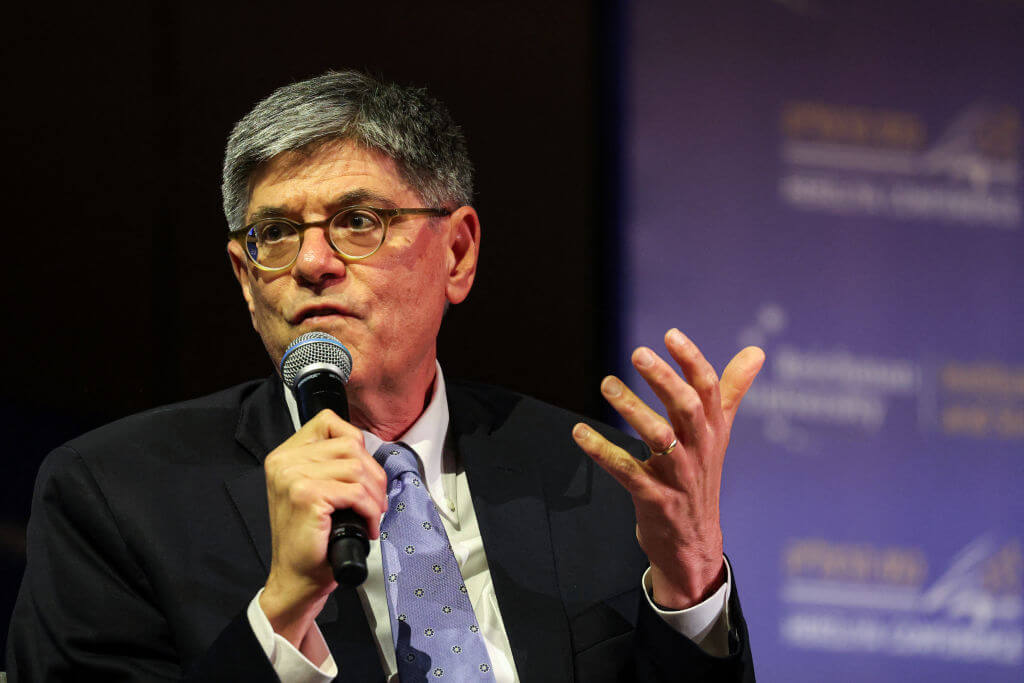
U.S. Ambassador to Israel Jacob Lew on June 24, 2024. Photo by GIL COHEN-MAGEN/AFP via Getty Images

By Jacob Kornbluh July 15, 2024
U.S. Ambassador to Israel Jack Lew on Monday expressed hope that Israeli Prime Minister Benjamin Netanyahu would deliver a speech that will strengthen bipartisan support for Israel when he appears before a joint session of Congress next week. More than a dozen Democrats have already said they would boycott the July 24 address.
Lew, in a virtual briefing with Jewish Americans hosted by the White House, said he has heard from Israeli and American officials that Netanyahu will strike a grateful tone, and focus on broad strategic issues on which the U.S. and Israel agree. “I certainly hope that that’s the kind of speech it is,” Lew said, noting growing isolationism and anti-Israel sentiment within Congress.
Netanyahu is a polarizing figure in American politics with low approval ratings at home, even some pro-Israel politicians and experts worry that the speech could further strain U.S.-Israeli relations and erode bipartisan support for Israel in Congress.
In the 45-minute conversation, Lew also sought to allay concerns about the administration’s criticism of Israel and disputes over weapons transfers. “There was never a moment when there was any kind of a hold on all support for Israel,” Lew said, reiterating the administration’s explanation that the recent suspension of the delivery of heavy bombs to Israel was an isolated incident to caution the country against a large-scale operation in Rafah.
U.S. aid to Israel
The ambassador added that providing arms to the Jewish state is “just the tip of the iceberg” in the broader context of U.S. support for Israel. The U.S. is also, he said, brokering a potential hostage-ceasefire deal, backing Israel at international forums, leading negotiations to reach a diplomatic solution to fighting in the north, and promoting a post-war vision for regional peace that will help ensure Israel’s security.
President Joe Biden took a tougher stance on Israel in a press conference on Thursday, saying he was “disappointed” by the constraints Israel continued to place on efforts to deliver humanitarian aid into Gaza. The president also described Israel’s war cabinet, which was disbanded after the exit of centrist minister Benny Gantz in June, as “one of the most conservative war cabinets in the history of Israel.”
Lew said that he understood why Israel has been, in light of security concerns in the aftermath of Oct. 7 attack from Gaza, reluctant to ease the delivery of humanitarian aid into the enclave. But “when the history of this is written,” he said, what will matter is that Israel chose to allow for humanitarian assistance despite its concerns.
Lew also addressed the possibility of normalized relations between Israel and Saudi Arabia. It can happen, he said, if Israel addresses the issue of Palestinian self-governance in Gaza and the establishment of a demilitarized Palestinian state.
“If there’s normalization with Saudi Arabia on the horizon, that is a whole different strategic order in the region,” he said.
This is a moment of great uncertainty. Here’s what you can do about it.
We hope you appreciated this article. Before you go, we’d like to ask you to please support the Forward’s independent Jewish news this Passover. All donations are being matched by the Forward Board - up to $100,000.
This is a moment of great uncertainty for the news media, for the Jewish people, and for our sacred democracy. It is a time of confusion and declining trust in public institutions. An era in which we need humans to report facts, conduct investigations that hold power to account, tell stories that matter and share honest discourse on all that divides us.
With no paywall or subscriptions, the Forward is entirely supported by readers like you. Every dollar you give this Passover is invested in the future of the Forward — and telling the American Jewish story fully and fairly.
The Forward doesn’t rely on funding from institutions like governments or your local Jewish federation. There are thousands of readers like you who give us $18 or $36 or $100 each month or year.
Support our mission to tell the Jewish story fully and fairly.