Prominent German cantor and opera singer is killed in what police say was a family dispute
A German news site said a son is being held after the death of Nikola David, 55, who had been cantor for Munich’s liberal Congregation Beth Shalom since 2014
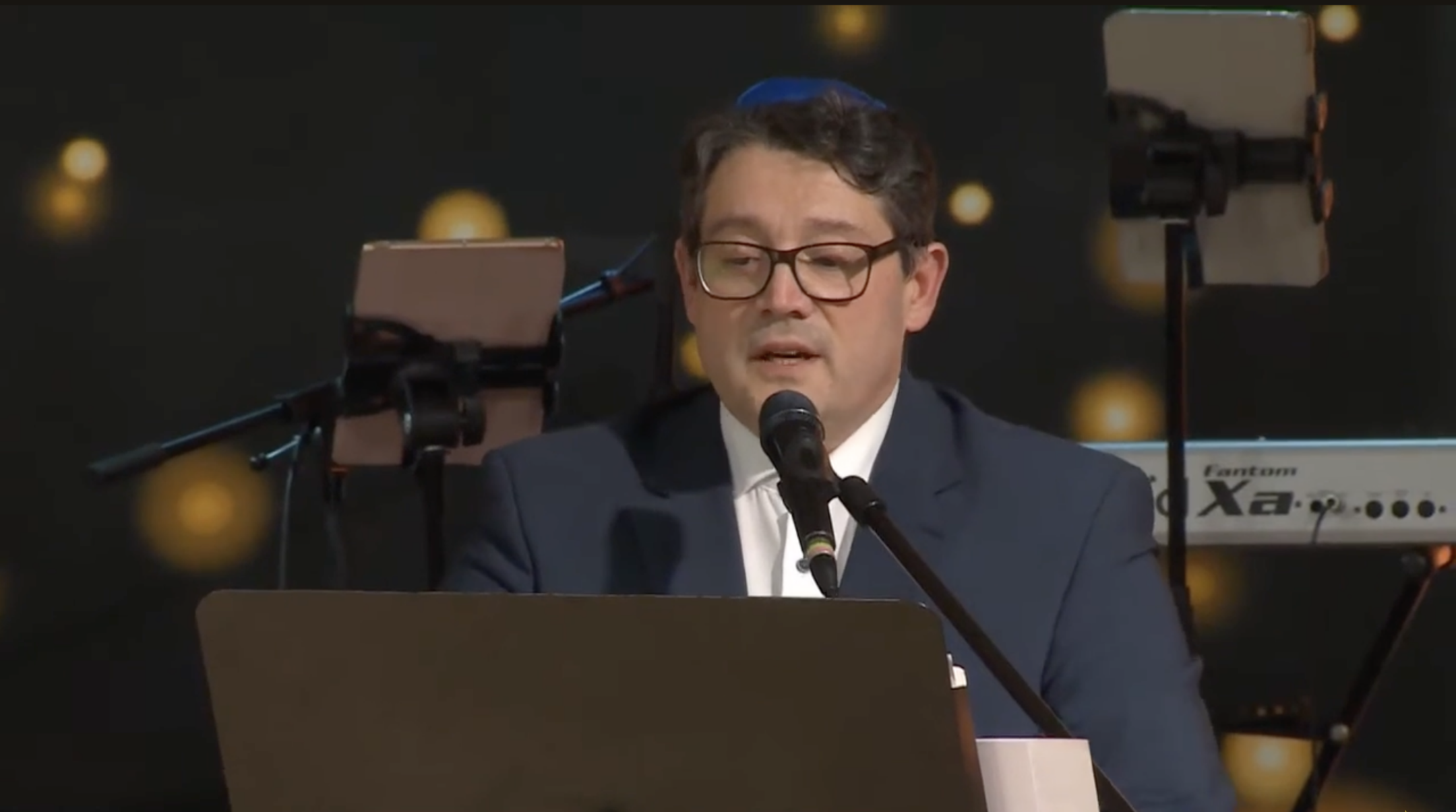
Cantor Nikola David appears in a 2018 performance. (March of Life on YouTube)
(JTA) — BERLIN — Munich’s liberal Jewish congregation is calling for donations to help the family of its cantor after he was killed earlier this month.
Nikola David’s adult son is being held on suspicion of manslaughter since the Aug. 2 killing, which rocked Munich’s Jewish community.
Nikola David, 55, was a former opera singer who had been cantor at Congregation Beth Shalom since 2014. The synagogue’s rabbi, Tom Kučera, officiated his Aug. 7 funeral, and three prominent German cantors — Amnon Seelig, Assaf Levitin and Isidoro Abramowicz — also participated.
Police said neighbors witnessed a physical altercation between father and son on the morning of Aug. 2 and called authorities, according to a report in the Bavarian news site Merkur. The site reported that police arrested the older son at the scene and brought Nikola David to a local hospital, where he died. The jailed son reportedly had minor injuries to his hand.
Details about the reported altercation have not been made public, although Merkur reported that David had been stabbed. Police and community have also withheld the names of family members, including the son who has been arrested and David’s wife and younger son, who were reportedly not present at the time.
Charlotte Knobloch, president of the Jewish Community of Munich and Upper Bavaria, tweeted that she was “absolutely shocked” to learn about David’s killing. “His death marks a painful loss for the Jewish community in Munich,” she said.
David was born in Bela Crkva in what is now Serbia but, growing up in communist Yugoslavia, had little exposure to his Jewish identity. At 20, he moved to Germany where he studied music education and classical vocal training and began working as an opera singer.
David’s path changed in 1993 when he performed at a ceremony marking the 48th anniversary of the liberation of Auschwitz, he recalled during an extensive interview and performance in 2018. There, the chief rabbi of the former Yugoslavia encouraged him to get involved in synagogue music. He balanced his opera career and ritual music until enrolling at the Abraham Geiger College in Potsdam, where he was ordained as a cantor in 2013.
“I had no background and music was that which kept me,” David said in the 2018 interview. Citing the Hasidic rabbi Nachman of Breslov, he said, “The Torah is the language of the heart. The words of the Torah are the words of the heart, and singing is the language of the soul. And that’s what kept me — and now I am what I am.”
David shared that his favorite Jewish prayer was Hashkivenu, which envisions God as a shelter of peace. He said it had been one of the first prayers he learned while becoming acquainted with his Judaism. “It’s always an evening prayer which you should pray before you go to sleep because one doesn’t know if one is going to wake up,” he said. “We should thank God that we can wake up every morning.”
In a plea for financial support for the family, Congregation Beth Shalom described its late cantor as “a wonderful person whose music and warmth enriched the community. His unexpected death leaves a painful gap for the community, the city, but of course especially for his family.”
The congregation already is supporting Nikola’s widow and his younger son, the announcement said in part.
“We will miss him terribly,” synagogue board member Eric Smutny told Merkur. “We cannot replace him.”
This is a moment of great uncertainty. Here’s what you can do about it.
We hope you appreciated this article. Before you go, we’d like to ask you to please support the Forward’s independent Jewish news this Passover. All donations are being matched by the Forward Board - up to $100,000.
This is a moment of great uncertainty for the news media, for the Jewish people, and for our sacred democracy. It is a time of confusion and declining trust in public institutions. An era in which we need humans to report facts, conduct investigations that hold power to account, tell stories that matter and share honest discourse on all that divides us.
With no paywall or subscriptions, the Forward is entirely supported by readers like you. Every dollar you give this Passover is invested in the future of the Forward — and telling the American Jewish story fully and fairly.
The Forward doesn’t rely on funding from institutions like governments or your local Jewish federation. There are thousands of readers like you who give us $18 or $36 or $100 each month or year.
Support our mission to tell the Jewish story fully and fairly.