In Gadi Mozes, the octogenarian freed from Gaza, Israelis see an icon of their country’s hardy ‘kibbutznik’ spirit
Several of the posts emphasized that Mozes is a kibbutznik, an identity that to many Israelis connotes a hardy work ethic and pioneering spirit
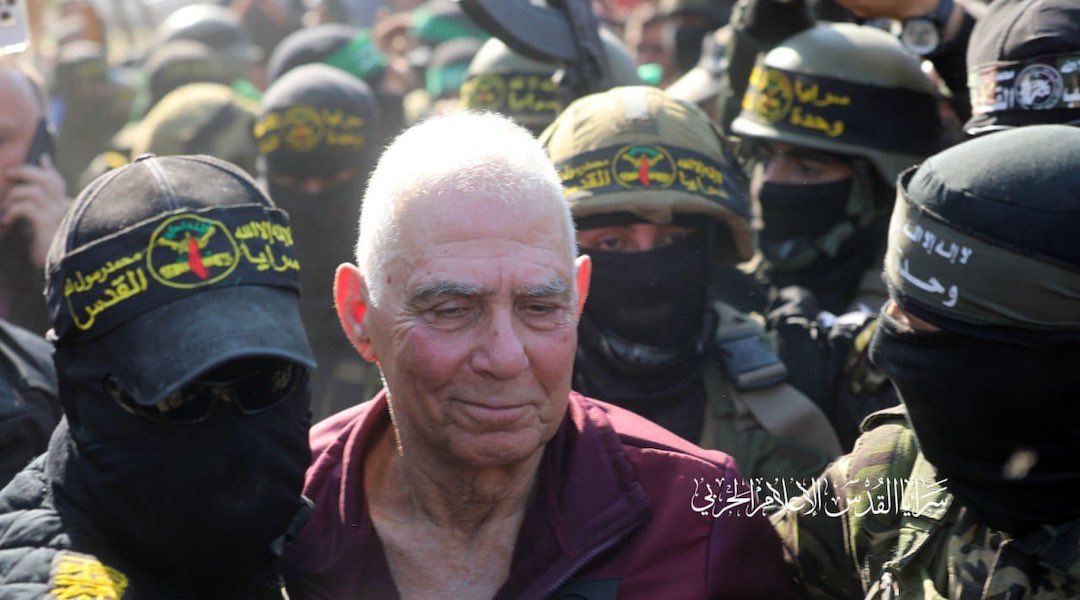
A photo of Gadi Mozes, who was released from Israeli captivity on Thursday, Jan. 30, has gone viral in Israel. (X/Twitter)
(JTA) — Thursday’s chaotic hostage release, which saw a crush of fighters push two captives through a restless crowd, shocked viewers and sparked a crisis in the Israel-Hamas ceasefire.
It also left Israelis with at least one lasting image: Hostage Gadi Mozes, 80, walking upright among the masked gunmen, with what appeared to be the faintest of smiles on his face.
גדי מוזס. קיבוצניק גיבור מניר עוז. pic.twitter.com/bD64AY68YH
— Or Heller אור הלר (@OrHeller) January 30, 2025
To many Israelis, the photo symbolized not only the resilience of an elderly hostage after almost 16 months of captivity; it was also a testament to the particular Israeli way of life Mozes embodies.
Several of the posts emphasized that Mozes is a kibbutznik — a resident of the border community of Nir Oz who, before Oct. 7, 2023, was known for his potato farming. But to Israelis, the word “kibbutznik,” especially when applied to an octogenarian, connotes more than just an address.
While Israel’s kibbutz movement has declined over the past 40 years, in the early days of the country — Mozes’ youth — the kibbutz symbolized a pioneering ethos, a hardy work ethic and a communitarian spirit. In past decades, kibbutzniks comprised a disproportionate share of Israel’s military and political leadership.
To some of those who shared the photo of Mozes, that’s the message that came through.
“He’s the salt of the earth, a classic kibbutznik,” one Israeli posted on X.
“Wow Gadi Mozes, 80-year-old kibbutznik, made of humanity’s toughest stuff,” Ram Shefa, a former Israeli lawmaker, posted on Facebook above the photo. “Welcome back to the community of Nir Oz and Israel.”
“We have Gadi Mozes, an 80-year-old alpha male, a strong kibbutznik,” wrote another Israeli on Facebook. “Survived for a year and a half and returned a hero.”
The photo is the latest instance, during this ceasefire, of Israelis turning an image of the hostages’ suffering into a symbol of national pride. First, Mia Schem’s post-release tattoo “We will dance again” became a mantra for survivors of the Nova music festival massacre. Most recently, Emily Damari’s hand — with fingers blown off — was transformed into the “rock on” symbol and was quickly adapted into a variety of graphics. More recently, Jews around the world paid homage to Agam Berger, another hostage released Thursday, who braided her fellow captives’ hair ahead of their release.
Mozes’ story had already spread across Israel before his release — how he attempted to negotiate with terrorists to spare his family, and how his longtime partner, Efrat Katz, was killed on Oct. 7. Her daughter and two grandchildren were also taken hostage and released in the November 2023 ceasefire, as was Mozes’ ex-wife.
The Israeli government released footage of Mozes reuniting with his three children, where his smile was replaced by tears as he hugged and kissed them and, according to local reports, learned for the first time that Katz had died on Oct. 7.
But first, the kibbutzik persona shone through. One of the videos shows him sitting on a couch, moments before seeing his children, and saying in a hoarse voice, “I will do everything I can to rehabilitate Nir Oz.”
This is a moment of great uncertainty. Here’s what you can do about it.
We hope you appreciated this article. Before you go, we’d like to ask you to please support the Forward’s independent Jewish news this Passover. All donations are being matched by the Forward Board - up to $100,000.
This is a moment of great uncertainty for the news media, for the Jewish people, and for our sacred democracy. It is a time of confusion and declining trust in public institutions. An era in which we need humans to report facts, conduct investigations that hold power to account, tell stories that matter and share honest discourse on all that divides us.
With no paywall or subscriptions, the Forward is entirely supported by readers like you. Every dollar you give this Passover is invested in the future of the Forward — and telling the American Jewish story fully and fairly.
The Forward doesn’t rely on funding from institutions like governments or your local Jewish federation. There are thousands of readers like you who give us $18 or $36 or $100 each month or year.
Support our mission to tell the Jewish story fully and fairly.