In UK and Australia, lawmakers are trying to curb protests outside of synagogues
‘I have listened to your calls for change,’ the U.K. home secretary told a Jewish group’s gala
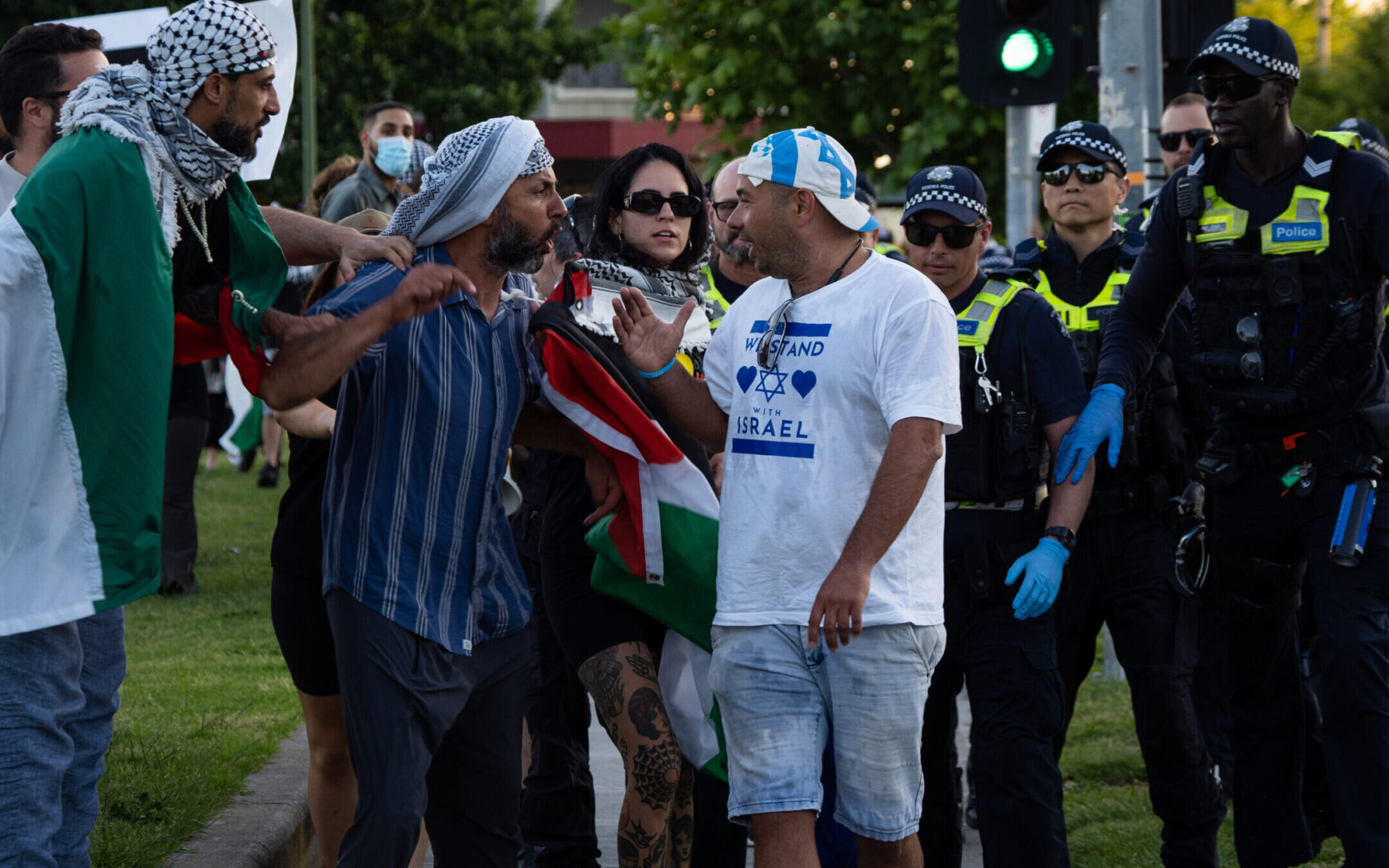
PRINCES PARK, CAUFIELD, VICTORIA, AUSTRALIA – 2023/11/10: Tense exchanges happen as a pro-Israel protester walks past the pro-Palestine demonstration. After a Burgertory chain-restaurant owned by Palestinian-Australian Hesham Tayah burned overnight in Melbourne’s most-Jewish suburb, Pro-Palestine protesters gathered in a nearby park where violent exchanges occurred with pro-Israel counter-protesters. Police deployed pepper spray on both sides and made one arrest. (Photo by Alex Zucco/SOPA Images/LightRocket via Getty Images)
(JTA) — The British government is pushing to let police block protests in front of places of worship, following a similar move earlier this year by Australian lawmakers.
The new measure in England, part of a policing bill currently moving through Parliament, would give police in England and Wales the ability to control the route and timing of protests that take place around places of worship, the Guardian reported.
The U.K. home secretary, Yvette Cooper, told a Jewish group on Wednesday that the provision is aimed at curbing protests outside of synagogues. Pro-Palestinian demonstrators have held regular rallies during the Israel-Hamas war that began in 2023, and some of the routes have passed synagogues on Shabbat.
“The right to protest must not undermine a person’s right to worship. And everybody has a right to live in freedom from fear,” she said at the annual dinner of the Community Security Trust, a Jewish security organization.
The initiative comes after organizers of a pro-Palestinian protest planned in January for a Saturday in London fought police orders to move away from a synagogue. Cooper’s proposed amendments to the UK’s crime and policing bill would grant the police powers to enforce such orders.
“I have strongly supported action taken by the Metropolitan Police in recent weeks and months to divert protest routes away from synagogues on Saturday mornings,” Cooper said at the CST dinner. “But I know how hard the community has had to fight for those conditions – each and every time. And I have listened to your calls for change.”
Another amendment to the policing bill would also add London’s forthcoming Holocaust memorial to a list of memorials that are protected from people climbing on them.
Similar restrictions also came to New South Wales, an Australian state, last month with the passage of a suite of laws that, in part, criminalized protest outside of places of worship.
A synagogue in Melbourne, located in another Australian state, was ordered to evacuate by police amid concerns over a nearby pro-Palestinian demonstration in 2023, in a dramatic incident that came amid a threefold increase in antisemitic incidents in the year since the beginning of the Israel-Hamas war.
Reception to the New South Wales legislation was mixed, with some critics citing potential free speech concerns.
“I welcome the government’s commitment to addressing the terrible rise in antisemitism and Islamophobia, but we should be careful not to erode civil rights or chill genuine protest in the process,” the lord mayor of Sydney, Clover Moore, told The Guardian in February.
In England, Jewish groups expressed cautious optimism about Cooper’s announcement.
“For too long, protests on Shabbat have disrupted communal life at multiple Central London synagogues,” the Jewish Leadership Council, which oversees Jewish organizations, said in a statement. “We look forward to seeing the detail about any forthcoming amendments in the hope that they will adequately re-establish the balance between the right to protest with the right of our community to practice our religion without fear and intimidation.”
This is a moment of great uncertainty. Here’s what you can do about it.
We hope you appreciated this article. Before you go, we’d like to ask you to please support the Forward’s independent Jewish news this Passover. All donations are being matched by the Forward Board - up to $100,000.
This is a moment of great uncertainty for the news media, for the Jewish people, and for our sacred democracy. It is a time of confusion and declining trust in public institutions. An era in which we need humans to report facts, conduct investigations that hold power to account, tell stories that matter and share honest discourse on all that divides us.
With no paywall or subscriptions, the Forward is entirely supported by readers like you. Every dollar you give this Passover is invested in the future of the Forward — and telling the American Jewish story fully and fairly.
The Forward doesn’t rely on funding from institutions like governments or your local Jewish federation. There are thousands of readers like you who give us $18 or $36 or $100 each month or year.
Support our mission to tell the Jewish story fully and fairly.