Trump defers Iran attack decision; Iranian foreign minister rejects talks unless Israel stops bombing
The twin developments put Israel in a bind as Iranian missiles continue to fall
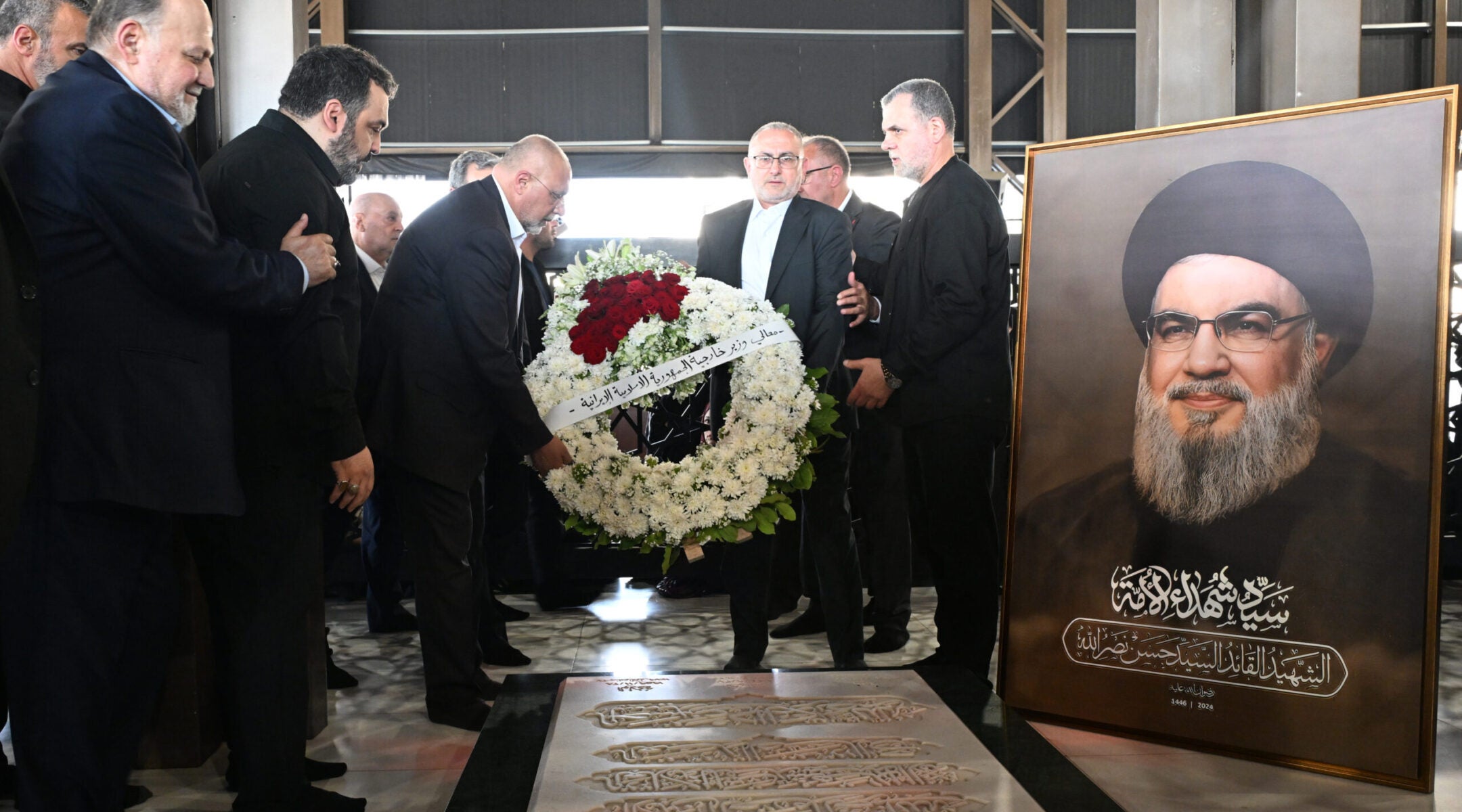
Iranian Foreign Minister Abbas Araghchi visits the grave of former Hezbollah leader Hassan Nasrallah during his official visit to Beirut, Lebanon, on June 3, 2025. (Houssam Shbaro/Anadolu via Getty Images)
(JTA) — After days of hinting that the United States could join Israel in its fight against Iran, then backing away, President Donald Trump said Thursday that he would make a decision about the conflict “within the next two weeks.”
Trump, who considers himself a master negotiator, invited Iran’s beleaguered leadership to resume talks over the country’s nuclear program. But Iran’s foreign minister, who was scheduled to meet Friday with European leaders seeking deescalation, said he did not intend to negotiate with the United States unless Israel’s attack ended.
Calling the United States “a partner in this crime,” Abbas Araghchi said on Iranian state TV on Friday, “The Americans want to negotiate and have sent messages several times, but we have clearly said that there is no room for talking until this aggression stops.”
Trump’s timeline — which Trump-watchers noted he has offered for a range of decisions in the past, often without sticking to it — and Iran’s demand place Israel in a bind.
Facing little resistance since launching their attacks on Iran’s nuclear program a week ago, the Israelis have run through a wide range of targets in Iran. Continuing the attacks for an indeterminate amount of time could continue to expose Israelis to deadly retaliatory strikes with uncertain gain.
Trump, meanwhile, has said he prefers diplomacy over military action, though he has emphasized that he is willing to use force if needed. Araghchi’s statement raises the possibility that Trump could press Israel to back down to open the door to talks.
Israel continued to pound targets in Iran on Friday, but the prime remaining target is Fordo, Iran’s underground nuclear enrichment facility. It has long been thought to be impenetrable by Israeli weapons, though Prime Minister Benjamin Netanyahu said on Thursday that Israel could attack it without help.
U.S. intelligence believes it would take Iran over a year to create a nuclear bomb and that bombing Fordo could increase the possibility that Iran takes that step, The New York Times reported on Friday. Israeli officials said they attacked last week because they believed Iran, whose regime has vowed to destroy Israel, was within days of being able to build a bomb.
On Friday, Iranian missiles fell again in Beersheba, the city where a major hospital suffered a direct strike on Thursday. Seven people were injured.
Netanyahu said in a televised interview late Thursday that Israel had so far destroyed half of Iran’s missile launchers. But concern is mounting about whether Israel’s supply of interceptors can keep up with the barrage.
This is a moment of great uncertainty. Here’s what you can do about it.
We hope you appreciated this article. Before you go, we’d like to ask you to please support the Forward’s independent Jewish news this Passover. All donations are being matched by the Forward Board - up to $100,000.
This is a moment of great uncertainty for the news media, for the Jewish people, and for our sacred democracy. It is a time of confusion and declining trust in public institutions. An era in which we need humans to report facts, conduct investigations that hold power to account, tell stories that matter and share honest discourse on all that divides us.
With no paywall or subscriptions, the Forward is entirely supported by readers like you. Every dollar you give this Passover is invested in the future of the Forward — and telling the American Jewish story fully and fairly.
The Forward doesn’t rely on funding from institutions like governments or your local Jewish federation. There are thousands of readers like you who give us $18 or $36 or $100 each month or year.
Support our mission to tell the Jewish story fully and fairly.