Over half of Jewish students at Columbia experienced discrimination and exclusion after Oct. 7, survey shows
The new survey found that 53% of Jewish students reported feeling personal danger for supporting Jews or Israel
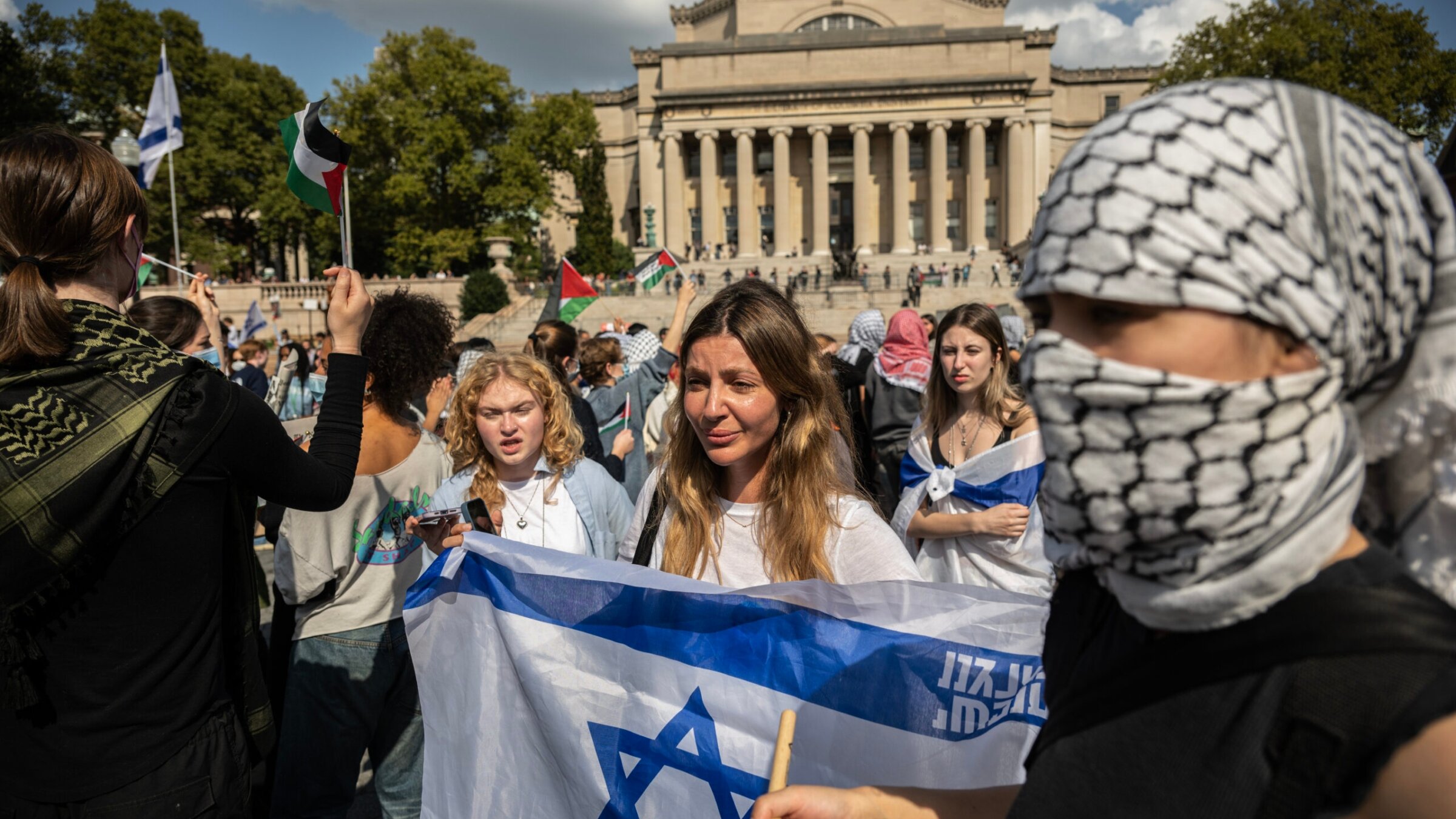
Students protest against the war in Gaza and in support of Israel on the anniversary of the Hamas attack on Israel at Columbia University in New York, New York, on Monday, October 7, 2024. One year ago today Hamas breached the wall containing Gaza and attacked Israeli towns and military installations, killing around 1200 Israelis and taking 250 hostages, and sparking a war that has over the last year killed over 40,000 Palestinians and now spilled over into Lebanon. Photographer: Victor J. Blue for The Washington Post via Getty Images
(JTA) — Nearly two thirds of Jewish students at Columbia University reported not feeling accepted for their religious identity during the school year that included Hamas’ attack on Israel, compared to 15% of students overall, according to a report released this week.
Jewish students were by far the most likely to report that political conversations about controversial topics strained their relationships during the 2023-2024 school year. And they were the most likely to say that they felt pressure to conform from their classmates — rather than, say, from their professors or school administrators — about their political beliefs.
The report was the third released by the Columbia University Task Force on Antisemitism, formed amid turmoil over pro-Palestinian protests at the Ivy League school in New York City. The first, released in March 2024, focused on rules about demonstrations, and the second, in August, surveyed Jewish students about their experiences.
The new report is based on a survey conducted in the summer of 2024 about experiences in the preceding school year. Asking students of all backgrounds about their sense of belonging, experiences of discrimination and opinions about protests, the survey found that Jewish and Muslim students were the most affected.
More than half of Jewish students — 53% — said they experienced discrimination over their religious identity, compared to 43% of Muslim students and 10% of the total population. And while half of all students reported positive feelings of belonging at Columbia, only 34% of Jewish and 41% of Muslim students reported feeling that way.
Just over half of Muslim students reported frequently feeling not accepted over their identity — fewer than Jewish students, but far more than in the overall student population.
The survey found that 53% of Jewish students reported feeling personal danger for support of Jews or Israel while 62% of Muslim students reported feeling personal danger for supporting Muslims or Palestinians.
“There were significant challenges, especially for Jewish and Muslim students, who frequently reported very different, and often more challenging, experiences than their peers who had other or no religious affiliations,” the report concludes.
The report comes as the school faces pressure from the Trump administration to address reports of antisemitism on its campus and many others. In March, the school acquiesced to a list of White House demands in a bid to win back $400 million in federal grants that were cancelled over antisemitism at the school. Last month, 70 pro-Palestinian protesters were arrested after occupying the main library on campus.
“There has been progress since the survey was done, but more is clearly needed,” Brian Cohen, the executive director of Columbia/Barnard Hillel, said in a statement calling the survey “very significant and sobering.”
The university’s interim president — the third leader since the 2023-2024 school year — said in a statement that she was confident about improvements.
“We knew we would find the results disturbing, but we also knew that such information would be necessary in order to move forward,” Claire Shipman said in a statement. “Indeed, the results—that in the 2023-2024 academic year a majority of our Jewish students felt they were not accepted here because of their religious identity—confirm the undeniable and painful reality that we failed to adhere to our values and failed to meet the expectations we set for our campus community.”
A pro-Palestinian encampment initiated at Columbia in the spring of 2024 triggered an international trend and caused many Jewish students on campus to report feelings of discomfort and isolation. The task force’s new report found that 66% of Jewish students reported the encampment affected their daily routine “a great deal or somewhat,” and 70% of Jewish students strongly or mostly opposed the encampment.
It also found that 27% of Jewish students participated in protests to support Israel while 12% participated in pro-Palestinian demonstrations.
This is a moment of great uncertainty. Here’s what you can do about it.
We hope you appreciated this article. Before you go, we’d like to ask you to please support the Forward’s independent Jewish news. All donations are still being matched by the Forward Board - up to $100,000 until April 24.
This is a moment of great uncertainty for the news media, for the Jewish people, and for our sacred democracy. It is a time of confusion and declining trust in public institutions. An era in which we need humans to report facts, conduct investigations that hold power to account, tell stories that matter and share honest discourse on all that divides us.
With no paywall or subscriptions, the Forward is entirely supported by readers like you. Every dollar you give is invested in the future of the Forward — and telling the American Jewish story fully and fairly.
The Forward doesn’t rely on funding from institutions like governments or your local Jewish federation. There are thousands of readers like you who give us $18 or $36 or $100 each month or year.

Support our mission to tell the Jewish story fully and fairly.