Israeli settler arrested after fatal shooting of Palestinian activist featured in ‘No Other Land’
The suspect was sanctioned by the United States for alleged violence against Palestinians but had his penalties lifted by the Trump administration in January
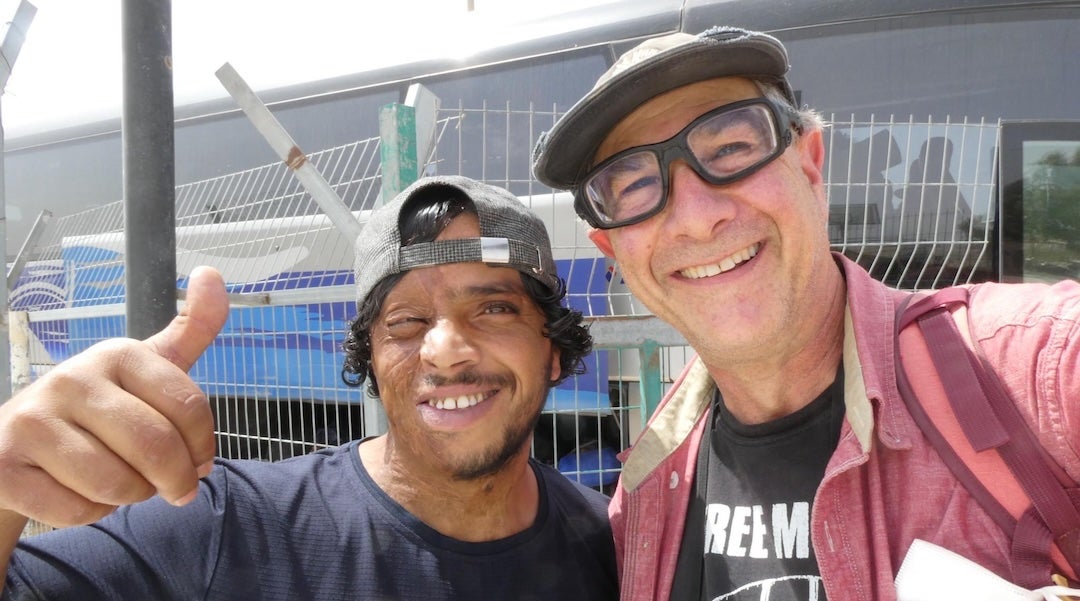
Awdah Hathaleen, left, with Kehilla Community Synagogue member Jim Haber. Courtesy of Phillip Weintraub

By Asaf Elia-Shalev July 29, 2025
(JTA) — Awdah Hathaleen, a Palestinian English teacher and activist featured in the Oscar-winning documentary “No Other Land,” was shot and killed Monday during a confrontation with Israeli settlers in the West Bank village of Umm al-Khair.
According to witnesses and human rights groups cited in multiple media reports, the incident began when settlers arrived with a bulldozer and began clearing land near the Palestinian community. Tensions escalated, and Hathaleen, 31, was struck by gunfire. He was transported to an Israeli hospital, where he was later pronounced dead.
On Tuesday, Israeli police identified Yinon Levi, a settler from the unauthorized outpost of Havat Ma’on, as the suspect in the shooting. Police detained him on suspicion of “reckless conduct resulting in death and unlawful use of a firearm,” according to the New York Times. Levi was placed under house arrest following a court appearance. An attorney representing Levi says his client acted in self-defense during a confrontation in which stones were thrown.
Levi, who owns an earthworks company that has been used by the Israeli military for demolitions, had previously been sanctioned by the Biden administration for alleged acts of violence against Palestinians. Those sanctions were lifted in January by President Donald Trump. Sanctions imposed by the United Kingdom and European Union remain in place.
Hathaleen, a father of three, had long documented life in Masafer Yatta, a cluster of Palestinian villages in the South Hebron Hills that face displacement due to Israeli military zoning and settlement expansion. Footage he filmed was featured in “No Other Land,” a documentary co-directed by Palestinian and Israeli activists that won Best Documentary Feature at the 2024 Academy Awards.
Hathaleen had visited the United States in June but was detained upon arrival at San Francisco International Airport along with his cousin Eid.
The two were invited to speak at events organized by Kehilla Community Synagogue in the Bay Area. Though they held valid visas, U.S. border officials canceled their entry and deported them the following day without providing a public explanation. Kehilla’s leaders described the treatment as “ridiculous and insane” and held a vigil in protest.
The shooting comes amid rising violence in the West Bank, where confrontations between settlers and Palestinian residents have intensified since the start of the war in Gaza.
Rights groups have long raised concerns about a lack of accountability for violence committed by settlers, noting that Palestinians fall under military law while settlers are generally subject to Israeli civilian law. Settlers say they’re being unfairly blamed for defending themselves against regular Palestinian attacks.
This is a moment of great uncertainty. Here’s what you can do about it.
We hope you appreciated this article. Before you go, we’d like to ask you to please support the Forward’s independent Jewish news. All donations are still being matched by the Forward Board - up to $100,000 until April 24.
This is a moment of great uncertainty for the news media, for the Jewish people, and for our sacred democracy. It is a time of confusion and declining trust in public institutions. An era in which we need humans to report facts, conduct investigations that hold power to account, tell stories that matter and share honest discourse on all that divides us.
With no paywall or subscriptions, the Forward is entirely supported by readers like you. Every dollar you give is invested in the future of the Forward — and telling the American Jewish story fully and fairly.
The Forward doesn’t rely on funding from institutions like governments or your local Jewish federation. There are thousands of readers like you who give us $18 or $36 or $100 each month or year.

Support our mission to tell the Jewish story fully and fairly.