New Trump policy letting federal employees proselytize at work references tefillin
In the federal government’s announcement, they cited a woman keeping tefillin on her desk
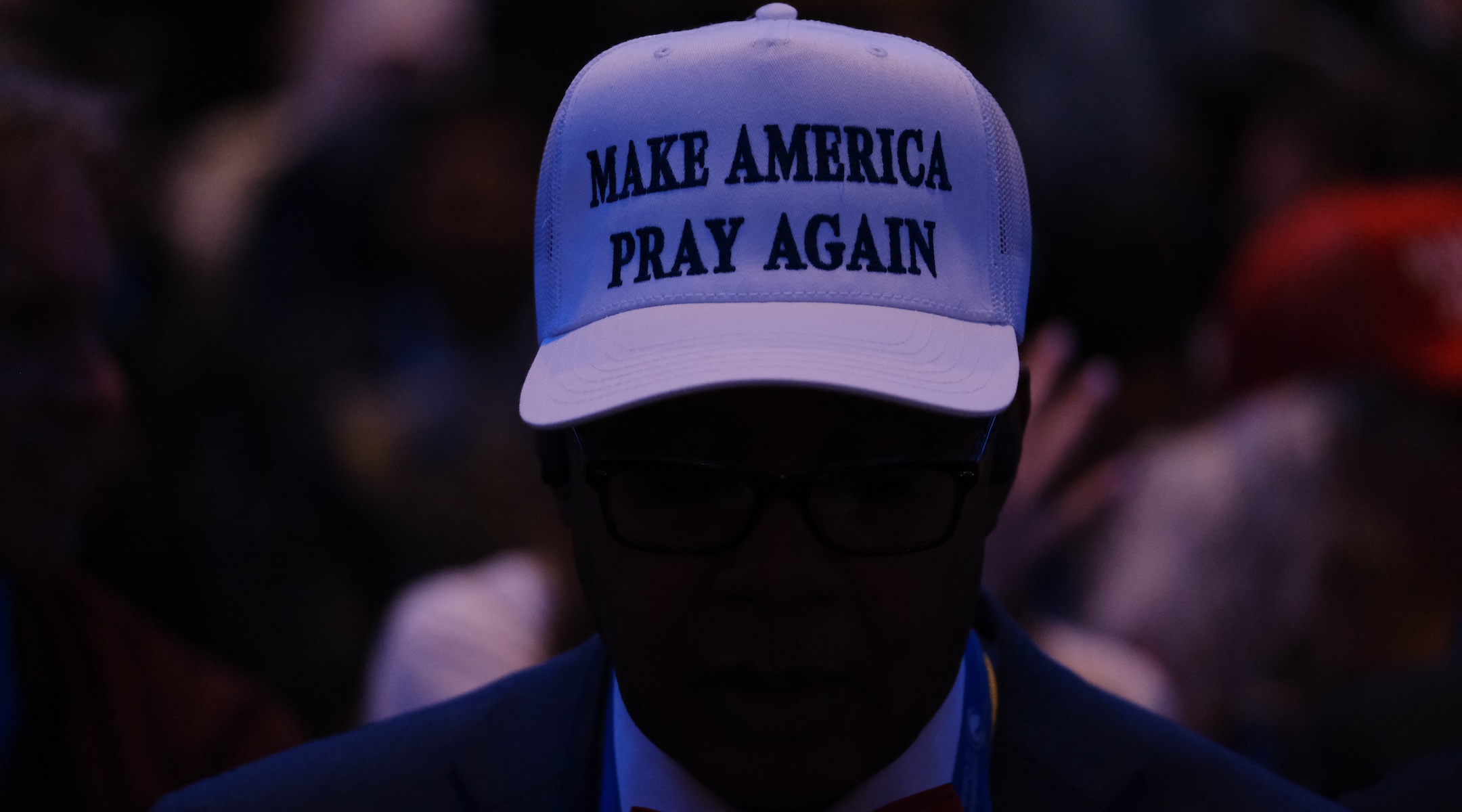
Attendees wear hats reading “Make America Pray Again” before former U.S. President and 2024 presidential hopeful Donald Trump addresses Christian broadcasters at the National Religious Broadcasters International Christian Media Convention in Nashville, Tennessee, on Feb. 22, 2024. Photo by Kevin Wurm/AFP via Getty Images
(JTA) — The Trump administration has released new guidelines for federal employees expressing their religion in the workplace, protecting activities ranging from displaying religious objects to recruiting coworkers to their religion.
The guidelines namecheck tefillin, Jewish prayer phylacteries, as an example of a religious item that federal workers may leave on their desks and use during breaks.
In a memo titled “Protecting Religious Expression in the Federal Workplace” sent on Monday by the Office of Personnel Management, the federal government’s human resources agency, the office said federal workplaces should be “a welcoming place” for employees who practice religion — or want to proselytize, within limits.
“During a break, an employee may engage another in polite discussion of why his faith is correct and why the non-adherent should re-think his religious beliefs,” the memo says before adding, “However, if the nonadherent requests such attempts to stop, the employee should honor the request.”
The new policy comes amid a concerted effort by the Trump administration to erode the separation of church and state, a goal of many on the Christian right that has drawn criticism from some Jewish groups and leaders.
“Federal employees should never have to choose between their faith and their career,” OPM Director Scott Kupor said in a statement about the new guidance. “This guidance ensures the federal workplace is not just compliant with the law but welcoming to Americans of all faiths. Under President Trumpʼs leadership, we are restoring constitutional freedoms and making government a place where people of faith are respected, not sidelined.”
The memo says employees may form prayer groups that meet at the office when they are not on duty, invite colleagues to attend their church even when they know the colleagues do not belong, or, in the case of Veteran’s Administration staffers, pray over the health of their patients.
Among the other examples of protect religious expression it outlines refers to Jewish prayer phylacteries. “An employee may keep a Bible on her desk, and may read it during breaks. Similarly, an employee may keep rosary beads or tefillin on her desk,” the memo says. “During breaks, she may use such items to pray.”
The mention of tefillin is notable because their use by women, who are not required according to traditional Jewish law to wear them, has been heavily contested in some observant communities where men use them daily in morning prayers.
This is a moment of great uncertainty. Here’s what you can do about it.
We hope you appreciated this article. Before you go, we’d like to ask you to please support the Forward’s independent Jewish news this Passover. All donations are being matched by the Forward Board - up to $100,000.
This is a moment of great uncertainty for the news media, for the Jewish people, and for our sacred democracy. It is a time of confusion and declining trust in public institutions. An era in which we need humans to report facts, conduct investigations that hold power to account, tell stories that matter and share honest discourse on all that divides us.
With no paywall or subscriptions, the Forward is entirely supported by readers like you. Every dollar you give this Passover is invested in the future of the Forward — and telling the American Jewish story fully and fairly.
The Forward doesn’t rely on funding from institutions like governments or your local Jewish federation. There are thousands of readers like you who give us $18 or $36 or $100 each month or year.
Support our mission to tell the Jewish story fully and fairly.