Israel approves vast West Bank settlement plan that far-right minister said ‘practically erases the two-state delusion’
The plan, known as E1, had been delayed for two decades
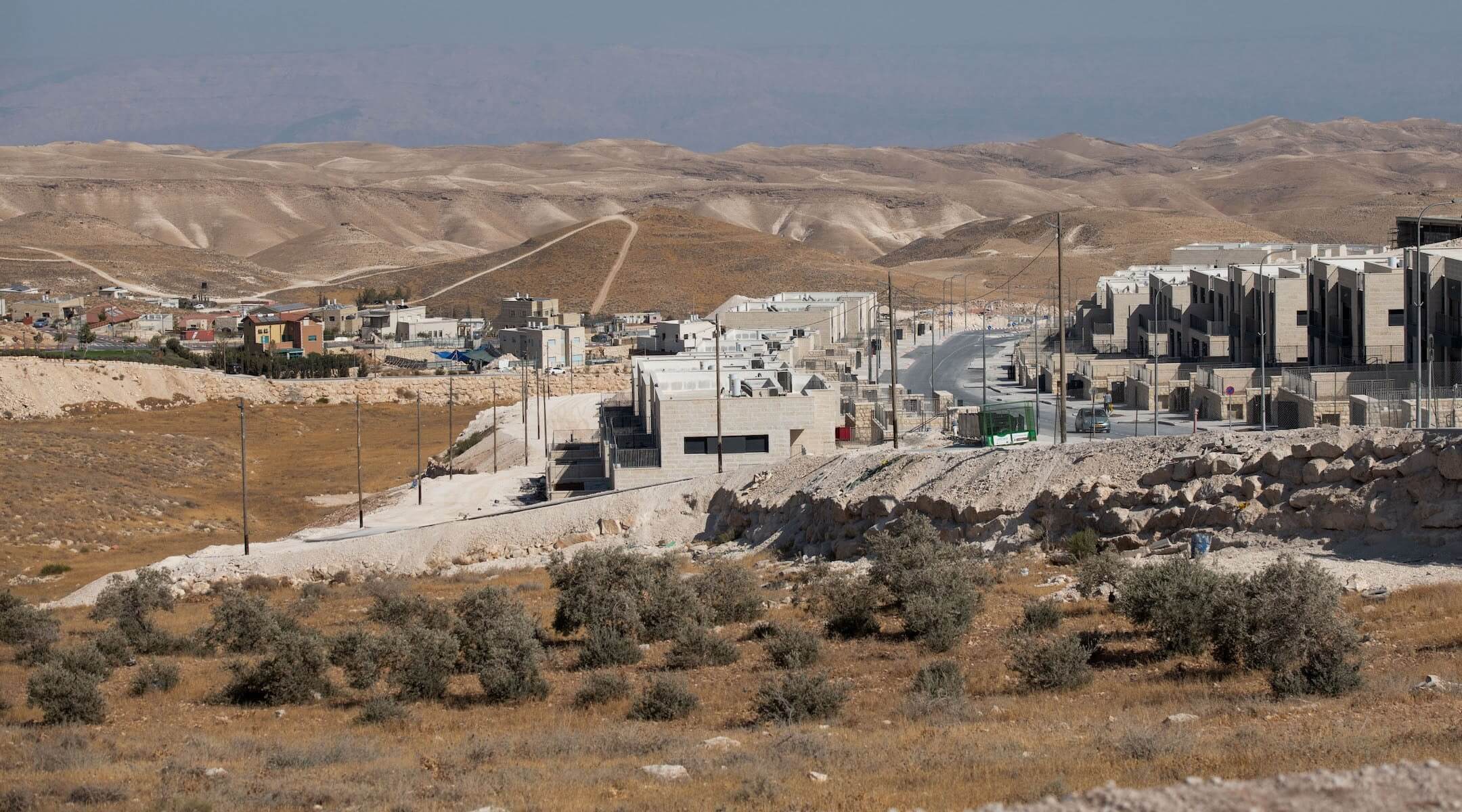
Housing in the Jewish settlements of Nokdim and Kfar Eldad, in the West Bank, September 11, 2022. Photo by Sraya Diamant/Flash90
(JTA) — Israel has approved a long-delayed settlement project that would build 3,400 housing units for Jews in the West Bank, in a move that both its backers and its many critics say would undercut Palestinian ambitions to control the region.
The E1 project would expand Jewish settlements on a stretch of land east of Jerusalem, effectively bisecting the West Bank and limiting Palestinian neighborhoods of Jerusalem from growing,
Proposed decades ago but never finalized, the plan was abruptly moved forward this month by Israel’s far-right finance minister, Bezalel Smotrich, and it received final approval Wednesday from a Defense Ministry planning committee.
Smotrich described the plan as a “significant step that practically erases the two-state delusion,” in an apparent rebuke of plans by some countries to recognize Palestinian statehood this fall.
“The Palestinian state is being erased from the table not with slogans but with actions,” Smotrich continued. “Every settlement, every neighborhood, every housing unit is another nail in the coffin of this dangerous idea.”
The settlement plan has drawn widespread condemnation, including from the United Nations, the European Union and several Arab countries which decried the plan for breaching international law. Liberal Jewish groups in the United States and Israel have also denounced it.
But a crucial roadblock — discouragement from the United States — was lifted last week when Ambassador Mike Huckabee said the United States would not oppose E1. Huckabee is a longtime support of Israeli settlements in the West Bank.
The plan’s approval comes amid a sharp increase in violence against Palestinians in the West Bank by Israeli settlers.
This is a moment of great uncertainty. Here’s what you can do about it.
We hope you appreciated this article. Before you go, we’d like to ask you to please support the Forward’s independent Jewish news this Passover.
This is a moment of great uncertainty for the news media, for the Jewish people, and for our sacred democracy. It is a time of confusion and declining trust in public institutions. An era in which we need humans to report facts, conduct investigations that hold power to account, tell stories that matter and share honest discourse on all that divides us.
With no paywall or subscriptions, the Forward is entirely supported by readers like you. Every dollar you give this Passover is invested in the future of the Forward — and telling the American Jewish story fully and fairly.
The Forward doesn’t rely on funding from institutions like governments or your local Jewish federation. There are thousands of readers like you who give us $18 or $36 or $100 each month or year.
Support our mission to tell the Jewish story fully and fairly.