Hegseth says ‘no more beardos’ in the military. What about religious exemptions?
Orthodox Jews and Sikhs have generally won court cases allowing them to wear beards in the military
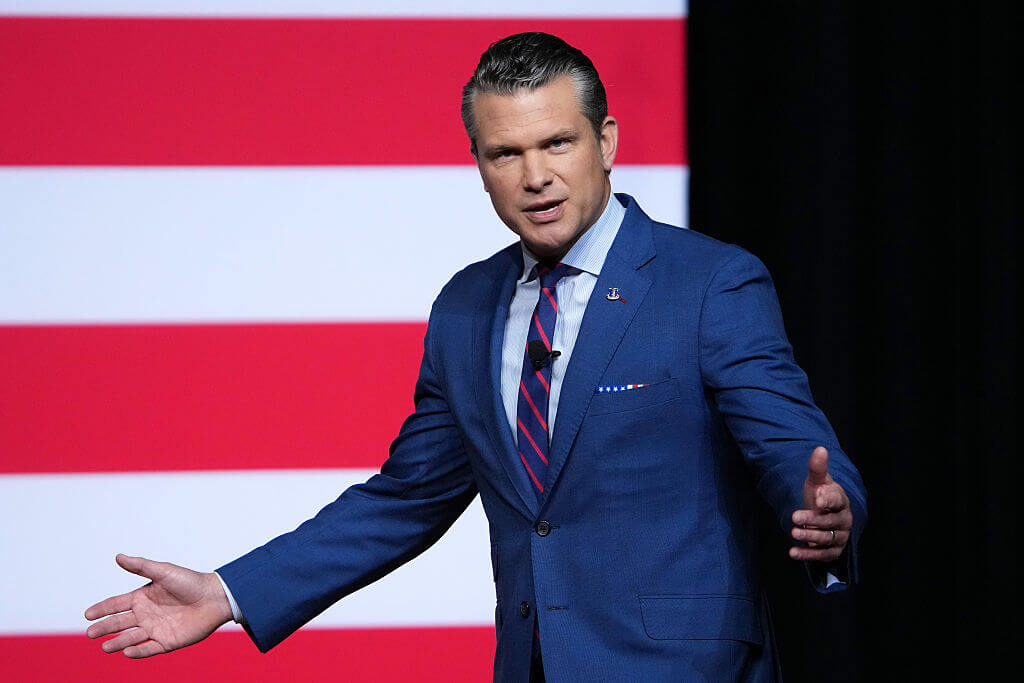
A clean-shaven Pete Hegseth speaks to senior military leaders at Marine Corps Base Quantico in Virginia Sept. 30. Photo by Andrew Harnik/Getty Images

By Hannah Feuer September 30, 2025
“No more beardos,” Secretary of Defense Pete Hegseth told an auditorium filled with top military officials. “The era of rampant and ridiculous shaving profiles is done.”
Hegseth, who summoned hundreds of generals and admirals from around the world to hear him speak Tuesday at the Quantico Marine Corps Base in Virginia, lectured them about grooming standards.
“If you want a beard, you can join Special Forces. If not, then shave,” Hegseth said (referencing an exemption put in place to allow Special Forces to better blend in with local populations where beards are customary). “We don’t have a military full of Nordic pagans.”
The directive ignored a significant nuance: Courts have granted Orthodox Jews and Sikhs who serve religious exemptions allowing them to keep their beards.
“It’s not a small thing about, ‘Oh, can you have a beard? Or what about my hair?’” said Mikey Weinstein, founder of the Military Religious Freedom Foundation, a watchdog group that exposes Christian nationalism in the armed forces. “This is a comprehensive, universal attack on anyone who is not straight, white, Christian and male.”
Under the 1993 Religious Freedom Restoration Act, the federal government is prohibited from “substantially burdening” a person’s exercise of religion unless it can show a compelling government interest. In the military, that means leadership has the burden of showing that allowing facial hair would substantially burden the military’s mission, such as compromising military readiness or unit cohesion.
“How do you show that a beard is going to destroy good order, morale, discipline, unit cohesion?” Weinstein said. “So you have to go through some gymnastics there.”
A number of lawsuits have helped codify the right to religious exemptions for beards. In 2011, Rabbi Menachem Stern successfully sued the Army after being barred from serving as a chaplain because he refused to shave. In 2016, the Sikh Captain Simratpal Singh won an accommodation to maintain his unshorn hair and beard while serving. And in the 2022 case Singh v. Berger, a court ruled that Sikh recruits could not be denied entry into the Marine Corps for keeping beards.
It wasn’t immediately clear how Hegseth’s “no beardos” policy would affect religious exemptions. A Department of Defense memo posted on Tuesday said documentation of sincere religious beliefs will be key in evaluating requests, and approvals will be limited to “non-deployable roles with low risk of chemical attack or firefighting requirements.” Standard gas masks may be susceptible to leakage when worn over beards, although in recent years some militaries have introduced innovations that accommodate facial hair.
But Weinstein said Hegseth’s comments have caused alarm and confusion among his religious clients.
“Everybody is terrified,” he said. “If you feel that you’ve been denied your accommodation request, there’s only so much you can do.”
Rabbi Sanford Dresin of the Aleph Institute, a nonprofit affiliated with the Chabad-Lubavitch movement that provides support to Jewish members of the military, said the group was “very concerned” about Hegseth’s comments.
“It has the potential to reverse years of hard work and dialogue that has allowed dozens of rabbis who wear beards for halachic reasons to serve with honor in the U.S. military, many of whom have been deployed in combat zones and served honorably on deployments across the world,” Dresin wrote in a statement to the Forward. “This policy has the potential to have an adverse impact on a Jewish chaplain’s career progression, involving promotions, assignments, and special schooling, and will hinder our chaplains’ ability to serve Jewish military service members.”
The Department of Defense did not respond to the Forward’s request for further clarification about how its policy on religious exemptions to grooming standards would change.
This article has been updated with information from Rabbi Sanford Dresin.
This is a moment of great uncertainty. Here’s what you can do about it.
We hope you appreciated this article. Before you go, we’d like to ask you to please support the Forward’s independent Jewish news this Passover. All donations are being matched by the Forward Board - up to $100,000.
This is a moment of great uncertainty for the news media, for the Jewish people, and for our sacred democracy. It is a time of confusion and declining trust in public institutions. An era in which we need humans to report facts, conduct investigations that hold power to account, tell stories that matter and share honest discourse on all that divides us.
With no paywall or subscriptions, the Forward is entirely supported by readers like you. Every dollar you give this Passover is invested in the future of the Forward — and telling the American Jewish story fully and fairly.
The Forward doesn’t rely on funding from institutions like governments or your local Jewish federation. There are thousands of readers like you who give us $18 or $36 or $100 each month or year.
Support our mission to tell the Jewish story fully and fairly.