War battered their Berlin hummus bar. But the Israeli-Palestinian partners behind Kanaan see a way forward.
Kanaan is a Hebrew and Arabic word for the ancient land they both call home, before it was known as Israel or Palestine
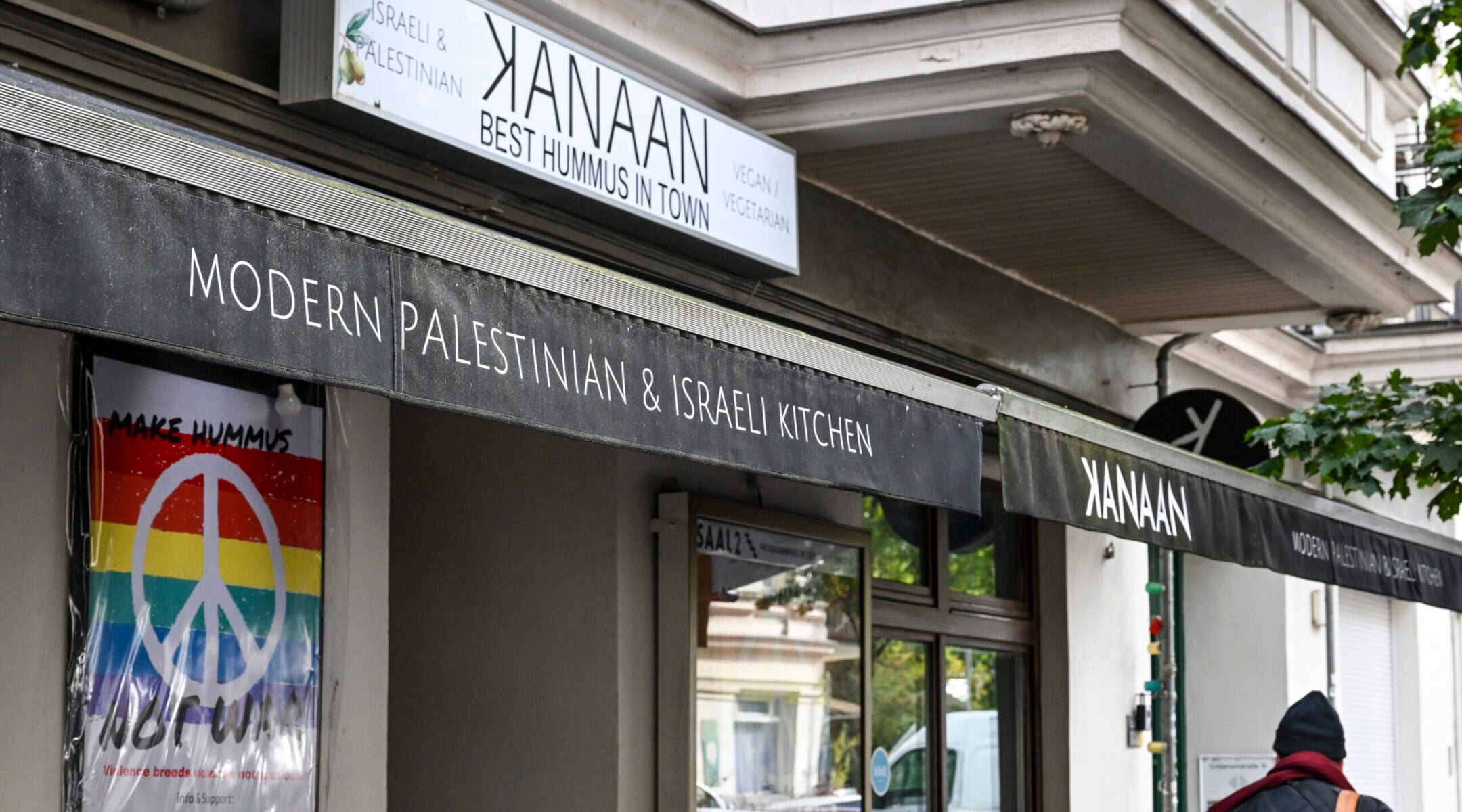
The Israeli-Palestinian restaurant Kanaan in Prenzlauer Berg, Berlin, is an Israeli-Palestinian restaurant brand. Photo by Jens Kalaene/picture alliance via Getty Images
(JTA) — BERLIN — At a hummus restaurant in Berlin’s leafy neighborhood of Prenzlauer Berg, war has come knocking many times over the last two years. Recently, it came with the threat of closure.
Jalil Dabit, a Palestinian, and Oz Ben David, an Israeli, have run the business together for 10 years. The last two saw Hamas’ Oct. 7 attack on Israel and the devastating war that ensued in Gaza, killing tens of thousands of Palestinians and largely reducing the enclave to rubble.
Dabit and Ben David named their restaurant Kanaan — a Hebrew and Arabic word for the ancient land they both call home, before it was known as Israel or Palestine.
They have a mission beyond bringing the best hummus to Berlin. They turned Kanaan into a local symbol of Israeli-Palestinian dialogue, organizing free programs that teach about cooking and prejudice. One project joined Palestinian refugees who fled Gaza during the war together with members of Berlin’s Israeli community to cook under one roof. A rainbow sign outside the restaurant reads, “Make hummus not war.”
But in August, the partners issued an emergency plea.
“Kanaan is facing closure,” they announced to customers. “The year 2025 was tough. War, economic uncertainty and a sharp drop in revenue have brought us to a point where we cannot continue without your help. If nothing changes in the next two weeks, we will have to close Kanaan.”
Dabit and Ben David have continuously fended off the Gaza war’s encroachment on their business. On Oct. 7, 2023, they closed for six days. Ben David said he felt driven to quit after his friend was killed and his family members hid in their safe room from the Hamas attack on Kibbutz Be’eri. Dabit coaxed him back from despair.
The unlikely duo supported each other even as their message cost them Israeli and Palestinian friends from home. Ben David grew up in Ariel, an Israeli settlement in the West Bank; Dabit comes from Ramle, a mixed city in central Israel where his family has lived for hundreds of years. He had 16 family members in Gaza when the war broke out, all of whom since escaped to Australia.
In Berlin, their restaurant has been tested by tensions over the war. Both far-right and far-left factions have protested the “normalization” of an Israeli and a Palestinian working together.
In July 2024, Kanaan was vandalized after hosting a Jewish-Muslim brunch. The attackers shattered wine glasses, destroyed furniture, spread excrement and left hate messages throughout the restaurant. With nothing stolen, police suspected the vandalism to be motivated by hate. Months later, an Israeli woman was assaulted by four people while wearing Kanaan’s signature pin, which depicts a heart divided between the Israeli and Palestinian flag. One of the attackers shouted “Israel muss weg,” or “Israel must go,” while they knocked the woman to the ground and kicked her.
More recently, Ben David said they faced a downturn in revenue. Their customers were dwindling and they struggled to keep up with rising costs and high rent. He reached out to an email list of previously loyal customers, asking for feedback about why they weren’t returning. The responses weren’t about the food.
One answer came back clearly: People couldn’t figure out how to place Kanaan’s message of dialogue and coexistence. “‘We don’t understand if you are pro-Israel or pro-Palestine.’ That’s something that we heard a lot,” said Ben David.
Another response came down to fatigue with the Israeli-Palestinian conflict. After reading and watching news about the war for two years, when they finally had a break, many customers said they’d rather go out for sushi or Italian food.
Two weeks from bankruptcy, Ben David and Dabit tried to explain the restaurant’s significance to their community. “Kanaan was never just a restaurant,” they wrote on social media. “It’s a place where Israelis and Palestinians work together, where all guests eat together, where food is more than just enjoyment. … It’s a bridge between people.”
The following weeks saw a stunning change in fortune. Kanaan filled up again with a 300% increase in diners. Catering orders poured in, while many customers bought vouchers for the future. The support wasn’t just financial, said Dabit.
“When people react to our call, they give me — not just Kanaan, but also Oz and me — they give us the energy to continue,” he said. “They show us that we’re doing something right, even though it’s a really bad situation, but we’re doing something right.”
For now, the restaurant can keep going. And the partners have new inspiration for their persistent hope: Back home, the first phase of a ceasefire agreement between Israel and Hamas saw the last 20 surviving Israeli hostages returned in exchange for 1,968 Palestinian prisoners on Monday, as scenes of ecstatic reunions and continued grief washed over Israel, Gaza and the West Bank.
Dabit and Ben David said they were filled with joy and relief, mixed with yearning for a lasting peace and reconciliation.
“The ceasefire feels like a breath of fresh air after so much suffering,” said Dabit. “It’s bittersweet, but it’s an opportunity for change. This is our chance to write a new narrative for our future.”
In Kanaan’s backyard, the Gaza war triggered a sharp rise in antisemitic and anti-Muslim incidents across Germany. It also drove a fraught debate over Germany’s relationship with Israel, which became central to German national identity after the Holocaust. Unlike other European countries that have recently recognized a Palestinian state, including the United Kingdom, France, Belgium, Portugal and Spain, Germany has declined to do so.
Pro-Palestinian protests in Berlin have also led to government crackdowns. In April, German immigration authorities ordered the deportation of three European nationals and one U.S. citizen over their alleged activity at pro-Palestinian demonstrations. Three of the orders cited Germany’s responsibility toward Israel — a doctrine known as the country’s “Staatsräson,” or “reason of state.” (All the protesters have appealed and won measures for interim relief.)
Dabit and Ben David plan to shape the conversations about Israelis, Palestinians, Jews and Muslims in Germany through projects beyond their restaurant. On Nov. 5, they will publish a cookbook titled “Kochen ohne Grenzen,” or “Cooking Without Borders.” The book collects their recipes while also sharing their kitchen with Berliners from around the world — including rabbis, imams and priests who cook together.
During a recent phone call between Dabit in Ramle and Ben David in Berlin, they jokingly interrupted each other’s stories about their families with accusations of “propaganda.” Turning serious, Dabit said, “I’m optimistic because I see the beauty of every person. If I couldn’t see the beauty, I couldn’t be with you for 10 years, Oz.”
“That’s true,” replied Ben David. “You managed to take a settler from Ariel and make him your best friend, like your brother.”
This is a moment of great uncertainty. Here’s what you can do about it.
We hope you appreciated this article. Before you go, we’d like to ask you to please support the Forward’s independent Jewish news this Passover. All donations are being matched by the Forward Board - up to $100,000.
This is a moment of great uncertainty for the news media, for the Jewish people, and for our sacred democracy. It is a time of confusion and declining trust in public institutions. An era in which we need humans to report facts, conduct investigations that hold power to account, tell stories that matter and share honest discourse on all that divides us.
With no paywall or subscriptions, the Forward is entirely supported by readers like you. Every dollar you give this Passover is invested in the future of the Forward — and telling the American Jewish story fully and fairly.
The Forward doesn’t rely on funding from institutions like governments or your local Jewish federation. There are thousands of readers like you who give us $18 or $36 or $100 each month or year.
Support our mission to tell the Jewish story fully and fairly.