Boston’s unfinished Holocaust museum hoists boxcar into exhibit space overlooking Boston Common
The railcar is believed to be the same type used by the Nazis to transport Jews to extermination camps
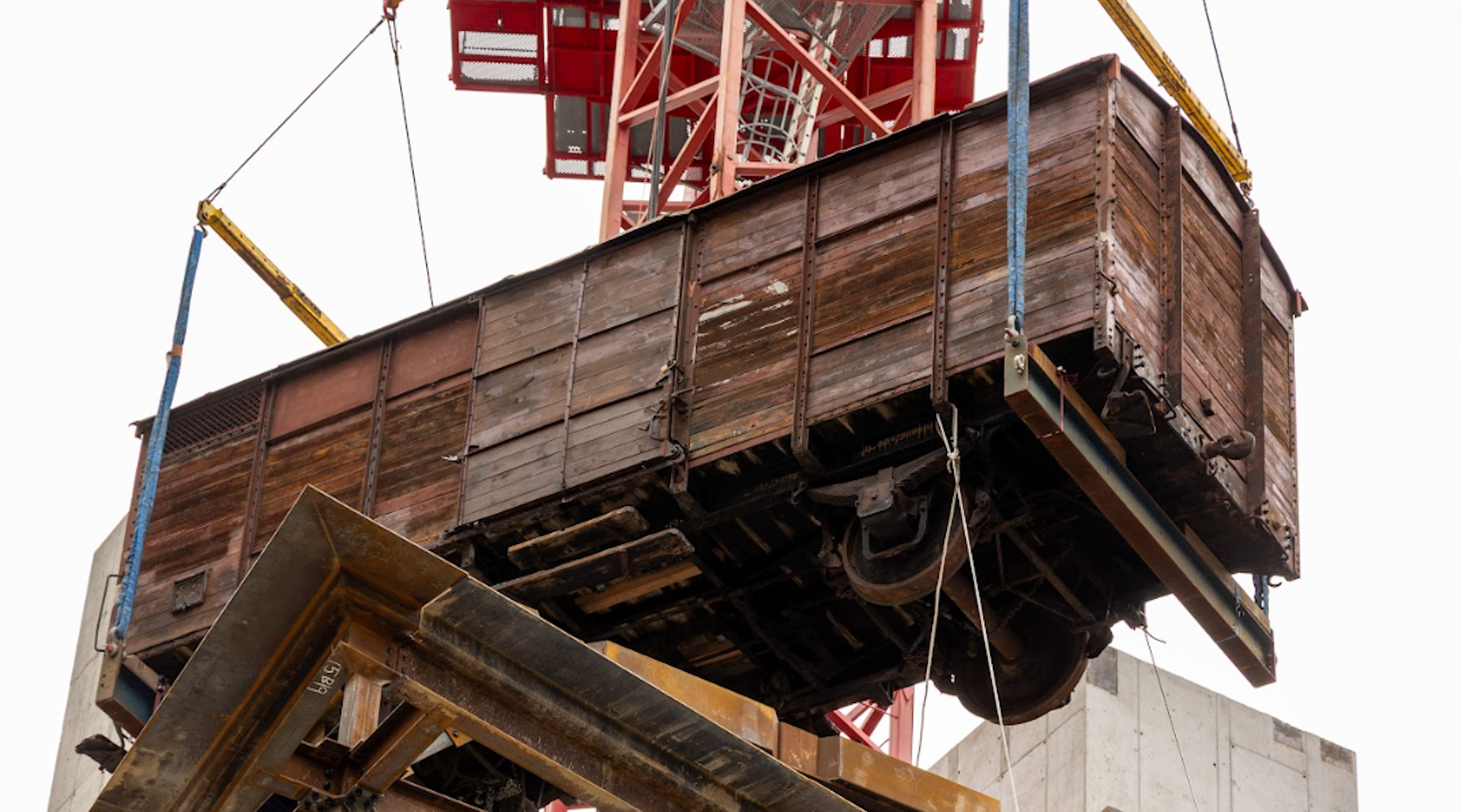
A 173-foot tower crain hoists a 20th century 12-ton railcar into the upcoming Holocaust Museum Boston. Photo by Kenneth Berman Photography
(JTA) — Traffic on Tremont Street in downtown Boston came to a standstill Tuesday morning as a crane lifted a historic 12-ton railcar onto the fourth floor of the city’s upcoming Holocaust museum.
The museum, the first of its kind in New England, was launched by the The Holocaust Legacy Foundation in 2022, which was founded by business partners Jody Kipnis and Todd Ruderman following a 2018 March of the Living trip to Auschwitz.
While construction on the site, which rests on the city’s Freedom Trail near the Boston Common, remains ongoing, the installation of the 20th-century railcar, believed to be the same type used by the Nazis to transport Jews to extermination camps, marked a major milestone for the museum’s creation.
The railcar, which measures 30 feet long, 12 feet high, and nearly 9 feet wide, was lifted into the new museum structure by a 173-foot tower crane before construction continues around it.
A group of supporters, Massachusetts officials, civic leaders, Jewish community representatives and Boston-area partners looked on as the railcar was installed, according to the museum.
“The hardest truth this railcar forces us to confront is this: the Holocaust was not carried out by the Nazis alone. It was carried out by people, ordinary people, who kept the trains running, who stamped the papers, who followed schedules, who chose silence over courage,” said Kipnis, the co-founder and CEO of Holocaust Museum Boston, in a statement. “This railcar will stand at the heart of the Holocaust Museum Boston to confront that truth.”
After the museum opens in late 2026, the railcar will rest in a protruding bay window on the museum’s fourth floor so that pedestrians will be able to see visitors enter the railcar but not exit, a choice the museum said it intended to symbolize “the millions who never returned and the freedoms that were stripped away.”
The railcar was donated to the museum by Sonia Breslow, a Phoenix resident whose father was deported to the Treblinka concentration camp on a railcar of the same kind. Breslow’s father, who later moved to Massachusetts, was among fewer than 100 survivors of Treblinka, where 900,000 Jews were murdered.
The railcar was first discovered in a Macedonian junkyard in 2012, according to the museum, and later transported to Massachusetts, where conservator Josh Craine of Daedalus Art Conservation spent the past six months restoring it for exhibition.
“Seeing this railcar lifted into its new home took my breath away,” said Breslow. “My father survived a transport to Treblinka in a car just like this. Most who were taken there did not survive. For this railcar to be in Massachusetts, a place where he rebuilt his life, is deeply personal. It ensures that his story, and the stories of millions, will never be forgotten.”
This story has been updated to describe Kipnis and Ruderman as “business partners” rather than “couple.”
This is a moment of great uncertainty. Here’s what you can do about it.
We hope you appreciated this article. Before you go, we’d like to ask you to please support the Forward’s independent Jewish news this Passover. All donations are being matched by the Forward Board - up to $100,000.
This is a moment of great uncertainty for the news media, for the Jewish people, and for our sacred democracy. It is a time of confusion and declining trust in public institutions. An era in which we need humans to report facts, conduct investigations that hold power to account, tell stories that matter and share honest discourse on all that divides us.
With no paywall or subscriptions, the Forward is entirely supported by readers like you. Every dollar you give this Passover is invested in the future of the Forward — and telling the American Jewish story fully and fairly.
The Forward doesn’t rely on funding from institutions like governments or your local Jewish federation. There are thousands of readers like you who give us $18 or $36 or $100 each month or year.
Support our mission to tell the Jewish story fully and fairly.