Bondi Beach attack transforms global Hanukkah celebrations into acts of defiance — with added security
The Chabad movement issued security recommendations surrounding the 15,000 public menorahs it erects annually
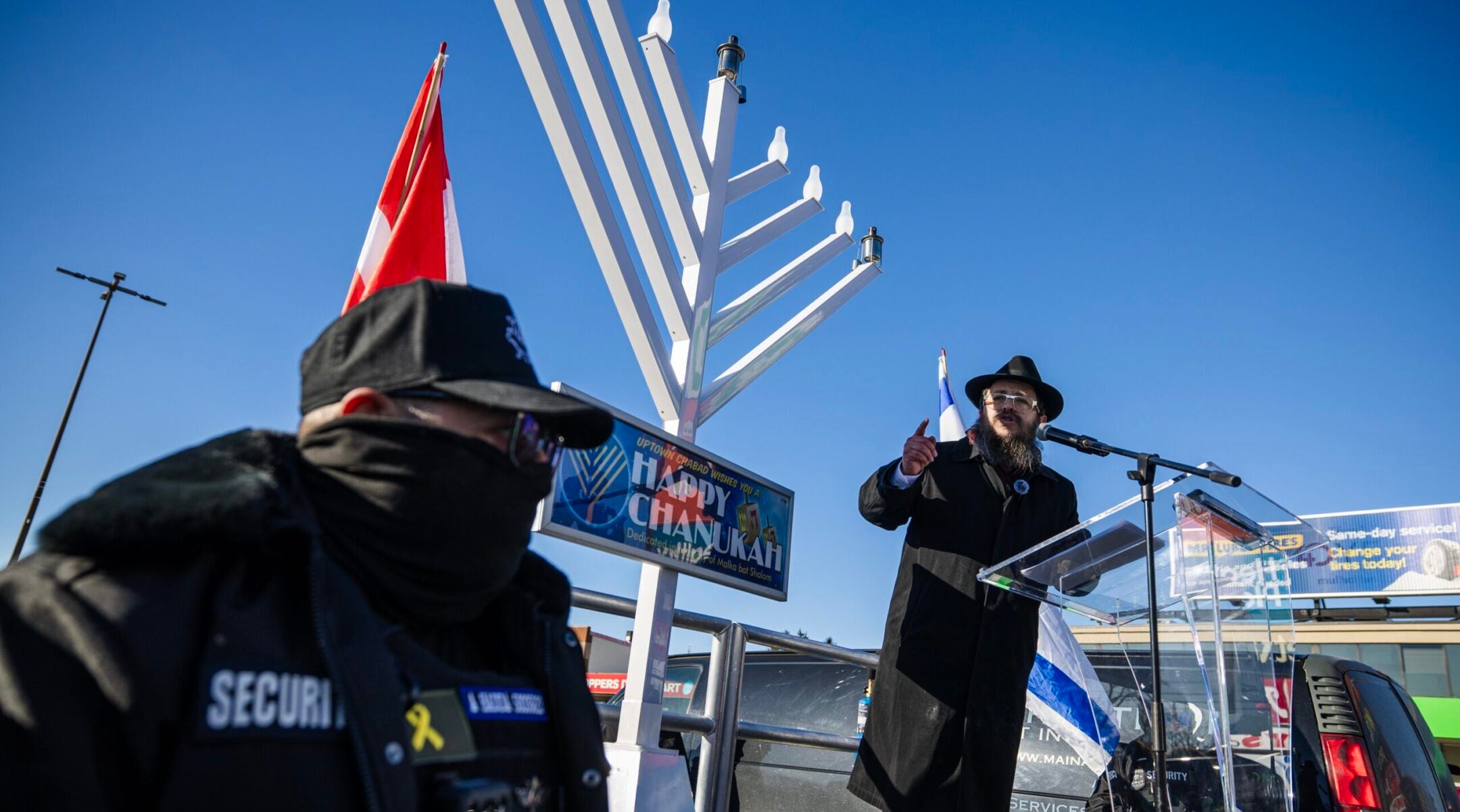
Flanked by private security, Rabbi Moshe Steiner speaks at a Hanukkah gathering in Toronto, Dec. 14. Photo by Nick Lachance/Toronto Star via Getty Images
(JTA) — Within hours of a devastating shooting on a Chabad Hanukkah party in Australia, other outposts of the Hasidic movement began outlining their plans to go forward with their own celebrations, despite their grief and the possible risk.
“Chanukah teaches that we do not respond to darkness by retreating,” said Rabbi Mendel Silberstein of Chabad Lubavitch of Larchmont and Mamaroneck, in suburban New York City, in one statement among many issued by Chabad emissaries.
“We respond by adding light,” he continued. “Today is not a time to stay home or stay silent. It is a time to come out, stand tall, and show support for our brothers and sisters in Australia and for Jews everywhere.”
Rabbi Avi Winner, a spokesman for Chabad World Headquarters and the leader of Chabad Young Professionals in Manhattan, said public menorah lightings across the globe hosted by Chabad were seeing a surge in attendance, with some lightings “doubling in size” because of the Bondi Beach shooting.
“The only response is to not cower, but to double down and stand up for who we are and let the menorah shine bright,” Winner said.
The attack on the event organized by Chabad of Bondi is renewing attention to the public menorah-lightings that are a trademark of Chabad’s presence around the world, as urged by the movement’s last leader, Rabbi Menachem Mendel Schneerson. Menorahs have been erected by the movement in about 15,000 different locations annually in recent years, with many of them hosting daily gatherings to add a new candle.
The menorahs make Chabad one of the the most visible purveyors of Judaism during Hanukkah. Their presence in public spaces also make gatherings convened around them vulnerable targets for those seeking to carry out antisemitic attacks.
The Bondi Beach celebration was staffed with both city and private security officers, according to local accounts, but it took place in an exposed public location that would be difficult to protect from all attacks. The attackers shot with powerful weapons from some distance away.
Rabbi Mendy Kotlarsky, the executive director of Merkos 302 at Chabad World Headquarters, a division that supports the movement’s expansion, said in an interview that Chabad’s security office had sent out a “high-alert email with recommendations and guidelines” following the attack on Bondi Beach.
He said that while some Chabads had altered their plans following the attack, the predominating sentiment was that it was important to press ahead with the festivities.
“There are certain changes that have been made to different events, some of them going indoors, some of them just rearranging to more secure places,” Kotlarsky said. “But by and large the consensus and the approach is that we cannot allow these people to win. They’re trying to put out the Jewish flame.”
The attack at Bondi Beach comes as Jewish institutions around the world have shored up their security practices amid surging antisemitism across much of the world following Hamas’ Oct. 7, 2023, attack on Israel and the subsequent Israel-Hamas war in Gaza.
Many have pulled back from publicly announcing the locations of their public events, making the details available only to registrants or people affiliated with Jewish organizations.
After a deadly shooting at the Capital Jewish Museum in Washington, D.C., in May and an attack on Israeli hostage solidarity demonstrators in Boulder, Colorado, in June, Jewish security agencies urged institutions to pay more attention to securing the perimeter of their events, ensuring that a determined attacker could not wage an assault from afar.
Several U.S. Jewish groups — the Jewish Federations of North America, the Anti-Defamation League, Secure Community Network, Community Security Service and Community Security Initiative of New York — reiterated that recommendation among others in a list issued on Sunday. They also urged increased coordination with local law enforcement, opening events only to identifiable individuals and providing details about events only to those who have registered in advance.
Expressing concern about copycat attacks, Israel’s National Security Council issued guidelines for Israelis abroad to steer clear of public events entirely in the wake of the Bondi Beach attack.
“It is strongly recommended to avoid unsecured public events, including events at synagogues, Chabad houses, Hanukkah parties, etc,” the guidance read.
The warning added to others issued recently about risks during the Hanukkah season. On Friday, the Security Community Network issued a threat assessment that warned that large public gatherings were at risk of being targeted by lone offenders, citing attacks on Christmas markets in Europe as well as the recent antisemitic attacks on public gatherings.
Michael Masters, the group’s national director and CEO, said in an interview that his organization was “encouraging” Jewish groups to go forward with Hanukkah events “with prudent security measures in place.”
“There’s absolutely a way to have a safe, secure outdoor event,” he said. “But you need to make sure that you’ve identified a perimeter, that you have proper security that has been identified with the security professional and law enforcement around that perimeter, and that you then think through containing or controlling access to the event that the best that you can.”
Moment of silence at the start of the annual lighting ceremony of the National Menorah on The Ellipse outside the White House by Rabbi @shemtovdc.
— Jacob N. Kornbluh (@jacobkornbluh) December 14, 2025
“The darkness that came over .. across the greater Jewish community.. will be answered with strength, light .. and with resilience.” pic.twitter.com/QbRzUI01sR
Despite reports of increased turnouts at Hanukkah events from Chabad officials, Masters said the larger crowds “did not necessitate new security concerns” — only careful attention to ongoing ones. He said he himself was planning to attend a public Chabad event Sunday evening in Chicago.
Rabbis from other denominations also urged their congregants and followers to rededicate themselves to lighting Hanukkah candles as a response to the Sydney attack, in keeping with the holiday’s commandment to “publicize the miracle,” historically understood as requiring Hanukkah candles to be made visible from beyond one’s home.
Rabbi Menachem Creditor, a scholar in residence and rabbi for the UJA-Federation of New York whose brother-in-law was shot in the Sydney attack, called for Jews to light the menorah in a post on Facebook, calling that act a “Sacred Protest in the Shadow of Bondi Beach.”
“Tonight, as we stand trembling and furious and heartbroken, the temptation to retreat inward is real. But that is not the Jewish way. The Chanukah lights were never meant to be hidden,” Creditor wrote. “We awaken to light, again and again, knowing that every illumination is an act of spiritual resistance. We choose joy not as denial, but as defiance. We affirm life not because it is easy, but because it is commanded.”
Police departments in major cities emphasized that they would be deploying forces to support Hanukkah festivities.
“While there is currently no specific or credible threat to Hanukkah celebrations here, the NYPD will be out in full force at events and synagogues so that our communities can gather safely,” New York City’s police department said in a statement.
Chabad was promoting 25 public Hanukkah celebrations in Manhattan alone, some at public sites such as skating rinks.
Back in the suburbs of New York, Silberstein said in an interview that his Chabad had planned a “Hanukkah walk,” where local residents would visit different businesses in downtown Larchmont and meet for a large public menorah lighting.
In light of the attack in Sydney, Silberstein said he had called local police to ensure that they would have a “strong presence” at the event.
“There’ll be two changes. One, there’ll be very much beefed-up security, but on the other hand, I expect hundreds of more people to come out in solidarity of our brothers and sisters,” he said. “When one part of the Jewish nation gets hit, it hits everyone deep.”
This is a moment of great uncertainty. Here’s what you can do about it.
We hope you appreciated this article. Before you go, we’d like to ask you to please support the Forward’s independent Jewish news this Passover. All donations are being matched by the Forward Board - up to $100,000.
This is a moment of great uncertainty for the news media, for the Jewish people, and for our sacred democracy. It is a time of confusion and declining trust in public institutions. An era in which we need humans to report facts, conduct investigations that hold power to account, tell stories that matter and share honest discourse on all that divides us.
With no paywall or subscriptions, the Forward is entirely supported by readers like you. Every dollar you give this Passover is invested in the future of the Forward — and telling the American Jewish story fully and fairly.
The Forward doesn’t rely on funding from institutions like governments or your local Jewish federation. There are thousands of readers like you who give us $18 or $36 or $100 each month or year.
Support our mission to tell the Jewish story fully and fairly.