Federal judge lets Hasidic abuse whistleblower’s civil-rights lawsuit against NYC move to trial
Sam Kellner faced charges, which were later dropped, after breaking the silence about abuse in his Brooklyn community
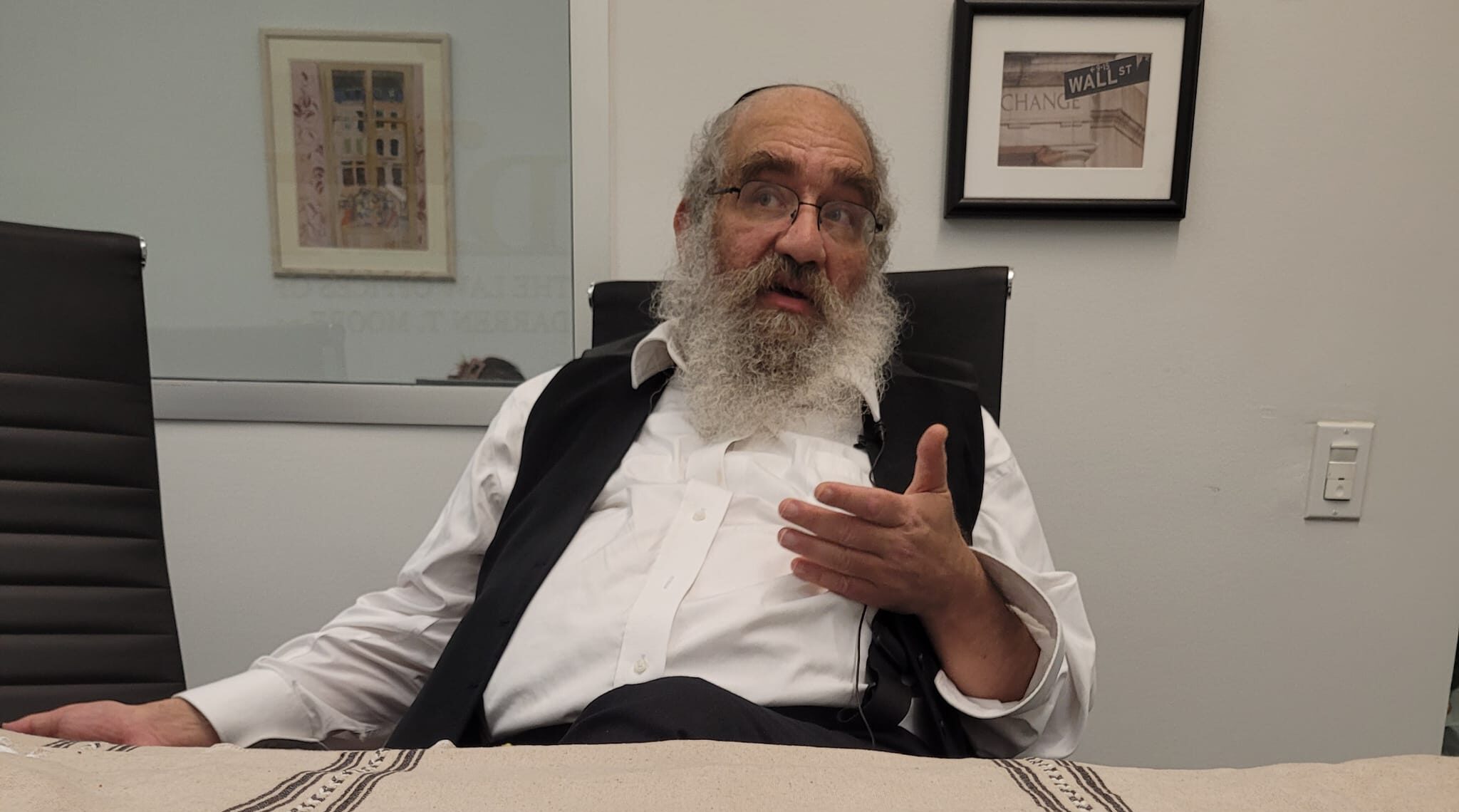
Sam Kellner poses in his attorney’s office in Brooklyn, nearly two decades into his legal journey as a whistleblower in his Hasidic community. Photo by Hella Winston
(New York Jewish Week) — A federal judge in Brooklyn has denied a bid by New York City and the estate of former Brooklyn District Attorney Charles Hynes to throw out a civil-rights lawsuit brought by Hasidic sex-abuse whistleblower Sam Kellner, clearing the way for a jury to hear claims that top prosecutors helped engineer his arrest to benefit a convicted child molester.
The 82-page ruling, by Judge Nina R. Morrison of the Eastern District of New York, is significant, as it effectively strips both the district attorney and the city of the legal immunity they would normally enjoy. Typically, absolute immunity protects prosecutors from civil suits over decisions about whether and how to bring criminal charges, while qualified immunity shields government officials from paying damages unless they violate clearly established legal rights.
“Justice for Sam has been a slow train coming. That train is now about to arrive,” said Niall MacGiollabhui, Kellner’s attorney, in a statement to the Jewish Telegraphic Agency.
The long saga leading to the judge’s decision began in 2008, when Kellner, a Borough Park resident, defied communal norms and reported his son’s sexual abuse by a prominent community member, Baruch Lebovits, to secular authorities. Working closely with a detective in the NYPD’s Special Victims Unit, Kellner helped locate and bring forward other alleged victims of Lebovits. His cooperation ultimately helped lead to Lebovits’ 2010 conviction on multiple counts involving another boy, identified as Y.R.
The Lebovits prosecution was a rarity in a community where few child sexual abuse cases ever make it to trial, let alone end in a substantial sentence. At the time, Hynes had been under mounting fire for how his office handled sexual abuse in the Hasidic community, with anti-abuse advocates arguing that the DA went easy on Hasidic offenders in deference to a Hasidic leadership capable of reliably delivering campaign contributions and a bloc vote.
For his involvement in the case, Kellner paid a steep price. Even though he obtained rabbinic permission to go to the authorities, community members branded him an informer or “moser,” a label that has serious consequences in Jewish tradition. He often left his house to find his tires slashed and his van papered with flyers calling for his death; people yelled threats at him on the street. He was also forced out of his synagogue and had trouble finding schools that would enroll his children; securing marriage matches for them took years.
Kellner says he also fielded a steady stream of offers of cash if he would just walk away from the case. He refused them all, saying that his son and the other boys were entitled to justice, even as he sank deeper into debt and isolation, becoming a cautionary tale for both supporters of abuse victims and critics who view cooperation with secular authorities as a betrayal.
But things only got worse for Kellner after Lebovits’ conviction. In 2011, he was arrested by the very same district attorney’s office that had used him to help put Lebovits behind bars. Prosecutors charged him with orchestrating an extortion scheme, alleging that he tried to use the very case he had helped build as leverage to extract hundreds of thousands of dollars from Lebovits’ family, and also accusing him of paying another witness to give false grand jury testimony against Lebovits.
People who had supported him fell away as he was branded an extortionist, a “crook” who would sell out his own son for money. Friends abandoned him, and even some family members kept their distance. “I wanted to vanish. I wanted that the floor would open up and I would fall into it,” he says.
Over time, however, the criminal case against Kellner unraveled amid mounting questions about the reliability and origins of the evidence against him, and in 2014 a Brooklyn judge dismissed the charges after the newly elected district attorney moved to drop the prosecution. Freed of the threat of prison, but maintaining that he had been framed for doing what the system asked of him, Kellner went on to file a federal civil‑rights lawsuit in 2017, accusing Brooklyn prosecutors of conspiring with allies of Lebovits to retaliate against him and upset Lebovits’ original abuse conviction.
In his filings, Kellner argues that these officials prosecuted him even though the DA’s office already possessed powerful evidence of Lebovits’ guilt and internal records suggesting that key witnesses against Kellner had been pressured — and, in one case, financially supported by Lebovits’ backers — turning the machinery of law enforcement against the father of a sex abuse victim in order to free a well-connected, convicted child molester.
For Kellner, the recent ruling is, in part, a kind of personal vindication.
“Wow, what a revenge. Fourteen years later and you exchange places with Charles Hynes. It is such a good felling that they are going to say ‘plaintiff Sam Kellner, defendant the City of New York and Charles Hynes.’”
But, more important, Kellner believes the judge’s decision offers proof that victims in his community can — and should — trust the justice system, no matter how slowly it moves.
“After my arrest, no rabbi was going to let a kid come forward, and then let that kid go to jail while the DA takes the side of the molester,” Kellner said.
Now, he believes, “these animals, these molesters should start feeling that they can no longer continue to molest in this neighborhood, and threaten the victims and get away with it because the DA will be on their side.”
For some, however, recent actions by the current DA, Eric Gonzalez, belie those sentiments. Just last month, Gonzalez drew sharp criticism from anti-abuse advocates for supporting the resentencing request of another convicted child molester from the Hasidic community, Nechemya Weberman, who has served about 13 years of his term.
Weberman was originally sentenced to more than 100 years for the sustained sexual abuse of a 12-year-old girl he was counseling, but that sentence was later reduced to 50 years through an administrative recalculation required by New York sentencing law. Gonzalez has argued that even the 50-year term is “unusually harsh” and out of step with sentences in comparable child-sex-abuse cases. His critics say he has caved to pressure from the same communal and political forces that arrayed themselves against Kellner and that his stance betrays survivors and undermines deterrence.
But Kellner still has faith.
“Until now, I was an example of why not to go to the DA,” he said. “They killed me. I am already 65. I was just over 45 when it started. They killed me. But I knew one thing: They are not going to have the victory that no one is going to come forward. Trust the system.”
This is a moment of great uncertainty. Here’s what you can do about it.
We hope you appreciated this article. Before you go, we’d like to ask you to please support the Forward’s independent Jewish news this Passover. All donations are being matched by the Forward Board - up to $100,000.
This is a moment of great uncertainty for the news media, for the Jewish people, and for our sacred democracy. It is a time of confusion and declining trust in public institutions. An era in which we need humans to report facts, conduct investigations that hold power to account, tell stories that matter and share honest discourse on all that divides us.
With no paywall or subscriptions, the Forward is entirely supported by readers like you. Every dollar you give this Passover is invested in the future of the Forward — and telling the American Jewish story fully and fairly.
The Forward doesn’t rely on funding from institutions like governments or your local Jewish federation. There are thousands of readers like you who give us $18 or $36 or $100 each month or year.
Support our mission to tell the Jewish story fully and fairly.