Vance declines to draw a line against rising influence of antisemitic figures in Republican party
‘What is actually happening is that there is a real backlash to a consensus view in American foreign policy,’ Vance said
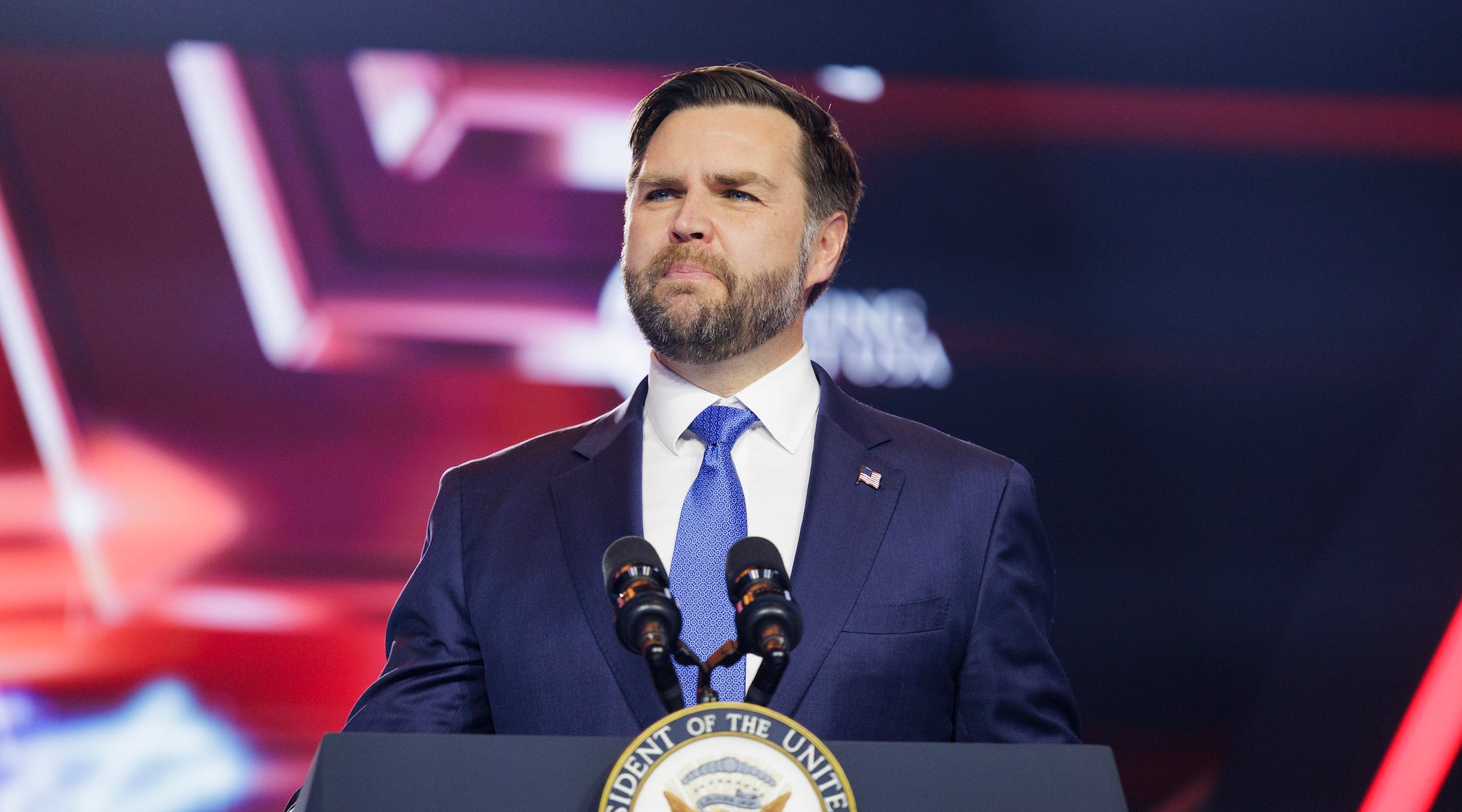
Vice President JD Vance speaks on the final day of Turning Point USA’s annual AmericaFest conference at the Phoenix Convention Center on Dec. 21, 2025 in Phoenix, Arizona. Photo by Caylo Seals/Getty Images
In the latest round of conservative infighting over the mainstreaming of antisemitic figures within the GOP, Vice President JD Vance has once again declined to draw a red line.
At the center of the controversy that has roiled the Republican Party is Nick Fuentes, the antisemitic and white nationalist livestreamer who set off a firestorm after he voiced his disdain for “these Zionist Jews” in a friendly interview with conservative commentator Tucker Carlson in October.
Since then, Vance has failed to meet calls from Jewish conservatives to set a boundary against antisemitic voices within the Republican coalition.
On Monday, in an interview with UnHerd, Vance downplayed the influence of Fuentes and instead argued that the focus on his presence in the GOP was crowding out a larger discussion about anti-Israel animus within the party.
“I think that Nick Fuentes, his influence within Donald Trump’s administration, and within a whole host of institutions on the right, is vastly overstated, and frankly, it’s overstated by people who want to avoid having a foreign-policy conversation about America’s relationship with Israel,” said Vance.
Vance also dismissed claims about the prevalence of antisemitism across the political spectrum, saying that much of what is alleged to be antisemitism is in fact “a real backlash” against Israel.
“Ninety-nine percent of Republicans, and I think probably 97% of Democrats, do not hate Jewish people for being Jewish. What is actually happening is that there is a real backlash to a consensus view in American foreign policy. I think we ought to have that conversation and not try to shut it down. Most Americans are not antisemitic, they’re never going to be antisemitic, and I think we should focus on the real debate,” said Vance.
Earlier this month, Vance also dismissed claims that antisemitism is surging within the Republican Party and said that the “the single most significant thing you could do to eliminate anti-semitism” was lowering immigration to the United States.
A poll released this month by the Manhattan Institute, a conservative think tank, found that nearly four in 10 GOP voters believe that the Holocaust was greatly exaggerated or did not happen “as historians describe.” It also found that roughly equal shares of Democrats and Republicans, around one in five, hold anti-Jewish sentiments.
Vance told UnHerd that while Israel is an important U.S. ally, a sentiment long held by the GOP, the party needed to widen its tent to include diverging opinions on the Jewish state.
“I happen to believe that Israel is an important ally, and that there are certain things that we’re certainly going to work together on,” Vance says. “But we’re also going to have very substantive disagreements with Israel, and that’s OK. And we should be able to say, ‘We agree with Israel on that issue, and we disagree with Israel on this other issue.’ Having that conversation is, I think, much less comfortable for a lot of people, because they want to focus on Nick Fuentes.”
On Sunday, Vance also declined to condemn antisemitism on the right at Turning Point USA’s annual convention, instead encouraging the party to widen its tent.
The convention, titled AmericaFest, was roiled by debates over antisemitic figures within the party. Vance told attendees that he “didn’t bring a list of conservatives to denounce or to de-platform,” adding that that party has “far more important work to do than canceling each other.”
“When I say that I’m going to fight alongside of you, I mean all of you — each and every one,” said Vance. “President Trump did not build the greatest coalition in politics by running his supporters through endless, self-defeating purity tests.”
At the beginning of AmericaFest, Vance also earned a 2028 presidential endorsement from Turning Point’s leader Erika Kirk, widow of its slain founder Charlie Kirk. The convention itself was also marked by internal Republican divisions over whether the party should lend its platform to figures espousing antisemitic rhetoric, including Fuentes.
Franklin Foer, a staff writer for The Atlantic, titled a Monday op-ed “J. D. Vance Fails a Simple Moral Test,” accusing Vance of welcoming antisemites into the Republican coalition.
“By failing to denounce anti-Semitism, Vance has emboldened its adherents to flaunt their prejudices more openly, to dehumanize Jews with greater abandon,” wrote Foer. “He told the Turning Point audience that he doesn’t want to ‘impose any purity tests’ when, in reality, he was granting license to those who celebrate the most murderous purity test of all time.”
Jonathan Tobin, the editor-in-chief of the Jewish News Syndicate, also criticized Vance in an op-ed Monday for failing to utilize a “chance to distinguish his national conservative vision from the views of Fuentes and Carlson.”
“By passing on a golden opportunity to draw a line in the sand between his ideas and those of right-wingers who share the left’s hatred for Jews, he’s telling us that he wants their votes,” wrote Tobin.
This article originally appeared on JTA.org.
This is a moment of great uncertainty. Here’s what you can do about it.
We hope you appreciated this article. Before you go, we’d like to ask you to please support the Forward’s independent Jewish news this Passover. All donations are being matched by the Forward Board - up to $100,000.
This is a moment of great uncertainty for the news media, for the Jewish people, and for our sacred democracy. It is a time of confusion and declining trust in public institutions. An era in which we need humans to report facts, conduct investigations that hold power to account, tell stories that matter and share honest discourse on all that divides us.
With no paywall or subscriptions, the Forward is entirely supported by readers like you. Every dollar you give this Passover is invested in the future of the Forward — and telling the American Jewish story fully and fairly.
The Forward doesn’t rely on funding from institutions like governments or your local Jewish federation. There are thousands of readers like you who give us $18 or $36 or $100 each month or year.
Support our mission to tell the Jewish story fully and fairly.